Opera guides
Les pêcheurs de perles: synopsis, roles, numbers and diction notes
Bizet's Les pêcheurs de perles (The Pearl Fishers): premiere, roles, the story act by act, the Pearl Fishers Duet explained, key numbers and revival history.
By Diction Desk editors · Published · Updated · Checked against 4 sources
Les pêcheurs de perles is an opera in three acts by Georges Bizet, with a libretto by Eugène Cormon and Michel Carré1. It premiered on 30 September 1863 at the Théâtre Lyrique in Paris and was given 18 performances in its first run1. Its friendship duet, Au fond du temple saint, is generally known as The Pearl Fishers Duet1.
- Composer
- Georges Bizet1
- Librettists
- Eugène Cormon and Michel Carré1
- Setting
- Ancient times on the island of Ceylon, now Sri Lanka1
- Voice types
- Leïla soprano, Nadir tenor, Zurga baritone, Nourabad bass1
- Running time
- About 1h45 with no interval, in the Opéra de Lille production3
- English title
- The Pearl Fishers2
Contents
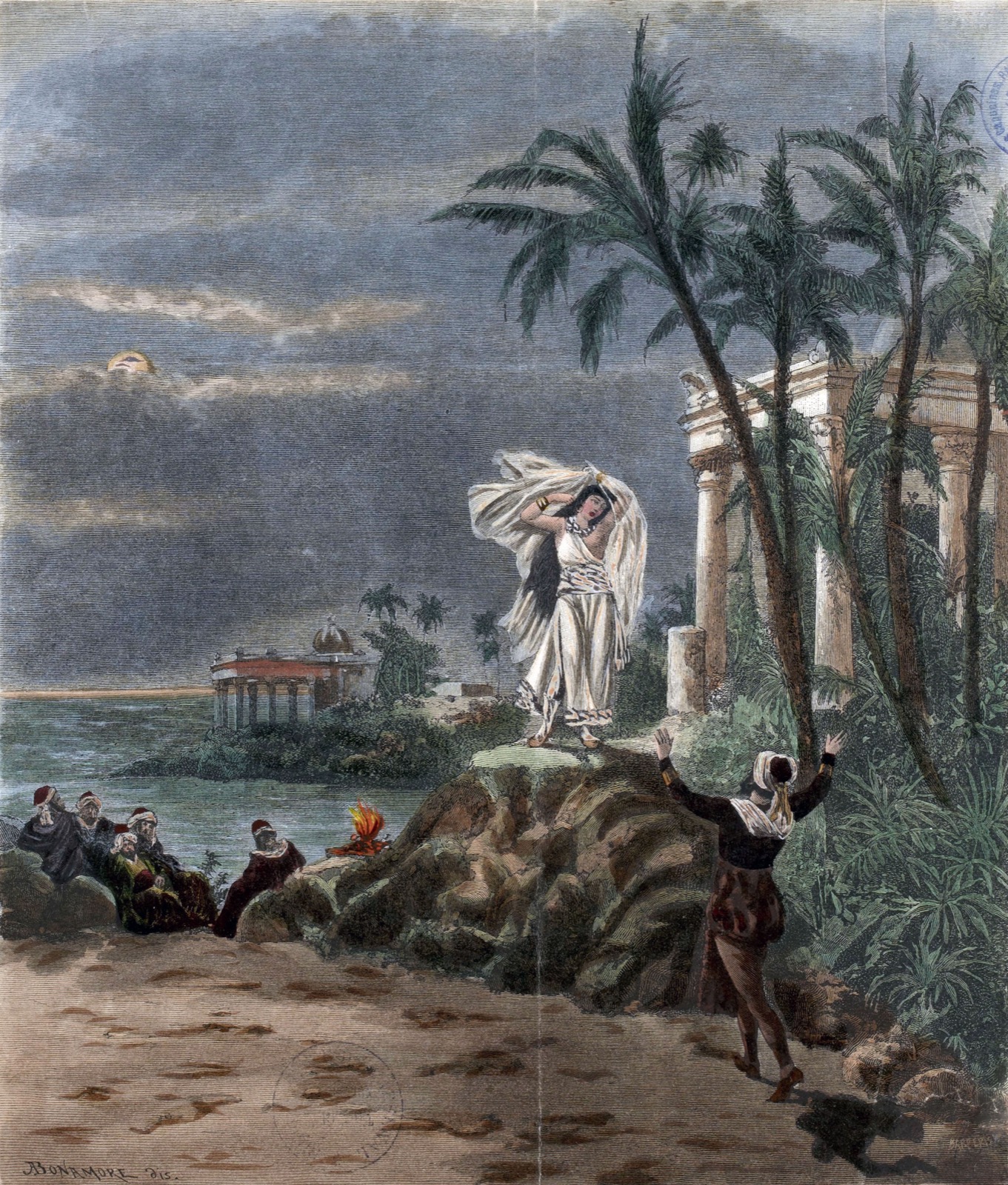
The plot turns on the operatic trope of a priestess who betrays her vows for love4. This guide gives the roles, the story act by act, the duet everyone asks about and every number by act and character; more guides are in the operas section.
Composition and libretto
Bizet’s first opera, the one-act Le docteur Miracle, was written in 1856 when the 18-year-old composer was a student at the Conservatoire de Paris1. In 1857 he was awarded the Prix de Rome1. He spent most of the following three years in Italy1. The poor reception of his 1858 Te Deum helped convince him that his future lay in musical theatre1. At the time of the premiere he was not yet 25 years old1.
In April 1862 Léon Carvalho, manager of the independent Théâtre Lyrique, approached Bizet with the libretto of Les pêcheurs de perles1. The Théâtre Lyrique received an annual grant on condition that each year it stage a new three-act opera from a recent Prix de Rome winner1. Bizet withdrew La guzla de l’Emir from the Opéra-Comique so that it would not disqualify him from the grant1. Its music has disappeared1.
The libretto is by Eugène Cormon and Michel Carré1,3. They had written Les pêcheurs de Catane for Aimé Maillart on a similar theme, performed in 1860, and first planned to set the new story in Mexico before moving it to Ceylon1. By general critical consent the libretto is a work of poor quality1. Donal Henahan wrote in 1986 that it ranked right down there with the most appallingly inept of its kind1. Cormon commented later that had they known Bizet’s quality as a composer, they would have tried harder1.
According to Mina Curtiss, Carvalho suggested in exasperation that Carré burn the libretto, and the remark led Carré to end the opera with the fishermen’s tents ablaze1. Bizet did not receive the commission until April 1863, with the opening night set for mid-September, so he composed quickly1. The score was completed by early August1.
Bizet drew on his unfinished opera Ivan IV for three numbers: the prelude, part of Zurga’s aria and the third-act duet O lumière sainte1. The Brahma divin Brahma chorus was adapted from his rejected Te Deum1. The chorus L’ombre descend was added at Bizet’s request while rehearsals were under way1.
Premiere and reception
The first performance was postponed from 14 September to 30 September 1863 because the soprano lead, Léontine de Maësen, was ill1. The premiere was conducted by Adolphe Deloffre, with Léontine de Maësen as Leïla, François Morini as Nadir, Ismaël as Zurga and Prosper Guyot as Nourabad1. The first-night audience received the work well and called for Bizet at the end, although most press reviews were hostile1.
Hector Berlioz was a voice apart in the general hostility: he wrote in the Journal des Débats that the score did Bizet the greatest honor1. Ludovic Halévy wrote that he persisted in finding the rarest virtues in it1. Parisian critics called the orchestration noisy, overloaded and Wagnerian, “a fortissimo in three acts”1. Bizet himself thought that, a few numbers apart, the work deserved oblivion1.
The opera ran for 18 performances, alternating with Mozart’s The Marriage of Figaro1. It closed on 23 November 18631. After the First World War it lost popularity with opera-house directors and was seen less often1. In 2024 stage productions ran in Berlin, Bordeaux, Cologne, Munich, Olomouc, Palermo, Saint-Étienne, Saint Petersburg and Stara Zagora, though many cities still choose concert performances1. One reviewer places the opera below Carmen, written ten years later, for invention, but praises its exotic atmosphere and lovely melodies4.
Roles and voice types
| Role | Voice type | Character | Premiere cast |
|---|---|---|---|
| Leïla | Soprano | A priestess of Brahma1 | Léontine de Maësen1 |
| Nadir | Tenor | A fisherman1 | François Morini1 |
| Zurga | Baritone | Head fisherman1 | Ismaël1 |
| Nourabad | Bass | The high priest of Brahma1 | Prosper Guyot1 |
The Opéra de Lille lists Nourabad as a bass-baritone where Wikipedia has a bass; the table follows Wikipedia1,3. Leïla’s lyric soprano extends from a low B to the high C, with many coloratura passages3. Nourabad is a secondary role that takes part in the outcome of the drama3.
The pearl fishermen elect Zurga as their leader, or king1. Zurga hails Nadir as a long-lost friend in Act 11.
Synopsis
The opera is set in ancient times on the island of Ceylon, now Sri Lanka1.
Act 1
The scene is a desolate seashore, with the ruins of a Hindu temple in the background1. A chorus of pearl fishermen sing of the dangerous tasks that lie ahead1. They elect one of their number, Zurga, as their leader, or king1. Nadir enters and is hailed by Zurga as a long-lost friend1. The pair reminisce about Kandy, where their friendship was nearly destroyed by their mutual love of a young priestess1.
A boat draws up on the beach bearing the veiled figure of Leïla, the virgin priestess whose prayers are required to ensure the safety of the fishermen1. She is the woman from Kandy with whom both had been in love1. She recognizes Nadir but says nothing, and Nourabad leads her up to the temple1. Alone, Nadir recalls in a troubled soliloquy how he broke his vows to Zurga in Kandy1.
Act 2
Nourabad exhorts Leïla to be brave and to fulfill her vows to Brahma on pain of her own death1. She tells him how, as a child, she hid a fugitive from his enemies and refused to give him up even when threatened with death1. The fugitive rewarded her with a necklace that he asked her always to wear1. Her love for Nadir is too great, and she sings of her happiness at seeing him again3. Nadir enters, and the two declare their love in a passionate duet1.
Nadir is captured by the fishermen after leaving the temple1. Zurga at first resists the fishermen’s calls for Nadir’s execution and advocates mercy1. When Nourabad removes Leïla’s veil, Zurga recognizes her as his former love and orders that both Nadir and Leïla be put to death1. A violent storm erupts as the fishermen unite in a hymn to Brahma1.
Act 3
Once the storm has abated, Zurga feels remorse for his anger towards Nadir1. Leïla is brought in; Zurga is captivated by her beauty as he listens to her pleas for Nadir’s life, but his jealousy is rekindled1. As Leïla is taken away, she gives one of the fishermen her necklace, asking for its return to her mother, and Zurga seizes it1.
Outside the temple, Nadir waits beside the funeral pyre as a chorus, singing and dancing, anticipates the dawn and the coming double execution1. Leïla joins him, and the pair sing of how their souls will soon be united in heaven1. Zurga rushes in to report that the fishermen’s camp is ablaze, and frees them1. He returns the necklace to Leïla and reveals that he is the man she saved1. He tells the couple to flee and is left alone to await the fishermen’s return1.
In the revised ending introduced after the 1886 revival, Nourabad denounces Zurga to the fishermen, one of whom stabs him to death1. In the 1863 original, Zurga is left standing on stage, alone, awaiting his fate4.
What is the Pearl Fishers Duet about?
The friendship duet Au fond du temple saint, generally known as The Pearl Fishers Duet, is one of the best-known in Western opera1. It is the Zurga and Nadir duet of Act 13. It comes after the two recall Kandy and the priestess who nearly destroyed their friendship, and they affirm once again that they will be faithful until death1.
The Opéra de Lille’s dossier prints the text of the 1893 version3. The lines below are from that libretto, with our own translation:
| Original | Our translation |
|---|---|
| Au fond du temple saint,3 | Deep in the holy temple, |
| Paré de fleurs et d’or, Une femme apparaît…3 | Dressed in flowers and gold, a woman appears… |
| Je crois la voir encore.3 | I can still see her. |
| Voyez, c’est la déesse3 | Look, it is the goddess |
| Son voile se soulève ;3 | Her veil is lifting; |
Flutes and harps introduce the main theme1. Nadir’s melodious theme rises in steps to an A-flat on the word femme, and the flute plays the goddess leitmotif for the first time3. That leitmotif returns about ten times in the opera3. The duet’s theme is the opera’s principal musical signature, repeated whenever the men’s friendship arises1. In the closing scene, where Zurga bids a last farewell to his dreams of love, the friendship theme sounds for the final time1.
In the post-1886 revisions the Act 1 duet Amitié sainte was replaced with a reprise of Au fond du temple saint1. In the 1863 original the duet is curtailed1. The Plasson recording of 1989 gives both versions1. Caruso and Mario Ancona recorded the duet in Italian as early as 19071. At the Met in 1916, W. H. Chase of the Evening Sun wrote, the Act 1 duet brought down the house in a superb blending of the two men’s voices1.
In the German version the duet opens Und in des Tempels Grund, and in the Italian version Del tempio al limitar4.
The woman from Kandy returns as Leïla1. Zurga’s Act 3 duet with Leïla, Je suis jaloux, follows his confession of love for her, while he refuses mercy1.
Numbers by act and character
The list below follows the 1863 vocal score as listed for the 1977 EMI recording1.
| Number | Character | Act | Notes |
|---|---|---|---|
| Sur la grève en feu | Chorus | Act 11 | Opening chorus on the dangerous tasks ahead, punctuated by a lively dance1 |
| Amis, interrompez vos danses et vos jeux! | Zurga, Chorus | Act 11 | |
| Mais qui vient là…Des savanes et des forêts | Zurga, Nadir, Chorus | Act 11 | Nadir’s first significant aria, over cellos and bassoons under a string tremolo1 |
| Demeure parmi nous, Nadir | Zurga, Nadir, Chorus | Act 11 | |
| C’est toi, toi qu’enfin je revois! | Zurga, Nadir | Act 11 | |
| Au fond du temple saint | Nadir, Zurga | Act 11 | The friendship duet1 |
| Amitié sainte | Zurga, Nadir | Act 11 | Bizet’s contrasting section, dropped after 18861 |
| Que vois-je…Une fille inconnue | Zurga, Nadir | Act 11 | |
| C’est elle, c’est elle…Sois la bienvenue | Chorus | Act 11 | |
| Seule au milieu de nous | Zurga, Leïla, Nadir, Chorus | Act 11 | Leïla’s oath3 |
| Qu’as-tu donc? Ta main frissonne et tremble | Zurga, Leïla, Nourabad, Chorus | Act 11 | |
| À cette voix…Je crois entendre encore | Nadir | Act 11 | Barcarole rhythm with a dominant cor anglais1; the most famous piece of the opera and very often sung in recital3 |
| Le ciel est bleu! | Chorus, Nourabad, Nadir | Act 11 | Act 1 finale3 |
| O Dieu Brahma! | Leïla, Nadir, Chorus | Act 11 | |
| L’ombre descend des cieux | Chorus, Nourabad, Leïla | Act 21 | Added at Bizet’s request1 |
| J’étais encore enfant | Nourabad, Leïla, Chorus | Act 21 | Leïla tells of hiding a fugitive as a child1 |
| Comme autrefois | Leïla | Act 21 | Cavatina, with the theme introduced by two French horns over cellos1 |
| De mon amie, fleur endormie | Nadir, Leïla | Act 21 | |
| Léïla! Léïla!…Dieu puissant, le voilà! | Nadir, Leïla | Act 21 | Passionate love duet1 |
| Ton coeur n’a pas compris le mien | Nadir, Leïla | Act 21 | |
| Ah! revenez à la raison! | Leïla, Nadir, Nourabad, Chorus | Act 21 | |
| Dans cet asile sacré, dans ces lieux redoutables | Nourabad, Leïla, Nadir, Chorus | Act 21 | |
| Arrêtez! arrêtez! | Zurga, Nourabad, Leïla, Nadir, Chorus | Act 21 | |
| Brahma! divin Brahma! | Chorus | Act 21 | Hymn adapted from the rejected Te Deum1 |
| L’orage s’est calmé…O Nadir, tendre ami de mon jeune âge | Zurga | Act 31 | Zurga’s remorse1 |
| Qu’ai-je vu? O ciel, quel trouble…Je frémis | Zurga, Leïla | Act 31 | |
| Quoi! Innocent? Lui, Nadir? | Zurga, Leïla | Act 31 | |
| Je suis jaloux | Zurga, Leïla | Act 31 | Zurga confesses his love for Leïla but refuses mercy1 |
| Entends au loin ce bruit de fête | Nourabad, Leïla, Zurga | Act 31 | |
| Dès que le soleil | Chorus | Act 31 | Anticipates the dawn and the coming double execution1 |
| Hélas! Qu’ont-ils fait de Léïla? | Nadir, Nourabad, Chorus | Act 31 | |
| Ah, Léïla!…O lumière sainte | Nadir, Leïla, Nourabad, Chorus | Act 31 | Music from Ivan IV; recomposed by Benjamin Godard as a trio for Nadir, Leïla and Zurga after 18861 |
| Le jour enfin perce la nue! | Nourabad, Zurga, Nadir, Leïla, Chorus | Act 31 | |
| Plus de crainte…Rêves d’amour, adieu! | Leïla, Nadir, Zurga | Act 31 | Final number, as Zurga is left alone1 |
Leïla’s Act 2 recitative and cavatina, Me voilà seule dans la nuit, conveys all the character’s anxiety3. Act 2 opens with a short orchestral introduction and an off-stage chorus accompanied by a tambourine and two piccolos1. Act 3 opens with Zurga’s entrance to quiet chromatic scales over a tonic pedal1.
Revivals and editions
After Bizet’s death the opera was first revived at La Scala, Milan, on 20 March 1886, in Italian1. The revival changed the finale, and the replacement trio was composed by Benjamin Godard1. The British premiere was on 22 April 1887 at Covent Garden under the title Leila, with Paul Lhérie as Nadir1. The Royal Opera House lists that date as its premiere of the work, at the Royal Italian Opera2. The opera returned to Paris on 20 April 1889, in Italian, at the Théâtre de la Gaîté1. It was given in French at the Opéra-Comique on 24 April 1893, its later regular home1.
The American premiere was at the Grand Opera House in Philadelphia on 25 August 18931. The Metropolitan Opera first gave the first two acts on 11 January 1896, with Emma Calvé1. Its first complete staging was on 13 November 1916 with Enrico Caruso, Frieda Hempel and Giuseppe De Luca1.
Sadler’s Wells presented the opera in March 1954, the first known use in Britain of the English libretto, in a production directed by Basil Coleman with designs by John Piper1. In 1973 Welsh National Opera staged a version close to Bizet’s original, without Godard’s trio and without Zurga’s violent death1. ENO staged a new production directed by Philip Prowse in September 19871.
Vienna first saw the opera in 1994, at the Vienna Volksoper1. San Diego Opera’s 2004 production, designed by Zandra Rhodes, generated new enthusiasm for the opera across the United States1. In January 2008 the opera received its first performance in Sri Lanka, the land of its setting1. In October 2010 it returned to the Royal Opera House in two concert performances using a new edition of the score1. The Royal Opera’s company premiere was on 4 October 20102. The Metropolitan Opera presented a new production in 2016, the first time the opera had been performed there for nearly a hundred years1.
Choudens published only a piano vocal score in 18631. In the early 1970s Arthur Hammond orchestrated the sections of the 1863 vocal score that had been cut from the post-1886 scores1. Bizet’s 1863 conducting score was discovered in the 1990s, and it became the basis for Brad Cohen’s critical edition, published by Edition Peters in 20021.
Recordings
The first complete recordings were issued in the early 1950s1. The 1951 René Leibowitz recording was the first complete recording in French4. The 1977 recording conducted by Prêtre was the first to return to Bizet’s 1863 vocal score; all earlier recordings used the posthumously prepared edition1,4. The 2016 Metropolitan Opera recording has Diana Damrau, Matthew Polenzani, Mariusz Kwiecień and Nicolas Testé under Gianandrea Noseda1.
Language and diction notes
The opera premiered at the Théâtre Lyrique in Paris1, and the French rules in French diction for singers apply to the original text. Productions have used other languages. La Scala gave it in Italian in 18861. Sadler’s Wells gave it in English in 19541. The Opéra de Lille sang and surtitled its production in French, with a running time of about 1h45 and no interval3. Its orchestra of 2 flutes, 2 oboes, 2 clarinets, 2 bassoons, 2 horns, 2 trumpets, 3 trombones, 1 timpanist, 3 percussionists and 1 harp played for a chorus of 9 sopranos, 8 altos, 13 tenors, 4 baritones and 4 basses3. Further reading: the Royal Ballet and Opera Collections record, the Opéra de Lille teaching dossier and MusicWeb International.
Where to go next
Bizet’s later opera is Carmen, written ten years after this one4. Two more French-language guides are Faust and Werther. The sounds behind the text start in IPA for singers.
