Opera guides
Werther: synopsis, roles, arias and diction notes
Massenet's Werther in one page: Goethe source, Vienna premiere, voice types, the four acts, arias with French first lines and diction notes for singers.
By Diction Desk editors · Published · Updated · Checked against 8 sources
Werther is an opera in four acts by Jules Massenet to a French libretto by Édouard Blau, Paul Milliet and Georges Hartmann, loosely based on Goethe's novel The Sorrows of Young Werther1,2. It premiered on 16 February 1892 at the Hofoper in Vienna, in a German translation1,2.
- Composer
- Jules Massenet, 1842 to 19123
- Librettists
- Édouard Blau, Paul Milliet and Georges Hartmann1
- Language
- French1
- Acts
- Four acts2
- Setting
- Wetzlar, Germany, July to December 17721
Contents
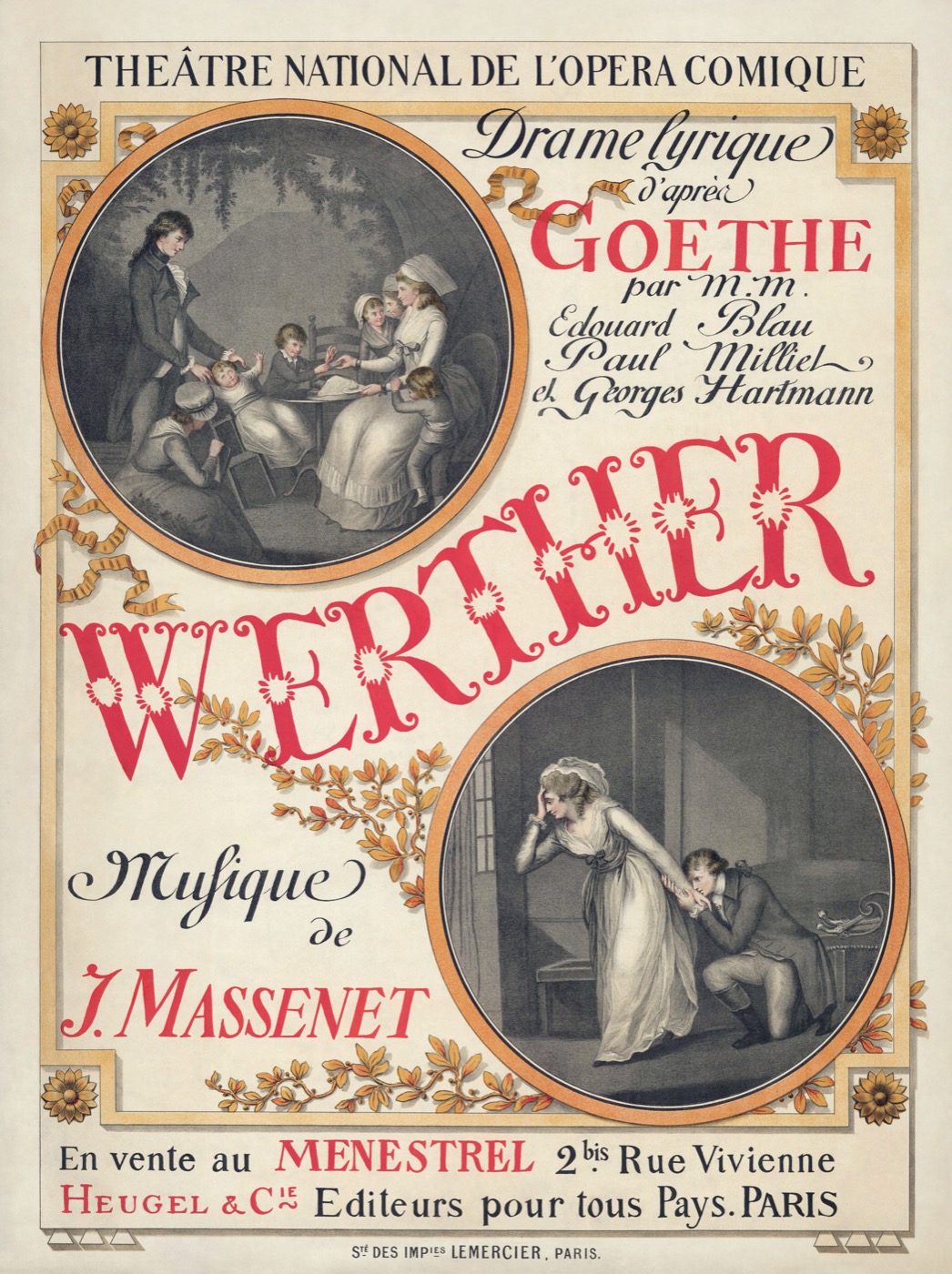
Werther is a number opera with closed vocal forms, loosely knit, and it has no ballet or chorus except for the six children of the Bailli5. Massenet, the leading composer of French opera in the late nineteenth and early twentieth centuries, was a consummate craftsman and man of the theatre5. It is one of the guides in the operas section.
At a glance
Jules Massenet was a French composer who lived from 1842 to 19123. The libretto is French, by Édouard Blau, Paul Milliet and Georges Hartmann1. Milliet was a French playwright and librettist, born on 14 February 1848 in Rio de Janeiro and died on 21 November 19246. The opera is loosely based on Goethe’s epistolary novel The Sorrows of Young Werther, which itself was based on Goethe’s own early life1. The action takes place between July and December 1772, in Wetzlar in Germany1.
Massenet did more than any other composer to establish the Opéra-Comique as a crucible of great artistic creation4. He started composing Werther in 1885 and completed it in 18871.
Who’s who
| Role | Voice type | Premiere singer | Notes |
|---|---|---|---|
| Werther | Tenor | Ernest van Dyck1 | A young poet, aged 23; idealistic, sensitive and fervent1,4 |
| Charlotte | Mezzo-soprano | Marie Renard1 | Aged 201 |
| Albert | Baritone | Franz Neidl1 | Betrothed to Charlotte, aged 251 |
| Sophie | Soprano | Ellen Brandt-Forster1 | Charlotte’s sister, aged 151 |
| Le Bailli | Bass | Karl Mayerhofer1 | Charlotte’s father, aged 501 |
| Schmidt | Tenor | A friend of the Bailli1 | |
| Käthchen | Mezzo-soprano | Brühlmann’s fiancée of seven years1 |
Massenet’s cast list suggests that Sophie is 15, Charlotte 20 and Werther 237. Charlotte is a part taken by both mezzos and sopranos7. She begins as a vision of maternal security7. Albert’s harmonies are solid but placid, and his vocal line moves in small, deliberate steps7.
Werther was written for tenor, and Massenet adjusted it for a baritone when Mattia Battistini sang it in Saint Petersburg in 19021. In the Met production, David Bižić made his Met debut as Albert and Jonathan Summers sang Le Bailli8.
Synopsis
Act 1
In July the Bailli is teaching his six youngest children a Christmas carol, “Noël! Jésus vient de naître,” while the drinking companions arrive1. Werther watches as Charlotte prepares her young siblings’ supper, just as her mother had before she died1. A shared love of poetry draws Werther and Charlotte together at once4. After an orchestral interlude, Werther and Charlotte return very late, and he is already enamoured of her1.
Albert returns unexpectedly after a six-month trip1. He is unsure of Charlotte’s intentions and disappointed not to find her at home, but is reassured and consoled by Charlotte’s younger sister Sophie1. Charlotte recalls how she promised her dying mother she would marry Albert1.
Act 2
It is three months later, and Charlotte and Albert are now married1. They walk happily to church to celebrate the minister’s 50th wedding anniversary, followed by the disconsolate Werther1. Charlotte begs Werther to leave her, though she indicates that she would be willing to receive him again on Christmas Day1. Werther contemplates suicide with “Lorsque l’enfant revient d’un voyage”1. He encounters Sophie, but the tearful girl does not understand his distressing behavior1. Albert now realizes that Werther loves Charlotte1.
Sent away because he refuses to accept the fact of her marriage, Werther becomes increasingly unstable7.
Act 3
Charlotte is at home alone on Christmas Eve, rereading the letters she has received from Werther1. Werther reads some poetry of Ossian, “Pourquoi me réveiller?”1. They embrace for a moment, but she quickly bids him farewell1. He leaves with thoughts of suicide1.
Werther sends a messenger to Albert, requesting to borrow his pistols, explaining he is going on an extended trip1. After the servant has taken them, Charlotte has a terrible premonition and hurries to find Werther1. The orchestral intermezzo “La nuit de Noël” leads without a break into the final act1.
Act 4
At Werther’s apartment, Charlotte has arrived too late to stop him from shooting himself, and he is dying1. She consoles him by declaring her love, and he asks for forgiveness1. After he dies, Charlotte faints, and outside children are heard singing the Christmas carol1.
The carol frames the opera. The Bailli rehearses it with his children in Act 1, and the children sing it outside as Werther dies in Act 41.
The famous arias
| Aria | Role | Act | First line |
|---|---|---|---|
| Invocation to nature | Werther | Act 1 | O Nature, pleine de grâce1 |
| Carol | Le Bailli and children | Act 1 | Noël! Jésus vient de naître1 |
| The other is her husband | Werther | Act 2 | Un autre est son époux!1 |
| Sophie’s aria | Sophie | Act 2 | Du gai soleil, plein de flamme1 |
| Letter scene | Charlotte | Act 3 | Werther! Qui m’aurait dit ces lettres!1 |
| Tears aria | Charlotte | Act 3 | Va! laisse couler mes larmes1 |
| Ossian aria | Werther | Act 3 | Pourquoi me réveiller?1 |
| Return from a journey | Werther | Act 2 | Lorsque l’enfant revient d’un voyage1 |
| Sophie’s cheering song | Sophie | Act 3 | Ah! le rire est béni1 |
Standing and reception
Werther has attractive music of great emotional intensity and an excellent libretto5. Despite a warm welcome at its Viennese premiere, the work went on to only 56 performances at the Opéra-Comique in Paris between 1893 and 19025. Early audiences gave a generally tepid response, due partly to a distaste for the introspective and dark subject5.
Werther entered the Opéra-Comique repertoire in 1903 in a production supervised by Albert Carré1. In the half-century that followed, the opera was performed over 1,100 times there1. Manon and Werther are Massenet’s two most frequently staged operas3. Massenet set great store by this opera and its success5.
Background, premiere and reception
Massenet wrote and completed Werther in 1887, and it received no performance until it premiered2. He completed the vocal score on 14 March 1887, and orchestration began the following day and continued until 2 July7. The Opéra-Comique theatre burned down in May 18877. Léon Carvalho, director of the Opéra-Comique, declined the work on the grounds that the scenario was too serious1. He preferred to present his bourgeois audience with love stories that ended in happiness4.
It premiered at the Imperial Theatre Hofoper in Vienna on 16 February 1892, in a German version translated by Max Kalbeck2. The French-language premiere followed in Geneva on 27 December 18921. The first performance in France was at the Opéra-Comique in Paris on 16 January 1893, with Marie Delna as Charlotte and Guillaume Ibos in the title role, conducted by Jules Danbé1,2. The Opéra-Comique kept Werther in its repertoire from 18937. The United States premiere with the Metropolitan Opera took place in Chicago on 29 March 18941. The UK premiere was a one-off performance at Covent Garden in London on 11 June 1894, with Emma Eames as Charlotte and Jean de Reszke in the title role1.
A well-regarded recording of the complete opera was made in January 1931 by French Columbia with a French cast1. Pappano made a second recording of Werther in 2011, live from Covent Garden7. Jonas Kaufmann sang the role with the Paris Opera in 2010 and the Vienna State Opera in 20118. In the Met’s new production he starred as the tortured poet, with Sophie Koch making her Met debut as Charlotte8. Richard Eyre directed that staging and Alain Altinoglu conducted8. Rob Howell designed its sets and costumes8.
Language and diction notes
The libretto is French, so the rules in French diction for singers apply from the first bar. The setting is in Germany, but the Vienna premiere was sung in German translation, and the original text is French1,2. For vowel work, use IPA for singers, and for translating line by line see how to read a libretto. For the other Massenet title in the same cluster, try Manon; the Classical Music recordings guide and the PBS Met feature cover performances7,8.
Read next
Manon: synopsis, roles, arias and diction notes
Massenet's Manon in one page: librettists, premiere, voice types, act-by-act synopsis, the famous numbers and French diction notes.
Opera guidesLes contes d'Hoffmann: synopsis, roles, arias and diction notes
Offenbach's Les contes d'Hoffmann in one page: librettist, premiere, voice types, the three tales, famous numbers and French diction notes.
Lyric dictionFrench diction for singers: nasal vowels, mute e, liaison and the French r
French lyric diction in one page: oral and nasal vowels, the mute e, the uvular r, silent final consonants and the three kinds of liaison.
Questions singers ask
What is the plot of the Werther opera?
Werther, a young idealistic poet, falls for Charlotte, who has made a solemn vow to her dying mother to marry Albert4. Three months later Charlotte and Albert are married1. In the last act Charlotte arrives too late to stop Werther shooting himself, and he dies1.
Did Lotte love Werther?
A shared love of poetry draws Charlotte and Werther together at once, yet she has made a solemn vow to marry Albert4. In Act 4 she consoles the dying Werther by declaring her love1. She arrives at his apartment too late to stop him1.
What is the Werther opera based on?
The opera is loosely based on Goethe's epistolary novel The Sorrows of Young Werther1. The novel was itself based on Goethe's own early life1.
What is Jules Massenet's most famous work?
Massenet became best known for his operas, and the two most frequently staged are Manon (1884) and Werther (1892)3. His two best-known operas remained popular in France and abroad3.
Is Werther a good opera?
Yes: the score has attractive music of great emotional intensity and an excellent libretto5. Werther is still regularly performed around the world and has been recorded many times1. The opera was performed over 1,100 times at the Opéra-Comique in the half-century after 19031.
Why did Werther premiere in Vienna in German?
Massenet completed the opera in 1887, but it received no performance until it premiered in Vienna on 16 February 1892 in a German version translated by Max Kalbeck2. The first performance in France followed at the Opéra-Comique in Paris on 16 January 18932.
Sources
- Werther (Massenet) - Wikipedia · Wikipedia · en.wikipedia.org · checked 19 October 2026
- Werther - Opera-Arias.com · Opera-Arias.com · opera-arias.com · checked 19 October 2026
- Jules Massenet - Wikipedia · Wikipedia · en.wikipedia.org · checked 19 October 2026
- Werther de Massenet - Opera-Comique · Opéra-Comique · opera-comique.com · checked 19 October 2026
- Werther in Zurich: first performance of the Bärenreiter new edition - Takte · Takte · takte-online.de · checked 20 October 2026
- Paul Milliet - Wikipedia · Wikipedia · en.wikipedia.org · checked 19 October 2026
- Massenet's Werther: a guide to his operatic masterpiece and its best recordings - Classical Music · Classical Music · classical-music.com · checked 20 October 2026
- GP at the Met: Werther | About the Opera - PBS · PBS · pbs.org · checked 19 October 2026
Photos (1)
- Eugène Grasset, Public domain

Translations of libretto lines on this page are our own. How we check facts · Report an error.