Lyric diction
IPA for singers: what the International Phonetic Alphabet is and how to use it
The International Phonetic Alphabet for singers: why one symbol equals one sound, the marks that matter, singers' charts and where to find IPA texts.
By Diction Desk editors · Published · Updated · Checked against 6 sources
The IPA is an alphabetic system of phonetic notation, based mainly on the Latin script1, in which one symbol always stands for one sound2. Classical singers use it in preparation because they often sing in several foreign languages, and coaches teach it to perfect diction1.
- What it is
- A phonetic notation based on the Latin script1
- Devised by
- The International Phonetic Association, from the late 19th century1
- Core rule
- One symbol, one sound2
- Stress mark
- [ˈ] before the stressed syllable2
- Brackets
- Square brackets for phonetic, slashes for phonemic transcription2
Contents
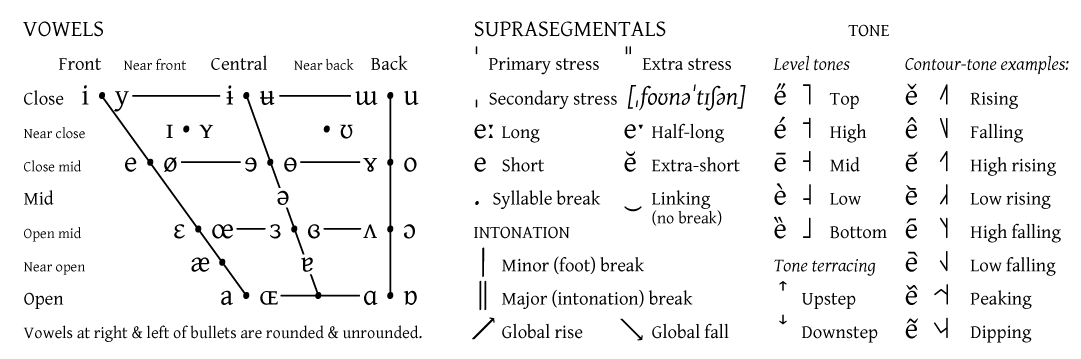
Every language in the diction section is written here in IPA. This page explains the alphabet so the tables on those pages make sense, and points you to the charts, courses and libraries singers use.
What the IPA is
The International Phonetic Alphabet is an alphabetic system of phonetic notation based primarily on the Latin script1. The International Phonetic Association devised it, starting in the late 19th century, as a standard written representation for the sounds of speech1.
Classical singers use it widely during preparation because they are frequently required to sing in a variety of foreign languages1. Vocal coaches teach it to perfect diction and to improve tone quality and tuning1.
Where the IPA comes from
In 1886, a group of French and English language teachers, led by the French linguist Paul Passy, formed what became the International Phonetic Association from 1897 onwards1. In 1888 the values of the letters were made uniform across languages1. The alphabet was last revised in May 2005 with the addition of a letter for a labiodental flap1.
The vowel letters a, e, i, o and u follow the long sound values of Latin1.
How the chart is organized
The Association sorts the letters into three categories: pulmonic consonants, non-pulmonic consonants and vowels1. Among the IPA’s symbols, 107 letters represent consonants and vowels, 31 diacritics modify them, and 17 additional signs mark length, tone, stress and intonation1. Diacritics combine with letters to add tone and phonetic detail1. English t shows the effect: it can be written as a single letter [t], or with diacritics as [t̺ʰ], depending on how precise you want to be1.
One symbol, one sound
The rule that makes the IPA useful is that one symbol always stands for one sound2. A singer can then name the exact vowel or consonant they are aiming for, independent of spelling2.
Singers use it because spelling is an unreliable guide to pronunciation, especially across languages like Italian, German and French2. With the IPA you mark the precise target sound once and sing it the same way every time2.
English spelling is the reason this matters. Though, through, cough and bough each end with a different vowel or consonant sound, despite looking similar on the page2.
Reading the vowel chart
The vowel chart is a map of the mouth. The horizontal axis shows front-to-back tongue placement, and the vertical axis shows how open the mouth and jaw are2.
Vowel counts differ between languages. Italian has four vowels where English speakers often hear two: closed [e] and open [ɛ], closed [o] and open [ɔ]2. Singers also meet three different “ah” vowels across languages: [a] (bright, front), [ɑ] (dark, back) and [ä] (central, between the two)2.
The rounded French vowels combine two positions. For [ø], the lips are shaped for [o] and the tongue for [e]2. For [œ], the lips are shaped for [ɔ] and the tongue for [ɛ]2. Singers approaching them typically start by producing the vowel’s tongue position first2.
The consonants are the larger group: pulmonic consonants make up the majority of consonants in the IPA1. A well-formed trill, as in Italian double rr, requires loose, buzzing tongue contact2.
What the IPA does not do
The IPA does not replace the ear. It sharpens what the ear is already doing, and it does not prescribe how a sound should be colored, shaped or styled2. Whether a vowel is bright, dark, open or closed is a matter of style, genre, language tradition and artistic intent2.
The marks that matter in singing
Beyond the letters, a few marks carry a lot of weight:
- A primary stress mark [ˈ] appears before the stressed syllable2.
- A tilde above a vowel, as in [ã], means the vowel is nasalized, which is central to French2.
- The length mark [ː] means the vowel is held longer, which matters in German, where [iː] and [ɪ] are distinct phonemes2.
- Slashes indicate a phonemic transcription; brackets a phonetic one2.
The pages of this site use square brackets, the form for a phonetic transcription.
Singers’ charts
A chart built for singers pairs each symbol with English example words. The Indianapolis choir’s chart, titled “International Phonetic Alphabet”, pairs k with cork, kiss and chord, the sh symbol with sheep and sugar, θ with thin and maths, and x with loch4. The affricate symbol ʤ goes with judge and general, and b with baby4. Its vowel page, “International Phonetic Alphabet-Vowels for Singers”, gives example words for each symbol, such as machine for [i], and Früh for the German version4.
The University of Iowa guide links an IPA chart with sounds, where you select a phonetic sign and hear what it sounds like3, and a video channel that explains the uses of the IPA with examples of phonetics in action3.
Ted’s Voice Academy offers a free interactive reference for singers, voice teachers and choral directors, billed as a complete guide to the IPA covering symbols, sounds and the languages singers sing2. The library covers about seventy sounds across English, Italian, German, French, Spanish, Latin, Russian, Czech and Hebrew2.
Where to find IPA texts
IPA Source is a library of IPA transcriptions and translations for both operatic and art song texts in French, Italian, German, Spanish, English and Latin3. Opera translation collections are held in the Iowa library under the call number ML 483. The Musicians Institute library guide lists Art Song Central as a free resource with thousands of IPA transcriptions for classical art songs in various languages6.
Opera librettos are also transcribed in IPA in volumes such as Nico Castel’s libretti1. When you do need to make your own, follow how to transcribe an aria into IPA.
Courses and books
At the University of Arkansas - Fort Smith, Diction for Singers I is an introductory study of the IPA, designed to achieve accurate and appropriate pronunciation of text in both speech and performance of English and Italian vocal music5. One outcome is to use the IPA as a tool for clarity and accuracy of pronunciation in singing5. Another is to read IPA transcriptions of English and Italian words5. A third is to discuss the influence of the IPA on the development of the singing tone5.
For books, the Musicians Institute library guide points to two. The Handbook of the International Phonetic Association is a comprehensive guide to the alphabet6. IPA Made Easy gives example words for every symbol in English, Latin, Italian, German, French and Spanish, and is a clear and concise tool for singing in foreign languages, equally useful in the choir room and the vocal studio6.
Using it in practice
Because one symbol is one sound, you can tell a coach exactly which vowel you are unsure of2. In French and German texts, check the length and nasal marks: the length mark means the vowel is held longer, and the tilde means it is nasalized2.
Web browsers generally do not need any configuration to show IPA characters1.
For a first language to read in IPA, see Italian diction for singers.
Read next
How to transcribe an aria into IPA: a step-by-step method for singers
Transcribe an aria into IPA: choose broad or narrow notation, use brackets, start from a ready-made IPA library and check the result by ear.
Lyric dictionItalian diction for singers: vowels, consonants, IPA and double-consonant rules
Italian lyric diction in one page: the 7 vowels, open and closed E and O, the c and g rules, gli, gn, sc, double consonants and the rolled r.
LibrettiNico Castel: Met diction coach, tenor and creator of the IPA libretti series
Nico Castel (1931-2015) was a Met comprimario tenor, staff diction coach for three decades and the translator behind the IPA libretti series.
Questions singers ask
Why do singers use the IPA?
Classical singers use the IPA widely in preparation because they often sing in a variety of foreign languages1. Coaches teach it to perfect diction and to improve tone quality and tuning1.
How can I find an IPA chart for singers?
A singers' chart from a choir and an interactive reference for singers both exist2,4. The chart pairs consonants with English examples, such as k in cork, kiss and chord, and has a vowel page for singers4.
Where can I find IPA transcriptions of arias?
IPA Source is a library of IPA transcriptions and translations for operatic and art song texts in French, Italian, German, Spanish, English and Latin3. Opera librettos are authoritatively transcribed in the IPA in volumes such as Nico Castel's1.
What do the marks above and after vowels mean?
A tilde above a vowel marks nasalization, which is central to French2. The length mark [ː] means the vowel is held longer, which matters in German, where [iː] and [ɪ] are distinct phonemes2.
Sources
- International Phonetic Alphabet · Wikipedia · en.wikipedia.org · checked 19 October 2026
- IPA for Singers: Hear Every Sound · Ted's Voice Academy · tedsvoiceacademy.com · checked 19 October 2026
- IPA - Resources for Singers · University of Iowa Libraries · guides.lib.uiowa.edu · checked 19 October 2026
- IPA Chart (Vowels for Singers) · Indianapolis choir (PDF) · indychoir.org · checked 19 October 2026
- Diction for Singers I (MUAC 21801) syllabus · University of Arkansas - Fort Smith · uafs.edu · checked 20 October 2026
- IPA Guide to Resources: Music-Related Resources (Books and Online) · Musicians Institute Library · library.mi.edu · checked 20 October 2026
Photos (1)
- International Phonetic Association, CC BY-SA 3.0

Translations of libretto lines on this page are our own. How we check facts · Report an error.