Libretti
How to read an opera libretto: layout, cast list, stage directions and translation
How to read an opera libretto: what it contains, how an 1816 libretto is laid out, how verse and acts work, and where to find a text with translation.
By Diction Desk editors · Published · Updated · Checked against 22 sources
A libretto is the text used in an extended musical work such as an opera, operetta, oratorio, cantata or musical1. It contains all the words and stage directions, while a synopsis only summarizes the plot1. In the 1816 libretto of Il barbiere di Siviglia, a cast list precedes the scenes, speaker names introduce their lines, and stage directions are printed apart2.
- Word
- Italian for little book6
- Contains
- All the words and stage directions1
- Not the same as
- A synopsis, which summarizes the plot1
- Form
- Verse, from about 1600 to well into the 19th century1
- Acts
- From one to five, two to four being most common3
- Library call numbers
- Mostly ML47 to ML54.94
Contents
- What a libretto is
- How to understand opera for beginners
- Who wrote it, and in what form
- Anatomy of a printed libretto
- Questions to put to a libretto
- Acts, scenes and numbers
- Stage directions
- Reading the verse
- Recitative and aria in the text
- Libretto versus score and vocal score
- Libretto versus translation
- Surtitles
- Libretti with IPA and word-for-word translation
- Where to find a libretto
A libretto is the words of an opera, and the printed ones sold at performances often survive better than music left in manuscript1. The pages in the libretti section build on this one.
What a libretto is
A libretto is the text used in, or intended for, an extended musical work such as an opera, operetta, masque, oratorio, cantata or musical1. The word is the diminutive of libro1. Other languages use their own words: livret for French works, Textbuch for German and libreto for Spanish1.
It is not a synopsis. The libretto contains all the words and stage directions, while a synopsis summarizes the plot1. A libretto is usually shorter than a play script, because lines take longer to sing6. The score is a different thing: it holds all the music, vocal and orchestral, with separate lines for each instrument and each singer’s vocal part6.
How to understand opera for beginners
Beginners can follow an opera through three aids: the synopsis, the surtitles and a few terms for the building blocks of the evening. The synopsis is a short written summary of the story6. The Opera Plot Summaries site covers a wide repertoire in various languages and suits students who are new to opera and want plot summaries to keep up with the drama9.
Follow the sung text as it happens. Surtitles are projected above the stage at the same time the character is singing, even when the opera is in English6. When the libretto is in another language, the story can be followed in English supertitles10. They give the essence of what is sung, not a transcript: the translation of a wordy work such as La bohème or Così fan tutte is cut, because translating everything would produce a barrage of text11.
Then learn the building blocks of the evening:
- Recitative is sung dialogue that propels the action, generally faster, with rhythm more like regular speech6.
- An aria is an extended solo passage, often lyrical, conveying emotion; the action usually stops while it is sung6. It focuses on a character’s emotions rather than actions10.
- An ensemble is an extended passage for four or more singers, and each performer is often singing different words and different musical lines6.
- The finale is the last number in an act and usually involves many singers6.
Words in a libretto are often repetitive, to emphasize emotion and to fit the music10. “You are your own microphone,” says Darryl Edwards of the University of Toronto’s opera program12. Opera is demanding on the voice in part because the sound must not seem the least bit strained12.
Who wrote it, and in what form
Opera libretti of the 17th and 18th centuries were generally written by someone other than the composer, often a well-known poet1. The libretto was written in verse from its inception around 1600, and this continued well into the 19th century1. Pietro Metastasio (1698-1782) wrote 26-28 librettos which produced around 800 operas5. In pop music or musicals, by contrast, the words are often added second to fit the tune5.
Metastasio was one of the most highly regarded librettists in Europe1. Another noted 18th-century librettist was Lorenzo Da Ponte1, the librettist for Mozart’s Le nozze di Figaro, Don Giovanni and Cosi fan tutte5. Beaumarchais’s plays and Casanova’s advice fed into his three librettos for Mozart5. Even Mozart used a Metastasio libretto, La clemenza di Tito5.
The order of work varies. The libretto is not always written before the music1. Wagner is perhaps the most famous composer who wrote his own libretti, and Berlioz wrote the libretti for two of his best-known works1. Since the late 19th century some opera composers have written music to prose or free verse libretti1, and Alban Berg adapted Georg Buchner’s play Woyzeck for the libretto of Wozzeck1. For La boheme, Puccini and his publisher Ricordi chose a “book” and “lyrics” approach: Luigi Illica wrote the scenario and Giuseppe Giacosa the verse5. In some 17th-century operas the librettist’s name was not even recorded1.
Anatomy of a printed libretto
The 1816 libretto of Il barbiere di Siviglia, as typeset by the University of Bologna, shows the pattern2.
- Title page. The work is to be performed at the Teatro Torre Argentina in the carnival of 1816, with music by maestro Gioacchino Rossini2. Cesare Sterbini is named as the one who put Beaumarchais’s comedy into verse for the Italian musical stage2.
- Preface. The notice to the public (Avvertimento al pubblico) carries Rossini’s request that Il barbiere di Siviglia be entirely versified anew2.
- Cast list. Headed ATTORI, it gives each role, followed by the singer: the Count is Manuel Garcia, principal tenor2.
- Setting. The scene is announced by a line that gives the place: Seville2. Act and scene follow, with the time of the action: the end of the night2.
- Speaker names and lines. Each speech opens with the speaker’s name, as FIORELLO and CONTE do in scene I2.
- Stage directions. They sit beside the sung lines, as in I suonatori accordano gl’istromenti (the musicians tune their instruments)2.
| Original | Our translation |
|---|---|
| La scena si rappresenta in Siviglia2 | The scene is set in Seville. |
| ATTO PRIMO SCENA I Il momento dell’azione è sul terminar della notte.2 | Act One, Scene I. The moment of the action is as the night comes to an end. |
| ROSINA Ah me meschina! l’aria m’è caduta!2 | Rosina: Ah, poor me! The aria has fallen! |
| Si nasconde nella prima porta a sinistra e poi tratto tratto si fa vedere.2 | He hides in the first door on the left and then shows himself from time to time. |
The rows show the conventions: place, act and scene, then the speaker followed by the words, then the stage direction. Read the directions with the lines: Rosina’s “the aria has fallen” comes with the direction that the paper is dropped into the street2.
Questions to put to a libretto
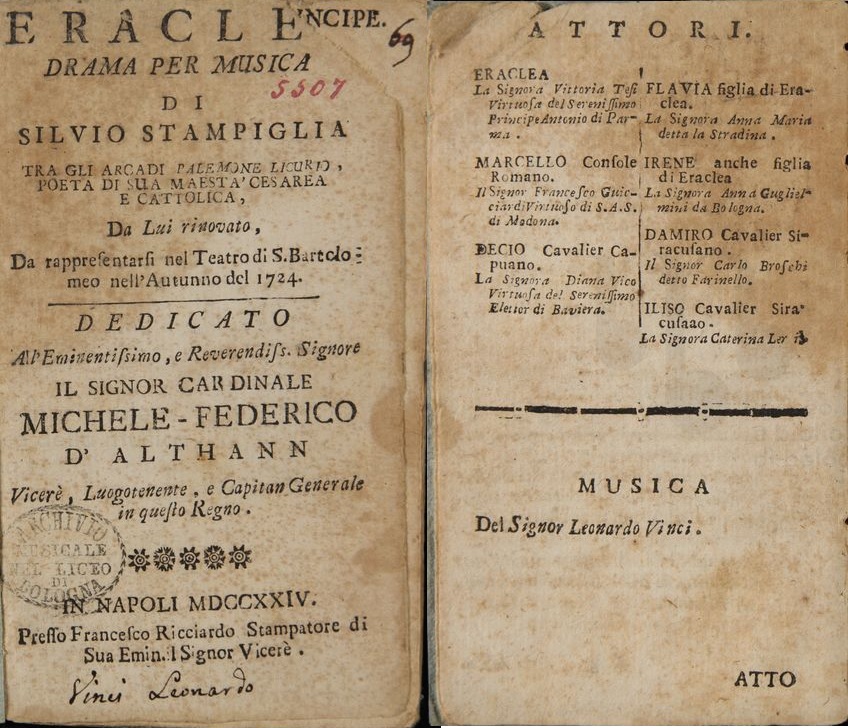
Start with the printed book. Who wrote the text? Is the composer named? Does the libretto match a specific production, and where and when was it given? Who printed it? A Ferrara university handout on reading libretti opens with these questions3.
Check the front matter. A printed libretto may carry a cast list, the personaggi, that can name the performers3. It can also carry a dedication, a notice, the argomento (Italian for subject) and the period and place of the action3. A libretto is usually a theater-hall libretto in a pocket-size, folding format3.
Acts, scenes and numbers
A libretto divides into acts, from one to five, though two to four is most common3. Below acts come scene changes (mutazioni sceniche) and then scenes3. A new scene begins whenever a character enters or leaves3.
The score usually does not mark scenes. It marks numbers or pieces, so musical units run against dramatic units, and the two may coincide3. A number opera consists of individual pieces called numbers that can be easily extracted from the larger work13. Numbers may be arias, duets, trios, quartets, quintets, sextets or choruses, interspersed with recitative or spoken dialogue13. The number format was standard until the mid-19th century, and Rossini, Donizetti, Bellini and Auber retained it13. Wagner condemned the number opera and replaced it with continuous music13.
Stage directions
Stage directions, the didascalie, are unsung text giving staging and interpretive cues for the characters3. Until the eighteenth century they are mostly few and essential3. Scenic directions usually sit at the start of the scene change and describe set details3.
Some directions are hidden inside the sung words, with a passage from Don Giovanni, act II scene 11, as the example3. Modern stagings tend to reinterpret or ignore the directions printed in the libretto3.
Reading the verse
In much of the lyric repertoire, especially in the eighteenth century, Italian verse splits into two kinds3. Versi sciolti serve recitative, and measured lyric verse serves arias, choruses and duets3.
| Versi sciolti | Lyric verse | |
|---|---|---|
| Lines used | Sevens and elevens: settenari and endecasillabi3 | Any metre except the endecasillabo3 |
| Rhyme | Absent or sporadic3 | Regular and symmetrical3 |
| Rhythm | Free and irregular3 | Measured and regular3 |
| Length | Sections of indefinite length3 | Regular strophes3 |
Odd-syllable lines are the endecasillabo (11), the settenario (7) and the quinario (5), and their other accents can move3. Even-syllable lines are the decasillabo (10), the ottonario (8) and the senario (6), with accents in fixed positions3. A verse is named by the position of its last fixed accent plus one, even if the line ends in no syllable or several3. Counting syllables must allow for sinalefe, the contraction of two vowels across a word boundary within a line3.
Strophes distributed regularly between characters can signal a strophic or simultaneous setting3. From the late seventeenth century a truncated line ending is often placed at the end of a strophe to allow a musical cadence3. A worked example from Rossini’s Il barbiere di Siviglia, act I scene 16, scans “Freddo ed immobile come una statua” to show that the last accent of a quinario always falls on the fourth syllable3.
Recitative and aria in the text
Recitative lets a singer adopt the rhythms and delivery of ordinary speech, and it does not repeat lines the way arias do14. Recitativo secco is accompanied only by continuo, typically cello and harpsichord, while accompanied recitative (accompagnato) uses the orchestra and is more song-like14. Wagner favoured through-composition, in which recitatives, arias and choruses are interwoven14.
On the page, the recitative text is free verse with little or no rhyme, and the aria text is measured and regular3. Gershwin’s Porgy and Bess goes the other way: the recitatives are prose, with verse for the arias and ensembles1.
Libretto versus score and vocal score
Printed scores contain the entire libretto, though the separately printed text can differ, usually by extra repetition in the score1. In Turandot’s Nessun dorma the libretto ends on a line that the score repeats1. Libretto text is usually published separately from the music, in a booklet1. Some libretti are published with melodic excerpts of notation for important numbers, particularly for operas in the public domain1.
A vocal score lets a conductor rehearse singers with a pianist before orchestral rehearsals15.
Libretto versus translation
Libretti have their share of problems and challenges with translation1. Some foreign works with spoken dialogue were sometimes performed with the sung portions in the original language and the dialogue in the vernacular1. Printed or projected translations make singing in the original language more practical today1.
Opera translation takes two forms: supertitles and singable translations16. Translators have limited space on each slide, so they cut extraneous details to fit16. A singable translation is a new version of the text set to the original music16, and Peter Low’s pentathlon principle balances five aims: rhythm, sense, naturalness, singability and rhyme16. See singing versus literal translation for the comparison.
Surtitles
Surtitles are translated or transcribed lyrics projected above a stage, used in opera and theatre8. Each surtitle is given an entry and exit point in the piano score, and an operator pushes a button at the marked point8. At Welsh National Opera, a music-staff member runs the surtitles from a box, following an annotated score and matching it to the music in the pit11. The surtitler sees the conductor, which makes cues more accurate because the upbeat and downbeat are visible, and can also watch the singers’ mouths to see when they breathe11. Without a view of the stage, the operator can slip by a second or two11.
The surtitle translation is a cut-down version that gives the essence of what is being sung11. The director sees it and may change words to fit the production11. Surtitles are rehearsed in the stage rehearsals so the director can suggest changes11.
Surtitles are different from subtitles, which are more often used in filmmaking and television production8. Originally the translations were photographed onto slides projected above the stage8. Surtitles can distract from the stage, so systems were developed that show captions only to the viewers who want them, and the electronic libretto system puts a screen in front of each seat so patrons can view a translation or switch it off8. The Metropolitan Opera installed Met Titles, the first US house to use the electronic libretto system8. Opera-goers have a love/hate relationship with surtitles: looking up every few lines can distract, but not looking means you can quickly lose the plot11.
Libretti with IPA and word-for-word translation
Singers who need the sounds as well as the sense use a layout that puts them side by side. The Leyerle Publications three-and-four-line system puts the IPA on the first line, the original text on the middle line and the word-for-word English on the third17. When a word-for-word passage is hard to follow, a fourth line gives a more literary translation17. The publisher created the system in 1977, with its first anthology nationally published in 198017.
The system appears in Nico Castel’s libretti series17. The Verismo volume covers Andrea Chénier, Fedora, Adriana Lecouvreur, La Bohème (Leoncavallo), Pagliacci, Mefistofele, Cavalleria rusticana, L’amico Fritz and La Gioconda in xx + 717 pages, and contains IPA transcriptions, word-for-word English translations, a guide to the IPA and notes on the Italian transcriptions18. The Strauss volume covers Der Rosenkavalier, Elektra, Salome and Ariadne auf Naxos in xxiii + 430 pages, with IPA transcriptions and word-for-word translations19.
Castel was a Portuguese-born comprimario tenor and diction coach who gave nearly 800 performances at the Metropolitan Opera, where he was also staff diction coach for three decades20. His libretto translations add the IPA pronunciation of every word in the original language20. See Nico Castel’s libretti and IPA for singers for the symbols.
In the University of Michigan translations guide, Castel’s French, German miscellaneous, Italian belcanto and Italian verismo libretti are each marked IPA included, as is Belov’s Libretti of Russian Operas21. IPA Source provides IPA transcriptions and literal translations of opera arias and art song texts, with over 15,000 titles21.
Where to find a libretto
- Search the opera title followed by the word libretto7.
- In a library catalog, search the opera title, the composer and the word libretto4. Adding the word booklet finds CDs with librettos22.
- Search the subject heading Operas–Librettos to find separately published librettos22.
- Librettos are published as standalone books, or inside CD liner notes4.
- Most libretto books have call numbers between ML47 and ML54.9; browse the shelves as well as the catalog4. At Ball State University Libraries the Castel volumes sit in Music Reference at call numbers ML 48 through ML 5022.
- The complete libretto and sometimes a translation can be found in the liner notes of recordings7. A libretto is commonly published separately from the music, and a booklet of this kind is usually included with sound recordings of most operas1.
- The Princeton guide lists complete original-language texts with English translations and plot summaries4; it also lists a scanned collection of nearly 3,500 mostly Italian opera librettos4.
- The Naxos Music Library streams audio and also includes a selection of opera librettos22.
- A libretto collection by Nico Castel gives IPA transcriptions and word-for-word translations for Italian belcanto operas7.
For texts you can use freely, see public-domain libretti.
