Opera guides
Le nozze di Figaro: synopsis, roles, arias and diction notes
Mozart's Le nozze di Figaro (The Marriage of Figaro) in one page: Da Ponte's libretto, premiere, voice types, synopsis by act, arias and Italian diction.
By Diction Desk editors · Published · Updated · Checked against 6 sources
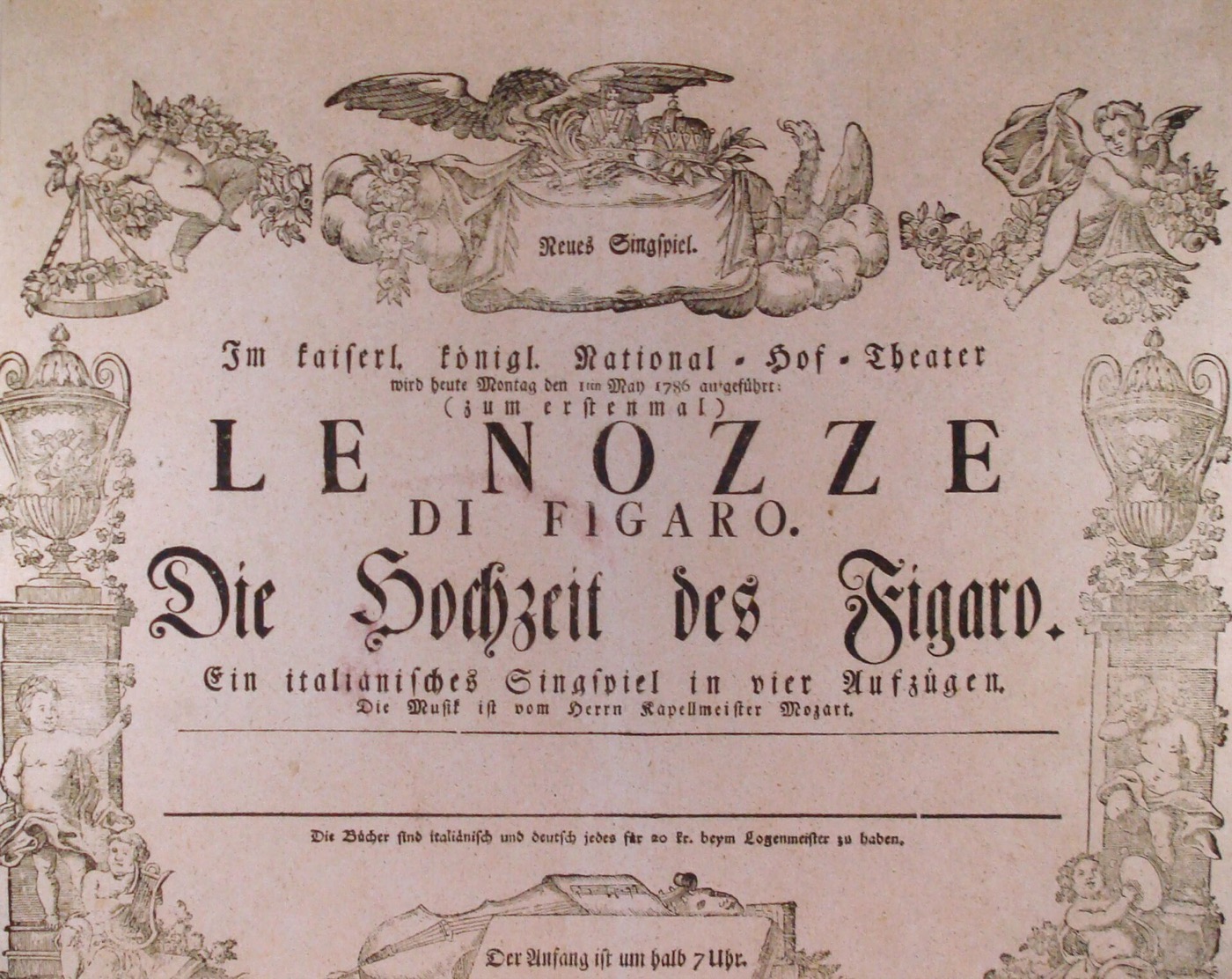
Le nozze di Figaro (The Marriage of Figaro) is a commedia per musica in four acts, composed in 1786 by Wolfgang Amadeus Mozart to an Italian libretto by Lorenzo Da Ponte1. It premiered at the Burgtheater in Vienna on 1 May 17861. The main characters are Figaro, Susanna, Count Almaviva, the Countess and Cherubino1.
- Composer
- Wolfgang Amadeus Mozart1
- Librettist
- Lorenzo Da Ponte1
- Premiere
- 1 May 1786, Burgtheater, Vienna1
- Language
- Italian1
- Acts
- 41
- Source play
- Beaumarchais, 17841
Contents
Mozart and Da Ponte turned a banned play into a comedy of one crazy day in a count’s palace. This page gives the facts a singer needs before opening the vocal score: who sings what, how the plot runs act by act, which numbers to learn and the Italian text behind them. It is one of the guides in the operas section.
At a glance
Le nozze di Figaro is a commedia per musica (opera buffa) in four acts, composed in 1786 by Mozart to an Italian libretto by Lorenzo Da Ponte1. It premiered at the Burgtheater in Vienna on 1 May 17861. The libretto is based on Beaumarchais’s 1784 stage comedy La folle journée1. The action takes place on a single day, in the palace of Count Almaviva near Seville1,2. A typical performance lasts around three hours1.
The opera tells how the servants Figaro and Susanna succeed in getting married, foiling the efforts of their philandering employer Count Almaviva to seduce Susanna1. It was the first of three collaborations between Mozart and Da Ponte, followed by Don Giovanni and Così fan tutte1. Mozart portrays the women as wiser, shrewder and more civilised than the men2.
Who’s who
| Role | Voice type | Premiere singer |
|---|---|---|
| Figaro, the count’s valet | Bass (bass-baritone today) | Francesco Benucci1 |
| Susanna, the countess’s maid | Soprano | Nancy Storace1 |
| Count Almaviva | Baritone | Stefano Mandini1 |
| Countess Rosina Almaviva | Soprano | Luisa Laschi1 |
| Cherubino, the count’s page | Soprano breeches role (mezzo-soprano today) | Dorotea Bussani1 |
| Marcellina, Doctor Bartolo’s housekeeper | Soprano | Maria Mandini1 |
| Bartolo, doctor and lawyer | Bass | Francesco Bussani1 |
| Basilio, music teacher | Tenor | Michael Kelly1 |
| Barbarina, Susanna’s cousin | Soprano | Anna Gottlieb1 |
| Antonio, the count’s gardener | Bass | Francesco Bussani1 |
Michael Kelly sang both Basilio and Don Curzio at the premiere1. In modern practice Cherubino and Marcellina are usually sung by mezzo-sopranos and Figaro by a bass-baritone1. Mozart and his contemporaries never used the terms mezzo-soprano or baritone, and women’s roles were listed only as soprano or contralto1.
Cherubino is a trouser role, written for a woman who plays a man, as was common in opera4. The Count has degenerated from the romantic youth of The Barber of Seville into a scheming, bullying, skirt-chasing baritone1. The 2025 Metropolitan Opera broadcast cast Joshua Hopkins as the Count, Federica Lombardi as the Countess and Marianne Crebassa as Cherubino, with Joana Mallwitz making her Met debut as conductor5. Details are on the PBS broadcast page.
Synopsis
The opera continues the plot of The Barber of Seville several years later1. Three years before the opera begins, Figaro helped Count Almaviva marry Rosina, whom the count stole from Dr Bartolo2. The Count had abolished the droit du seigneur when he married Rosina, but now wants to reinstate it, his right to bed a servant girl on her wedding night1. Figaro had borrowed money from Marcellina and promised to marry her if he could not repay it, and her contract requires him to repay the money or marry her himself1,2. Through the clever manipulations of Susanna and the Countess, Figaro and Susanna are finally able to marry1.
Act 1
Figaro measures the space where the bridal bed will fit while Susanna tries on her wedding bonnet1. Susanna gets the better of Marcellina in their exchange by congratulating her on her impressive age1. Bartolo, seeking revenge on Figaro for helping the Count and Rosina to marry, agrees to represent Marcellina pro bono in her suit1.
Cherubino has been dismissed for being caught alone with Barbarina, the gardener’s daughter, and the Count plans to punish him2,1. Cherubino confesses his infatuation with all women and asks Susanna for help1. He hides behind the chair, and the count discovers him1. The Count forgives Cherubino but sends him to his regiment in Seville, effective immediately1. Figaro gives Cherubino mocking advice about the harsh military life ahead1.
Act 2
The Countess laments her husband’s infidelity in her opening aria1. Figaro plans to distract the count with anonymous letters warning him of adulterers, and Susanna urges Cherubino to sing the song he wrote for the Countess1. The Countess reluctantly lets the Count into her room while Cherubino is hidden in the closet, and Cherubino locks the door1.
The Countess, thinking herself trapped, admits that Cherubino is in the closet, and the Count draws his sword1. Meanwhile Cherubino has escaped by jumping through the window into the garden, and Susanna has taken his place1. When the closet door is opened, they find only Susanna, and the Countess calls it a practical joke to test the Count’s trust1.
Antonio the gardener complains that a man jumped from the window and damaged his carnations1. Figaro claims it was he who jumped1. Figaro must identify the paper the escaping man dropped, which is Cherubino’s appointment to the army, and he is saved by signals from Susanna and the Countess1. The finale ends with the Count postponing the wedding to investigate the charge1.
Act 3
Susanna gives the Count a false promise to meet him in the garden that night1. The Count overhears her telling Figaro that he has already won the case, and he resolves to punish Figaro by forcing him to marry Marcellina1.
The discussion about Marcellina’s suit reveals that Figaro is the long-lost illegitimate son of Bartolo and Marcellina1. Susanna enters with a payment to release Figaro from his debt and, seeing him with Marcellina, has a tantrum and slaps his face1. Bartolo agrees to marry Marcellina that evening in a double wedding1.
The Countess dictates a love letter for Susanna to send the Count, proposing a meeting under the pines1. The letter is sealed with a pin and inscribed to return the seal to the sender2. Barbarina asks for Cherubino’s hand in marriage, reminding the Count of his offer of favors, and the Count is forced to agree1.
Act 4
Figaro finds Barbarina with the pin, recognizes it as the pin that fastened the letter and is overcome with jealousy1. Figaro swears to be avenged on the Count, on Susanna and on all unfaithful wives1. Susanna and the Countess arrive, each dressed in the other’s clothes1.
Figaro, hiding behind a bush, grows increasingly jealous as Susanna sings a love song he thinks is meant for the Count1. He mistakes Susanna for the Countess, then recognizes her voice1. The Count kneels and pleads for forgiveness, the Countess forgives her husband, and everyone sets out to celebrate1.
Arias and ensembles
The opera is packed with back-to-back hit tunes, and the arias are connected by recitative that carries the plot forward4. The table lists the numbers a singer meets first.
| Number (first line) | Role | Act | Gloss |
|---|---|---|---|
| Se vuol ballare, signor contino | Figaro (cavatina) | Act 1 | Should you wish to dance, little Sir Count1 |
| Non più andrai | Figaro, to Cherubino | Act 1 | No more will you go wandering1 |
| Non so più cosa son | Cherubino | Act 1 | I can no longer tell what I am1 |
| Porgi, amor, qualche ristoro | Countess | Act 2 | Love, bring me a little ease1 |
| Voi che sapete che cosa è amor | Cherubino, for the Countess | Act 2 | A song Susanna urges him to sing1 |
Mozart uses the sound of two horns playing together to represent cuckoldry in Figaro’s Act 4 aria, and Verdi later used the same device in Ford’s aria in Falstaff1. In that aria Figaro muses bitterly on the inconstancy of women1. Two arias from Act 4, Marcellina’s and Basilio’s, are often omitted from performances, though some recordings include them1. Marcellina regrets that people, unlike goats, sheep or wild beasts, abuse their mates, and Basilio tells how he escaped danger in his youth by using the skin of a donkey for shelter1.
The Act 2 finale has seven characters all singing at once4. It lasts 20 minutes and is one of the longest uninterrupted pieces Mozart ever wrote1. Eight of the opera’s 11 characters appear on stage in its more than 900 bars of continuous music1. The overture, in a presto tempo, is well known and often played alone as a concert piece1,4. The Susanna and Countess duet Sull’aria also appears in The Shawshank Redemption4.
For the 1789 revival Mozart wrote two replacement arias for Susanna for Adriana Ferrarese1. They replace the clarinets with basset horns and are normally not used in modern performances1. Cecilia Bartoli sang Susanna with those arias in a series of Metropolitan Opera performances in 19981.
In the original
Da Ponte’s Italian libretto of 1786 is also on Italian Wikisource6. The first lines below are set out for study. The translation is ours and literal.
| Original | Our translation |
|---|---|
| Se vuol ballare, signor contino1 | Should you wish to dance, little Sir Count |
| Non più andrai1 | No more will you go wandering |
| Non so più cosa son1 | I can no longer tell what I am |
| Porgi, amor, qualche ristoro1 | Love, bring me a little ease |
| Voi che sapete che cosa è amor1 | You who know what love is |
Background and premiere
Mozart selected Beaumarchais’s play and brought it to Da Ponte (1749 to 1838)3,1, who turned it into a libretto in six weeks, rewriting it in poetic Italian1. The play was banned in Vienna at first, and the Austrian censor had forbidden performing the German version1. Emperor Joseph II had objected that the piece contained much that is objectionable1. The idea of servants revolting against their masters caused outrage among the aristocracy2,4. Da Ponte obtained approval from the emperor for an operatic version, and the Emperor approved the libretto before Mozart wrote any music1. Da Ponte replaced Figaro’s climactic speech against inherited nobility with an angry aria against unfaithful wives1.
The company paid Mozart 450 florins for the work, three times his meager yearly salary in Salzburg, and Da Ponte was paid 200 florins1. Mozart conducted the first two performances seated at the keyboard, the custom of the day, and Joseph Weigl conducted later performances1. The first production was given eight further performances, all in 1786, nine in total1. The premiere audience encored five numbers, and the Emperor, concerned by the length of the performance, ruled that no piece for more than a single voice was to be repeated1. Posters announcing the rule were in the Burgtheater in time for the third performance on 24 May1.
The Vienna premiere was a moderate success, and the Prague production, which began in December 1786 under the Pasquale Bondini company, made the opera’s popularity soar4,1. The Prague success led to the commission of Don Giovanni1.
Joseph Haydn appreciated the opera greatly and wrote to a friend that he heard it in his dreams1. Brahms judged that each number in Figaro is a miracle1. Charles Rosen judged Mozart’s version the dramatic equal, and in many respects the superior, of Beaumarchais’s play1. When BBC News Magazine asked 172 opera singers to vote for the best operas ever written in 2017, The Marriage of Figaro came first out of the 20 operas featured1. It appears consistently among the top ten on the Operabase list of most frequently performed operas1.
Language and diction notes
The libretto is Italian, so prepare the text with Italian diction for singers before you open the score. The recitativi secchi are accompanied by a keyboard instrument, usually a fortepiano or a harpsichord, often joined by a cello1.
Where to go next
Figaro continues the plot of The Barber of Seville several years later1. For a setting of that earlier play, see Rossini’s Il barbiere di Siviglia. For a German-language Mozart score, read The Magic Flute. To place these roles by voice type, read the Fach system guide.
