Opera guides
Il barbiere di Siviglia: synopsis, roles, arias and diction notes
Rossini's Il barbiere di Siviglia (The Barber of Seville): Sterbini's libretto, 1816 premiere, voice types, synopsis by act, arias and Italian diction.
By Diction Desk editors · Published · Updated · Checked against 6 sources
Il barbiere di Siviglia (The Barber of Seville) is an opera buffa in two acts by Gioachino Rossini to an Italian libretto by Cesare Sterbini1. It premiered on 20 February 1816 at the Teatro Argentina in Rome1. ENO calls Figaro's entrance, Largo al factotum della città, famous2.
- Composer
- Gioachino Rossini1
- Librettist
- Cesare Sterbini1
- Premiere
- 20 February 1816, Teatro Argentina, Rome1
- Language
- Italian1
- Acts
- 21
- Source play
- Beaumarchais, 17751
Contents
Rossini’s comedy of bribery, deception and disguise2 opened to jeers and is now ranked among the greatest masterpieces of comedy in music1. This page gives the facts a singer needs before opening the vocal score: the roles by voice type, the plot act by act, the arias and the Italian behind them. It is one of the guides in the operas section.
At a glance
Il barbiere di Siviglia is an opera buffa in two acts by Gioachino Rossini to an Italian libretto by Cesare Sterbini1. It is based on Pierre Beaumarchais’s French comedy The Barber of Seville (1775) and recounts the first of Beaumarchais’s three Figaro plays1. Mozart’s The Marriage of Figaro (1786) is based on the second part of the trilogy1. Rossini composed the music in just under three weeks1. It is a classic example of the buffa genre, comic and light-hearted2.
It premiered on 20 February 1816 at the Teatro Argentina in Rome, under the title Almaviva, o sia L’inutile precauzione1. Rossini lived from 29 February 1792 to 13 November 18682. Sterbini (1784 to 19 January 1831) was an Italian writer and librettist who is best known for two Rossini operas3.
Who’s who
| Role | Voice type | Premiere singer |
|---|---|---|
| Count Almaviva (disguised as Lindoro) | Tenor | Manuel Garcia1 |
| Figaro, the barber | Baritone | Luigi Zamboni, for whom Rossini wrote the role1 |
| Rosina, Bartolo’s pupil | Contralto | Geltrude Righetti-Giorgi1 |
| Doctor Bartolo, Rosina’s guardian | Bass | Bartolomeo Botticelli1 |
| Basilio, Rosina’s music teacher | Bass | Zenobio Vitarelli1 |
| Berta, Bartolo’s old governess | Soprano | Elisabetta Loyselet1 |
| Fiorello, Almaviva’s servant | Bass | Paolo Biagelli1 |
In 1816 “baritone” had yet to become recognized as a separate vocal register, so Rossini wrote baritone parts as basses1. Female singers were typically designated simply as soprano or contralto, and the term mezzo-soprano was not yet standard in scores1.
Synopsis
Almaviva has followed Rosina from Madrid to Seville, disguised as a poor student called Lindoro2. He hopes to make her love him for himself, while Bartolo plans to marry her once she is of age and so take her considerable dowry1. Rosina is the young ward of the grumpy, elderly Bartolo1. Figaro used to be a servant of the Count, who asks him for help1.
Act 1
A band of musicians and Lindoro serenade Rosina’s window in vain1. The serenade produces no response from Rosina2. Almaviva pays off the musicians, who depart, leaving him to brood alone1.
Figaro, a barber who prides himself on his ability to manage the affairs of the city, enters with Largo al factotum and agrees to help1,2. He advises the Count to disguise himself as a drunken soldier ordered to be billeted with Bartolo1. Knowing the Count only as Lindoro, Rosina writes to him because she wants to get to know him better, and Figaro asks her to write the encouraging words she has already written1. Basilio advises that Almaviva be discredited with false rumors, in La calunnia1.
Almaviva enters the house disguised as a drunken soldier and demands to be quartered there1. Bartolo holds a billeting exemption that excuses him from quartering soldiers, and the Count passes Rosina a love letter while Bartolo searches his desk for it1. Rosina fools Bartolo by handing over her laundry list instead of the letter1. The row grows until the neighbors call the militia, and the Officer of the Watch backs off when the Count quietly reveals his true identity2,1. The confusion intensifies until everyone suffers headaches and auditory hallucinations1.
Act 2
Almaviva returns as Don Alonso, a priest and singing tutor who is substituting for the supposedly ailing Basilio1. Don Alonso tells Bartolo that he has intercepted a note from Lindoro to Rosina1. Figaro arrives to shave Bartolo, who insists on the shave in the music room, unwilling to leave Rosina alone with the singing teacher1.
Basilio appears for his scheduled music lesson but is bribed with a full purse and persuaded to leave1. Figaro smashes a pile of crockery to lure Bartolo away from the music room and steals the key to Rosina’s balcony2. Bartolo orders Basilio to have the notary ready to marry him to Rosina that evening1. Bartolo persuades Rosina that Lindoro is merely a flunky of Almaviva, and she agrees to marry Bartolo1. Berta complains of the crazy household, where the little old man is looking for a wife1.
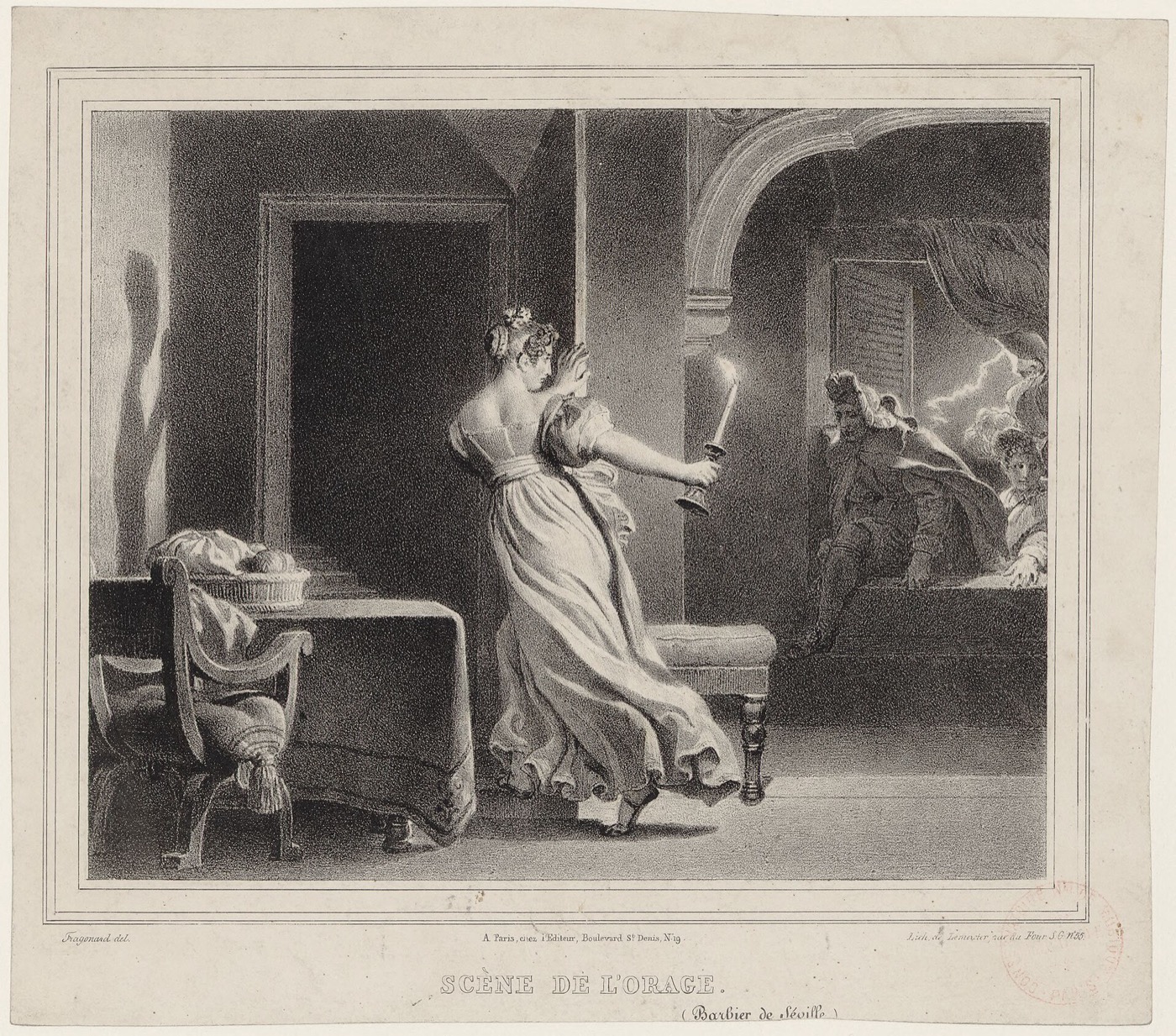
During an instrumental interlude the music creates a thunderstorm to indicate the passage of time1. The Count and Figaro climb a ladder to the balcony and enter Rosina’s room through a window1. The lovers find they cannot escape because Bartolo has removed the ladder2. Using bribes and threats, Almaviva coerces the notary into marrying him to Rosina, with Basilio and Figaro as the legally required witnesses1. Bartolo and the magistrate appear too late, and he must acknowledge that he has lost Rosina2. Bartolo is pacified by being allowed to retain Rosina’s dowry1. The opera concludes with an anthem to love1.
Songs and arias
| Number (first line) | Role | Act | Gloss |
|---|---|---|---|
| Ecco, ridente in cielo | Count Almaviva, as Lindoro | Act 1 | The opening serenade, There, laughing in the sky1 |
| Largo al factotum della città | Figaro | Act 1 | Room for the city’s jack-of-all-trades1 |
| Una voce poco fa | Rosina | Act 1 | Cavatina that opens her scene in Bartolo’s house1 |
| La calunnia è un venticello | Basilio | Act 1 | Slander is a gentle little wind1 |
| Fredda ed immobile, come una statua | Ensemble | Act 1 | Cold and still, just like a statue, in the finale1 |
| Il vecchiotto cerca moglie | Berta | Act 2 | The little old man is looking for a wife1 |
| Cessa di più resistere | Count Almaviva | Act 2 | Bravura aria omitted from most performances after the premiere1 |
| Contro un cor | Rosina, in the lesson scene6 | Act 2 | Maria Callas sang it shortened and transposed up a tone in a 1956 La Scala recording1 |
Figaro and the Count also sing the duet All’idea di quel metallo, and Bartolo sings A un dottor della mia sorte1.
The Act 2 singing lesson has often been turned into a show-stopping cabaret1. Adelina Patti was known to include Luigi Arditi’s Il bacio in the lesson, and Pauline Viardot began the practice of inserting Alyabyev’s Nightingale1. Rossini is reported to have asked Patti who wrote the piece she had just performed1.
In the original
Three first lines set out for study. The translation is ours and literal. A bilingual Italian and English libretto printed in London in 1826 for performance at the King’s Theatre Haymarket on 11 March 1826, with W. J. Walter’s translation, is catalogued by Corago4.
| Original | Our translation |
|---|---|
| Largo al factotum della città1 | Room for the city’s jack-of-all-trades |
| Una voce poco fa1 | A voice not long ago |
| La calunnia è un venticello1 | Slander is a gentle little wind |
Background and early history
The 1816 premiere was a disaster: the audience hissed and jeered throughout, and several on-stage accidents occurred1. Many in the audience supported one of Rossini’s rivals, the veteran Giovanni Paisiello, who had composed another opera on the first play in 17821. The second performance, however, was successful1. The original French play was also poorly received at first, then became a favorite within a week1. Today the opera is considered one of the greatest masterpieces of comedy in music1.
The overture was recycled from two earlier Rossini operas1. Rossini completed an average of two operas per year for 19 years1. The opera was first performed in England on 10 March 1818 at the King’s Theatre in London, in Italian1. It was first performed in America on 3 May 1819, in English, and in 1825 it became the first opera performed in Italian in New York1. ENO’s production debuted at the London Coliseum in November 19872.
The opera is the prequel to Mozart’s Figaro, and the Count of Rossini’s opera becomes the jealous Count of Mozart’s, while Rosina becomes the long-suffering Countess5. For that sequel, read Le nozze di Figaro, which draws on the second Beaumarchais play1. The PBS Met preview quotes The New York Times on the Met production: Rossini’s effervescent music, an energetic cast and Michael Yeargan’s spinning set5.
Casting and voice notes
Rosina was originally written for a contralto1. Because of a scarcity of contraltos, the role has most frequently been sung by a coloratura mezzo-soprano1. Ewa Podleś, a famous contralto, made her stage debut as Rosina1. Rossini wrote a new aria for the second act for Joséphine Fodor-Mainvielle, a soprano Rosina1. Osborne called the upward transposition of the role, which turns a lustrous alto into a pert soprano, the most serious distortion of Rossini’s intentions1.
A mezzo-soprano Berta will find the tessitura of her aria uncomfortable1. For a mezzo-soprano Berta the climb to C6 at the conclusion of the Act 1 finale ensemble is rather difficult to achieve, according to Zedda, editor of the first critical edition1.
Language and diction notes
The libretto is Italian, so prepare the text with Italian diction for singers before you open the score.
Look up factotum, calunnia and venticello on the Italian page before you learn the first lines above. To place Rosina, Almaviva and Basilio by voice type, read the Fach system guide.
Where to go next
Mozart’s Le nozze di Figaro is based on the second part of Beaumarchais’s trilogy1. For a German-language Mozart score, read The Magic Flute.
