Libretti
Public-domain opera libretti: where to find free texts and what copyright allows
Where to find free public-domain opera libretti: Wikisource, IMSLP, Gutenberg, librettidopera.it and library scans, and what copyright still limits.
By Diction Desk editors · Published · Updated · Checked against 24 sources
In the United States, works published before 1 January 1931 are in the public domain1; in the UK, copyright usually lasts for the author's life plus 70 years2. A 2000 survey found most standard operatic repertory had reverted to the public domain3. Wikisource, IMSLP and librettidopera.it carry libretti4,5,6. Recent titles and translations stay tied to copyright3.
- Wikisource portal
- Lists public-domain libretti of operas, operettas and oratorios4
- IMSLP libretti category
- 193 pages, checked 20 October 20265
- Italian-language texts
- librettidopera.it6
- US rule
- In the United States, published before 1 January 1931: public domain1
- UK rule
- In the UK, author's life plus 70 years2
- Library of Congress catalogue
- Opera librettos printed before 1800, published 19147
Contents
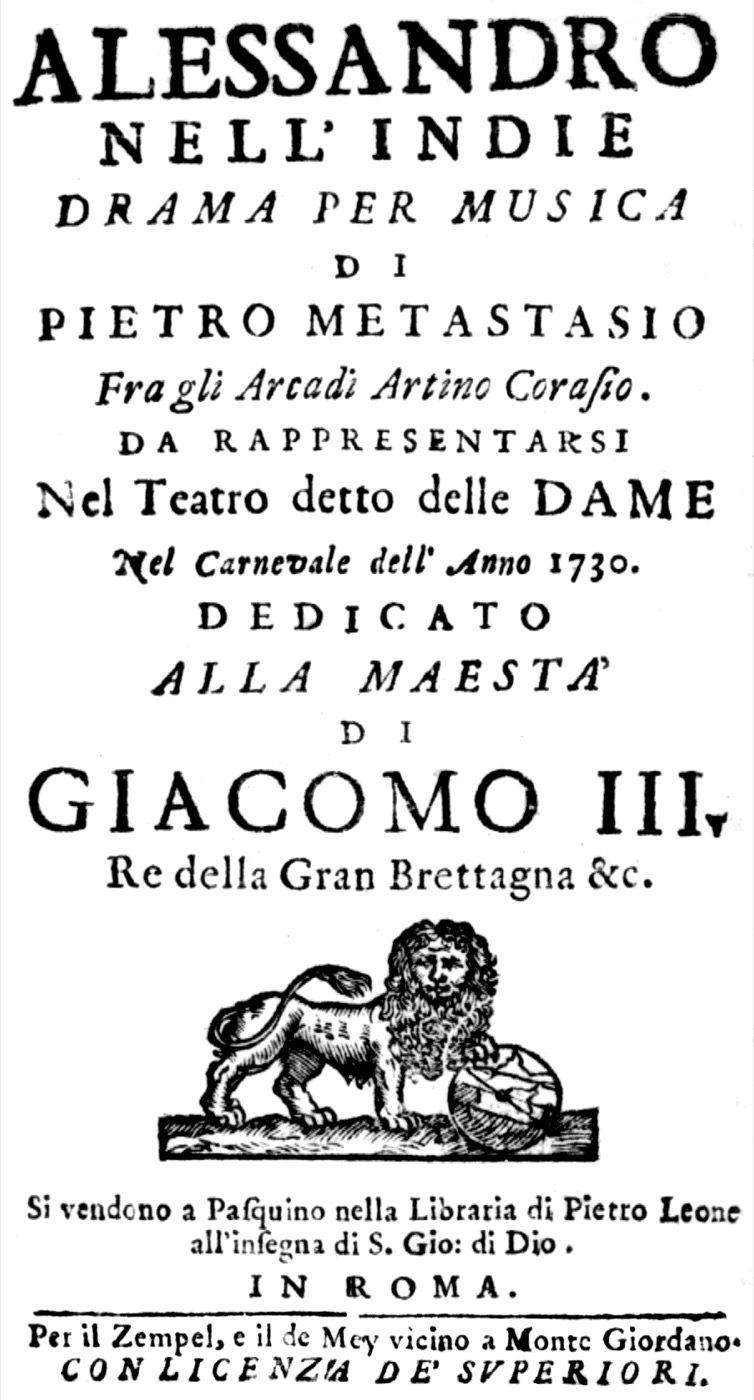
Opera libretti were commonly printed for the audience of the first stage production3. As of 2000, the vast majority of the standard operatic repertory had reverted to the public domain, but the rules depend on the source, the country and the date3. This guide is part of the libretti section.
Where to find libretti at a glance
| Source | What it holds | Format |
|---|---|---|
| Wikisource opera portal | Public-domain libretti of operas, operettas and oratorios4 | Web text, CC BY-SA, with additional terms possible4 |
| Wikisource, Dido and Aeneas | Versions of the libretto by Nahum Tate, including a 1689 edition with libretto only10 | Web text under the Creative Commons Attribution-ShareAlike License10 |
| IMSLP librettos category | Texts of operatic and vocal works that omit the music, 193 pages, checked 20 October 20265 | Category pages sortable by work type, instrumentation and composer5 |
| librettidopera.it | Italian-language opera libretti6 | Libretti, MP3 pieces and images, as the site navigation lists them13 |
| Project Gutenberg | eBooks, the vast majority in the US public domain; 79,642, checked 20 October 202614,8 | Kobbé page: EPUB3, Kindle, plain text and older EPUB8 |
| OperaFolio | 1051 links to libretti and translations of 512 operas, checked 20 October 202615 | Links to original libretti and translations15 |
| Library of Congress catalogue, 1914 | A catalogue of opera librettos printed before 18007 | Scan of the 1914 volume at the Internet Archive7 |
| Harry Ransom Center | 3,421 Italian opera libretti, donated in 196916 | Catalogue records, no digitized images in the 2010 review17 |
| OperaGlass (Stanford) | Libretti, source texts, performance histories, synopses and discographies18 | Wayback copy marked last maintained 14 Feb 202018 |
Wikisource
The Wikisource opera portal lists public-domain libretti of operas, operettas, oratorios and similar works4. Its external links include one titled 400 Librettos of the most famous Operas, as of the page checked 20 October 20264. The list includes Aida, The Bartered Bride and HMS Pinafore, and also The Pirates of Penzance, Patience, Iolanthe, Princess Ida and individual selections from The Mikado4.
A single work shows how it is organized. The Wikisource page for Dido and Aeneas lists versions of the libretto by Nahum Tate, composed by Henry Purcell10. One version is the 1689 edition with libretto only10. Text on Wikisource is available under the Creative Commons Attribution-ShareAlike License10; on the portal, additional terms may apply4.
The site applies a licensing rule to every text. Wikisource requires every text to be in the public domain or under a compatible licence12. A translation counts as a derivative work, and the contributor warrants that both the original and the translation are public domain or compatibly licensed12. A translation has a copyright status separate from the original19. Original works on Wikisource, including translations, are licensed CC BY-SA unless stated otherwise12.
IMSLP
The IMSLP librettos category holds publications of the text of operatic and vocal works that omit the music5. It listed 193 pages, checked 20 October 20265, and it sorts by work type, instrumentation, composer and more5. Entries include Monteverdi’s L’Arianna, SV 291, Vivaldi’s Arsilda, regina di Ponto, RV 700, Hasse’s Achille in Sciro and Graun’s Armida, GraunWV B:I:235.
librettidopera.it
For Italian opera, librettidopera.it is dedicated to Italian-language opera libretti6. Each libretto was searched for, copied and laid out with passion6. The site sets out to condense more than three centuries of libretto writing13 and lists libretti, MP3 pieces and images13. Its aim is popularizing rather than philological: to make known aspects of Italian culture13.
The title index gives the composer, the librettist and a date for each work6.
| Opera | Composer | Librettist | Date in the index |
|---|---|---|---|
| Alceste | Gluck | Ranieri de’ Calzabigi | 26 December 17676 |
| Agrippina | Handel | Vincenzo Grimani | 26 December 17096 |
| Alcina | Handel | Antonio Fanzaglia and an anonymous author | 16 April 17356 |
| Il barbiere di Siviglia | Paisiello | Giuseppe Petrosellini | 15 September 17826 |
| Le nozze di Figaro | Mozart | Lorenzo Da Ponte | 1 May 17866 |
| Il barbiere di Siviglia | Rossini | Cesare Sterbini | 20 February 18166 |
| Rigoletto | Verdi | Francesco Maria Piave | 11 March 18516 |
| Aida | Verdi | Antonio Ghislanzoni | 24 December 18716 |
| Tosca | Puccini | Three librettists, including Sardou | 14 January 19006 |
| Madama Butterfly | Puccini | Giacosa and Illica | 28 May 19046 |
Il barbiere di Siviglia appears twice in the index: Paisiello’s opera of 1782 has a libretto by Petrosellini, Rossini’s of 1816 one by Sterbini6.
Project Gutenberg
The vast majority of Project Gutenberg’s eBooks are in the US public domain14. Its catalogue page counts 79,642 free eBooks, checked 20 October 20268. Opera titles there include Kobbé’s Complete Opera Book, first published posthumously in 19198, and Annesley’s Standard Operaglass, which gives plots and critical remarks for 151 famous operas20. Kobbé’s page offers EPUB3, Kindle via Send-to-Kindle, plain text and older EPUB8.
Project Gutenberg’s permissions page puts the US limit plainly: outside the US, readers must confirm for themselves whether an item is free to redistribute where they are14. A copyright statement printed on an included title page does not mean the item is still copyrighted14. Gutenberg grants no permission for public-domain items, because nobody can14.
OperaFolio
OperaFolio’s libretti page contained 1051 links to the libretti, original and translated, of 512 operas, checked 20 October 202615. The entries give the language of each text: Adam’s Le postillon de Lonjumeau (1836) with a French libretto and a German translation, Beethoven’s Fidelio (1805) with a German libretto plus English and Spanish translations, and Balfe’s The Bohemian Girl (1843) with an English libretto15. Modern entries sit in the same list: Bartók’s Bluebeard’s Castle (1918) with a Hungarian libretto and a Spanish translation, and Adams’s Nixon in China (1987) with an English libretto and a Spanish translation15.
Library of Congress catalogue
The Library of Congress published a catalogue of opera librettos printed before 1800 in Washington in 19147. The scan shows no visible notice of copyright, with a stated date of 19147. It has a title catalogue and a separate author list, composer list and aria index7. Oscar George Theodore Sonneck, Chief of the Division of Music, prepared it7.
The catalogue came from the Albert Schatz collection, which the Library of Congress purchased before planning the catalogue7. The collection held, in round figures, 12,240 librettos, not counting duplicates, of which 12,000 are opera libretti7. Schatz’s plan seems to have been to collect first editions, meaning librettos printed for an opera’s first performance7. He formed the collection over more than forty-two years of collecting, and his collection and other European librettos carried his history of opera to the point that the statistical part stood on about 80,000 cards7.
Harry Ransom Center and library guides
The Harry Ransom Center at the University of Texas at Austin holds 3,421 Italian opera libretti donated by the New York rare book dealer Hans P. Kraus in 196916. The collection spans the 17th to the 20th century and includes cantatas, serenatas, oratorios, dialogues and Passions16. The Center’s page shows the title page of Peri and Rinuccini’s L’Euridice, Florence, 160016, and the collection holds items published as early as 160017. The items document performances by Italian, French, German and Austrian composers in numerous Italian cities16.
A 2010 review of the database counts over 3400 items, searchable by title, call number, librettist, location and printer17. The reviewer saw no digitized images; item pages give title-page information and the cast, if available17.
Opera Libretti is a selection of public-domain opera libretti and other vocal texts, and OperaGlass presents performance histories, synopses, libretti and discographies, according to the Eastern University library guide21. The guide also links the University of Illinois online scores at the Internet Archive as access to opera and vocal scores21.
OperaGlass
OperaGlass at Stanford lists libretti, source texts, performance histories, synopses and discographies for operas18. Its Wayback copy, checked 20 October 2026, indexes over 4800 opera composers with more than 25,000 operas and links to about 350 opera companies worldwide18. Its pages are marked as last maintained by Rick Bogart on 14 Feb 202018.
What copyright still limits
In his 2000 survey, Lyle K. Neff of the University of Delaware called copyright law the most significant limit on the availability of libretti on the Internet3. Most of the standard repertory had reverted to the public domain, but many titles, especially recent ones, could not be posted without the copyright holder’s permission3. Copyright is also tied in with the availability of translations3.
Copyright term is the length of time copyright subsists before a work passes into the public domain9. It varies by jurisdiction9.
| Jurisdiction | Rule | Source |
|---|---|---|
| Most countries | Author’s life plus 50 or 70 years; Berne Convention terms are minimums for signatory countries, which may grant longer ones9 | Wikipedia, Copyright term9 |
| United States | Works published before 1 January 1931 are in the public domain; copyright generally lasts 70 years after the author’s death1 | Wikipedia, Copyright law of the United States1 |
| United States, never published or registered | Unpublished works from authors who died before 1956 are in the public domain (life plus 70 years)22 | Cornell University Library chart, updated 1 January 202622 |
| United Kingdom | Author’s life plus 70 years from the end of the year of death2 | The British Library2 |
| United Kingdom, joint authors | The term runs from the death of the last surviving author23 | University of Stirling Library23 |
| Italy and France | Post-war extensions of about six years in Italy and up to about 14 in France were added to some terms9 | Wikipedia, Copyright term9 |
In the US, works first published in the US before 1931 are in the public domain through copyright expiration, and works first published abroad before 1931 are too, with a special case, on the Cornell chart22. In the US, works created but not published before 1 January 1978 may be protected until 20471. A work can be public domain in one country and protected in another11.
The University of Montana chart covers literary, musical and dramatic works, and only works published or created in the United States24. Under that chart’s rule of thumb, a work whose status cannot be determined is likely still covered by copyright24.
Translations and editions
Wikipedia’s Public domain article states that translations or new formulations of public-domain works may be copyrighted in themselves, and that derivative works include translations, musical arrangements and dramatizations11. In the US, per the Cornell guide, a copy of a public-domain work gains no new copyright, while a curated selection of public-domain works may have one22.
In the UK, per the University of Stirling guide, a typographical arrangement of a published edition has its own 25-year protection23. When an author died fewer than 70 years ago and the estate or relatives cannot be contacted, the works are known as orphan works23.
Neff noted that existing public-domain translations for much of the standard repertory could be put online, but they often contain out-of-date language or, if meant to be sung, do not render the meaning as accurately as a reading translation3. New translations are a rare occurrence online, because the volunteer nature of the enterprise limits contributions3.
A short history of the free-text web
Lyle Neff began a web page titled Public Domain Opera Libretti and Other Vocal Texts in 1995, relying on voluntary contributions of vocal texts and related information3. The first opera text he posted was Purcell’s Dido and Aeneas3, and contributions and links poured in quickly after the announcement3. He gave the paper at the ACRL Western European Studies Section Romance Languages Discussion Group annual meeting in Chicago on July 8, 20003.
At that date there was a lack of anything comparable to the e-text repositories for opera libretti, oratorio texts and art song lyrics3. Libretti online came in formats from plain text to highly sophisticated HTML3. Italian, French and German items predominated3. Rick Bogart supplied many Italian operas and Robert Frone French opera3. A Don Giovanni literature site held eleven works in seven languages as of May 20003. Eduardo Almagro’s site used borderless tables to show two parallel texts3.
Many early operas are known today only through the libretto, because the text was printed while the score stayed in manuscript and often disappeared or became fragmented3. An online libretto can also replace a lost booklet that came with a recording3.
Link rot was already a cost. A lost URL meant a lost libretto, and the Vox Neapolis site appears to have vanished, taking some dozen or so online libretti with it3. In a revision dated December 31, 2002, Neff recorded that his own site at Indiana University had been defunct since October 2002 and pointed readers to Rick Bogart’s OperaGlass3. He saw the need for at least an offline archive of the texts3.
Comparing a text with the vocal score revealed missing stage directions and the need to mark simultaneous singing3. The Indiana University Online Opera Scores Prototype held full public-domain vocal scores in facsimile3.
The 2000 survey also listed print series and specialist sites. Project Gutenberg and Athena were among the major repositories of publicly available online texts3. The series 101 Opera Libretti was published by Black Dog and Leventhal3, and each volume of L’avant-scène opéra carries a libretto with the original text and, where applicable, a parallel French translation3. A separate site carried sacred oratorio and cantata texts, mostly in German and Latin3. The space limits of projected titles generally allow only a condensation or sketch of what is sung3.
Using the texts
Each source states its own terms. Wikisource gives its license on the page: text is available under the Creative Commons Attribution-ShareAlike License10, and additional terms may apply on the portal4. A translation carries a copyright status separate from the original’s19, and copyright is tied in with the availability of translations3. The librettidopera.it index lists both the composer and the librettist beside each title6. Project Gutenberg’s permissions page says readers outside the US must confirm an item’s status where they are14.
To read a libretto as a singer reads it, see how to read a libretto. For an annotated edition with IPA, see Nico Castel’s libretti, and for the symbols see IPA for singers.
Read next
How to read an opera libretto: layout, cast list, stage directions and translation
How to read an opera libretto: what it contains, how an 1816 libretto is laid out, how verse and acts work, and where to find a text with translation.
LibrettiNico Castel: Met diction coach, tenor and creator of the IPA libretti series
Nico Castel (1931-2015) was a Met comprimario tenor, staff diction coach for three decades and the translator behind the IPA libretti series.
Lyric dictionIPA for singers: what the International Phonetic Alphabet is and how to use it
The International Phonetic Alphabet for singers: why one symbol equals one sound, the marks that matter, singers' charts and where to find IPA texts.
Questions singers ask
Where can I find opera libretti online for free?
The Wikisource opera portal lists public-domain libretti of operas, operettas and oratorios4. IMSLP holds a librettos category of 193 pages5, and librettidopera.it is dedicated to Italian-language opera libretti6. Project Gutenberg's page for Kobbé's Complete Opera Book offers EPUB3, Kindle and plain-text formats8.
Are opera libretti in the public domain?
A 2000 survey of online libretti found that most of the standard operatic repertory had reverted to the public domain, while many titles, especially recent ones, could not be posted without the copyright holder's permission3. Copyright is also tied in with the availability of translations3.
How long does copyright last?
In most of the world the default term is the life of the author plus either 50 or 70 years9. In the UK copyright usually lasts for the author's life plus a further 70 years from the end of the year of death2. Berne Convention terms are minimums that apply only to signatory countries, which may grant longer ones9.
Can I use Wikisource libretti freely?
Wikisource text is available under the Creative Commons Attribution-ShareAlike License10. Its Dido and Aeneas page lists versions of the libretto by Nahum Tate, composed by Henry Purcell, including a 1689 edition with libretto only10.
Is a translation of a public-domain libretto also free?
Not automatically. Translations or new formulations of public-domain works may be copyrighted in themselves11. On Wikisource a translation is a derivative work, and the contributor warrants that both the original and the translation are public domain or compatibly licensed12.
Are free opera libretti downloadable for Kindle?
Yes, for titles Project Gutenberg carries. Its page for Kobbé's Complete Opera Book offers EPUB3, Kindle, plain text and older EPUB8. The page counts 79,642 free eBooks, checked 20 October 2026, and Kobbé's book was first published posthumously in 19198.
Sources
- Copyright law of the United States · Wikipedia · en.wikipedia.org · checked 19 October 2026
- An Introduction to Copyright, British Library guide · The British Library · bl.libguides.com · checked 20 October 2026
- Opera Libretti on the Web: E-Texts, E-Music, and E-Hopes (Lyle K. Neff, 2000) · University of Delaware (Lyle K. Neff), via Wayback · udel.edu · checked 19 October 2026
- Portal:Operas · Wikisource · en.wikisource.org · checked 19 October 2026
- Category: Librettos (IMSLP) · IMSLP · imslp.org · checked 19 October 2026
- Libretti d'opera italiani: indice dei titoli · librettidopera.it · librettidopera.it · checked 19 October 2026
- Catalogue of opera librettos printed before 1800 (Library of Congress, 1914) scan · Internet Archive / University of California Libraries · archive.org · checked 19 October 2026
- The Complete Opera Book by Gustav Kobbe · Project Gutenberg · gutenberg.org · checked 20 October 2026
- Copyright term · Wikipedia · en.wikipedia.org · checked 19 October 2026
- Dido and Aeneas · Wikisource · en.wikisource.org · checked 19 October 2026
- Public domain · Wikipedia · en.wikipedia.org · checked 19 October 2026
- Wikisource:Copyright policy · Wikisource · en.wikisource.org · checked 20 October 2026
- Libretti d'opera italiani, Pagina iniziale · Libretti d'opera italiani · librettidopera.it · checked 20 October 2026
- Project Gutenberg Permissions, Licensing and other Common Requests · Project Gutenberg · gutenberg.org · checked 20 October 2026
- List of Libretti for Operas by Composer · OperaFolio.com · operafolio.com · checked 20 October 2026
- Opera libretti collection database, Harry Ransom Center · Harry Ransom Center, University of Texas at Austin · sites.utexas.edu · checked 20 October 2026
- Opera Libretti Database Available at Texas University · ResearchBuzz · researchbuzz.me · checked 20 October 2026
- OperaGlass (Stanford) home page (via Wayback) · Stanford University · opera.stanford.edu · checked 19 October 2026
- Template:Translation license · Wikisource · en.wikisource.org · checked 20 October 2026
- The Standard Operaglass by Charles Annesley · Project Gutenberg · gutenberg.org · checked 20 October 2026
- Vocal Performance & Opera Guide: Websites, Eastern University · Eastern University Warner Library · libguides.eastern.edu · checked 20 October 2026
- Copyright Term and the Public Domain, Cornell University Library guide · Cornell University Library · guides.library.cornell.edu · checked 20 October 2026
- Copyright and publishing, University of Stirling library guide · University of Stirling Library · libguides.stir.ac.uk · checked 20 October 2026
- Public Domain, copyright duration chart, University of Montana library guide · University of Montana Library · libguides.lib.umt.edu · checked 20 October 2026
Photos (1)
- Leonardo Vinci, Public domain

Translations of libretto lines on this page are our own. How we check facts · Report an error.