Lyric diction
French diction for singers: nasal vowels, mute e, liaison and the French r
French lyric diction in one page: oral and nasal vowels, the mute e, the uvular r, silent final consonants and the three kinds of liaison.
By Diction Desk editors · Published · Updated · Checked against 9 sources
Standard French contrasts up to 13 oral vowels and up to 4 nasal vowels1. Nasal vowels differ in quality from the oral vowels they resemble1. The mute e is not necessarily a distinctive sound1. Liaison pronounces a usually silent final consonant before a vowel or mute h, and it is obligatory, forbidden or optional depending on the grammatical context3.
- Oral vowels
- Up to 131
- Nasal vowels
- Up to 41
- Most common r
- Voiced uvular fricative [ʁ]1
- Mute e
- Schwa, not necessarily a distinctive sound1
- Liaison
- 3 types: obligatory, forbidden, optional3
Contents
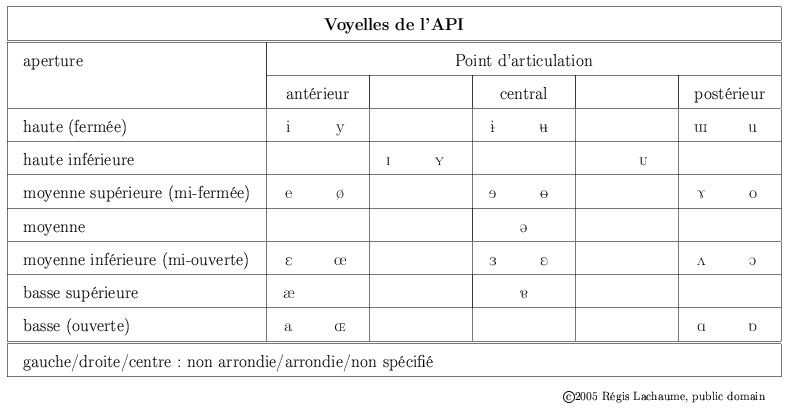
The pronunciation of a French word varies depending on the words that precede or follow it4. This page covers nasal vowels, the mute e, the r, silent final consonants and liaison, as one of the guides in the diction section.
Vowels: oral and nasal
Standard French contrasts up to 13 oral vowels and up to 4 nasal vowels1. Most French syllables are open and end in a vowel3.
Oral vowels
| IPA | Example words |
|---|---|
| [a] | patte, là, femme6 |
| [ɑ] | pâte, glas6 |
| [e] | clé, et, chez, aller, pied, journée6 |
| [ɛ] | baie, faite, mettre, renne, crème, peine, violet6 |
| [ɛː] | fête, maître, reine6 |
| [ə] | reposer, monsieur, faisons6 |
| [i] | si, île, régie, pays, fils6 |
| [œ] | sœur, jeune6 |
| [ø] | ceux, jeûner, queue6 |
| [o] | saut, haut, bureau, chose, tôt, cône6 |
| [ɔ] | sort, minimum, pomme6 |
| [u] | coup, roue6 |
| [y] | tu, sûr, rue6 |
Nasal vowels
| IPA | Example words |
|---|---|
| [ɑ̃] | sans, champ, vent, temps, Jean6 |
| [ɛ̃] | vin, impair, pain, plein6 |
| [œ̃] | Some speakers merge it with [ɛ̃], especially in the northern half of France1 |
| [ɔ̃] | son, nom6 |
Nasal vowels
The phonetic qualities of the back nasal vowels differ from those of the corresponding oral vowels1. The front pair is less stable: some speakers merge [œ̃] with [ɛ̃], especially in the northern half of France1.
Spelling points to the nasal. A vowel before a single final n is nasal, so pain and vin carry the [ɛ̃] vowel3. That vowel is spelled aim, ain, eim, ein, im, in, ym and yn3. The nasal in enfant, Caen and paon is spelled an, am, en, em, aen and aon3, and the nasal in son and nom is spelled on or om3. When the nasal consonant is doubled, the vowel is oral: une and Anne have an oral vowel, and so do année and ami3.
The mute e
The mute e is the schwa, and the letter e writes it3. The schwa is not necessarily a distinctive sound in French1. When it is sounded, it often merges with one of the mid front rounded vowels1, and the French vowel transcribed as schwa is closer to [ø]7. Schwa is written e with three exceptions: monsieur, faisant and the forms of faire3. The letter e can also be pronounced [e] or [ɛ] depending on context3.
Whether the mute e sounds is a matter of register and speed. The higher the register, the more schwas are kept, and the faster the speech, the more are dropped3. A schwa is kept to avoid a double consonant3. The mute e can be forbidden, obligatory or optional depending on context3.
Elision is the omission of a final, unstressed -e in a word followed by a word beginning with a vowel or a mute h2. Elision is common both in lyric diction and in everyday speech2.
The French r
The most common French r is the voiced uvular fricative, written [ʁ]1. Singing treats it separately: traditionally operatic singers avoided it because of its effect on vowel production, while some modern French lyric singers use it in art song and opera9. In speech it has a voiceless positional allophone, written [χ], in the positions before or after a voiceless obstruent or at the end of a sentence1. The alveolar trill [r] and the alveolar tap [ɾ] are considered dialectal realisations1.
Consonants
| Spelling | IPA | Example |
|---|---|---|
| r | [ʁ] | most common realisation1 |
| r before or after a voiceless consonant, or at the end of a sentence | [χ] | devoiced variant1 |
| liaison consonant | [z] | des amis4 |
| final n, silent | none | million5 |
| final t, silent | none | art5 |
| h | none | never pronounced as in English2 |
Spelling guides the other consonants. The k sound is spelled k, ck, c, cc or ch; the sh sound is spelled ch, sch or sh; the soft j sound is spelled j, or g before i, y or e3. The palatal nasal is spelled gn3. A double letter stands for one phonetic symbol3. The palatal lateral of some dialects has merged with the glide j in standard French1. Word-final [k] may be palatalised1, and a word spoken with emphatic stress can geminate its first syllable-initial consonant1.
Many words with silent final consonants have lost them entirely: neither the n in million nor the t in art is ever pronounced5. A final consonant that is always pronounced links to the initial vowel of the next word3. Between a verb and the pronoun that follows it, liaison is obligatory: vient-elle, comprend-il3.
Liaison
Liaison is a sandhi process in which word-final consonants are not pronounced unless they are followed by a word beginning with a vowel1. Most liaison arises from a mute word-final consonant that used to be pronounced5. Silent final consonants may be pronounced in some syntactic contexts when the following word begins with a vowel or non-aspirated h5.
The result of liaison is a regular alternation of consonant and vowel sounds4. In des amis, liaison links the two words with the sound [z]4. Liaison is a phonological process by which an initial vowel brings out a normally silent final consonant3. It is also subject to wide stylistic variation5, and it is primarily active in high-frequency word pairs5.
Obligatory, forbidden and optional
There are 3 types of liaison3. Obligatory liaisons occur inside a grammatical group, forbidden liaisons are never made, and optional liaisons depend on register3.
| Type | Context | Examples |
|---|---|---|
| Obligatory | Determiner + noun | les enfants [le.z‿ɑ̃.fɑ̃]5 |
| Obligatory | Determiner + adjective | trois anciens ministres3 |
| Obligatory | Pronoun + verb | nous avons [nu.z‿a.vɔ̃]5 |
| Obligatory | Verb + following pronoun, including the imperative | dort-elle [dɔʁ.t‿ɛl]; vient-elle, comprend-il; allez-y, reprenez-en5,3 |
| Obligatory | After a monosyllabic preposition or adverb | sous un arbre; chez elle, but not chez Anne3 |
| Obligatory | Fixed expressions | États-Unis [e.ta.z‿y.ni]; nuit et jour5,3 |
| Forbidden | Non-pronominal subject + verb | Mes amis arrivent, no link after amis5 |
| Forbidden | After a singular noun, and after et | Comment allez-vous and Quand est-ce que are the two exceptions that link3 |
| Forbidden | Before an aspirated h | haricot, héros, haleter5 |
| Optional | Everything else; link in careful, formal speech | pas encore may be present or absent5 |
Optional liaison signals formal register5.
When not to link
A liaison should not be made just because a word ends in a silent consonant and the next one starts with a vowel5. Complete knowledge of all the types of liaison is essential to singing French text correctly2. Native speakers often do not know the rules of liaison2.
Sung versus spoken
Poetry, whether said or sung, takes every liaison except the impossible ones5, so verse and song settings call for the optional links as well as the obligatory ones5. The h has its own rule: a mute h behaves like a vowel for liaison, and the French h is never pronounced as in English2.
Common mistakes for English speakers
- Nasal vowel built from an oral vowel plus n. The nasal vowels differ in quality from their oral partners1.
- An English h. French never pronounces the h as English does2.
- Linking everything. Silent final consonant plus vowel is not enough reason for liaison5.
- Skipping an obligatory liaison. A verb and the pronoun after it link: vient-elle, comprend-il3.
- Pronouncing every final consonant. Neither the n in million nor the t in art is ever pronounced5.
- Schwa as English “uh”. The French vowel is closer to [ø]7.
- An American r. The standard r is uvular [ʁ]; trill and tap are dialectal in speech1. Operatic tradition avoided the uvular r in singing, and modern French singers have recorded both a uvular approximant and a uvular trill in Fauré songs9.
- Treating each word alone. French pronunciation varies with the words before and after4.
Next steps
Read the symbols in IPA for singers, then compare with the rules in Italian diction. For the verse behind the songs, Understanding French Verse is aimed at singers and singing teachers interested in the French song repertoire8. It uses examples from well known song settings to set out the basics of French versification8. For scores, work through Manon or Werther. The course handout and the LAITS liaison page cover the liaison rules above3,4.
Read next
IPA for singers: what the International Phonetic Alphabet is and how to use it
The International Phonetic Alphabet for singers: why one symbol equals one sound, the marks that matter, singers' charts and where to find IPA texts.
Lyric dictionItalian diction for singers: vowels, consonants, IPA and double-consonant rules
Italian lyric diction in one page: the 7 vowels, open and closed E and O, the c and g rules, gli, gn, sc, double consonants and the rolled r.
Opera guidesManon: synopsis, roles, arias and diction notes
Massenet's Manon in one page: librettists, premiere, voice types, act-by-act synopsis, the famous numbers and French diction notes.
Questions singers ask
How many vowels does French have?
Standard French contrasts up to 13 oral vowels and up to 4 nasal vowels1. Some speakers merge the nasal [œ̃] with [ɛ̃], especially in the northern half of France, so the working number of nasals can be lower1.
What is liaison in French?
Liaison is the pronunciation of a word's usually silent final consonant because the next word begins with a vowel or a mute h2. It links the words with a consonant sound, as with [z] in des amis4.
Do I have to make every liaison when I sing?
No. A liaison should not be made just because a word ends in a silent consonant and the next one starts with a vowel5. Make the obligatory ones, skip the forbidden ones, and in verse, said or sung, add the optional ones too3,5.
Is the h pronounced in French?
Never as in English2. Liaison treats a mute h like a vowel, so the silent final consonant before it is pronounced2.
What is the mute e in French?
The mute e is the schwa, written as the letter e3. It is not necessarily a distinctive sound in French and often merges with one of the mid front rounded vowels1. A higher register keeps more schwas, and faster speech drops more of them3.
Which r do French singers use?
The most common French r is the voiced uvular fricative [ʁ]1. The alveolar trill [r] and the alveolar tap [ɾ] are considered dialectal realisations1. Traditionally operatic singers avoided the uvular r because it disturbs vowel production, yet some modern French lyric singers use it in art song and opera9.
Sources
- French phonology · Wikipedia · en.wikipedia.org · checked 19 October 2026
- Liaison and the Singular Noun / Singing in French: Linking Words (Nathalie Doucet) · Nathalie Doucet, singing and diction teacher · nathaliedoucet.live · checked 19 October 2026
- Introduction à la phonétique française (course handout, Ayoun) · University course handout (hosted by Università di Trieste Moodle) · moodle2.units.it · checked 19 October 2026
- French pronunciation: liaison (LAITS, UT Austin) · University of Texas at Austin, LAITS · laits.utexas.edu · checked 19 October 2026
- Liaison (French) · Wikipedia · en.wikipedia.org · checked 19 October 2026
- Help:IPA/French · Wikipedia · en.wikipedia.org · checked 19 October 2026
- Schwa · Wikipedia · en.wikipedia.org · checked 19 October 2026
- Manners of rhotic articulation in French lyric singing (Kochetkova, ExLing 2018) · Saint Petersburg State University, ExLing 2018 proceedings · pureportal.spbu.ru · checked 20 October 2026
- Understanding French Verse - Western University library guide · Western University Libraries · guides.lib.uwo.ca · checked 20 October 2026
Photos (1)
- Régis Lachaume, Public domain

Translations of libretto lines on this page are our own. How we check facts · Report an error.