Opera guides
Carmen: synopsis, roles, arias and diction notes
Bizet's Carmen in one page: librettists, premiere, voice types, synopsis by act, the Habanera, Seguidilla and Toreador Song, editions, French diction.
By Diction Desk editors · Published · Updated · Checked against 6 sources
Carmen is an opera in four acts by the French composer Georges Bizet, with a libretto by Henri Meilhac and Ludovic Halévy based on Prosper Mérimée's novella1. It was first performed by the Opéra-Comique in Paris on 3 March 18751. The Habanera and Seguidilla in Act 1 and the Toreador Song in Act 2 are among its best-known arias1.
- Composer
- Georges Bizet1
- Librettists
- Henri Meilhac and Ludovic Halévy1
- Premiere
- 3 March 1875, Opéra-Comique, Paris1
- Language
- French, in the genre of opéra comique1
- Acts
- 41
Contents
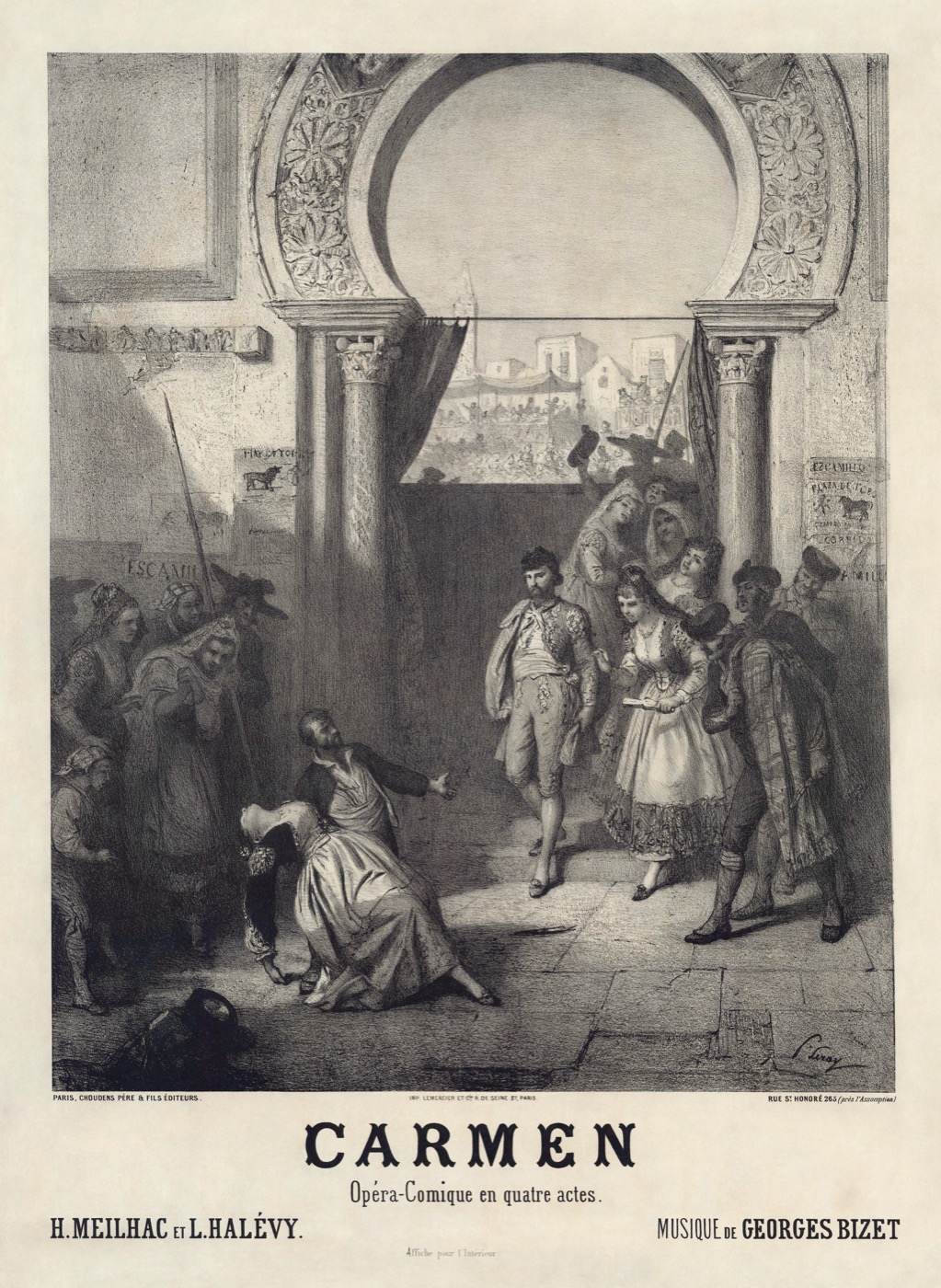
Carmen has become one of the most popular and frequently performed operas in the classical canon1. Carmen is a new type of operatic heroine representing a new kind of love6. This page is one of many guides in the operas section.
At a glance
Carmen is an opera in four acts by the French composer Georges Bizet1. The libretto was written by Henri Meilhac and Ludovic Halévy, based on the novella of the same title by Prosper Mérimée, dating from 18451. Meilhac wrote the dialogue and Halévy the verses1. Bizet enlisted both men for the libretto; they were known for their collaborations with Jacques Offenbach on comic operas5. Bizet and the two librettists were all in Paris during 1873 and could easily meet1.
The opera is written in the genre of opéra comique, with musical numbers separated by dialogue1. It is set in southern Spain1. The story unfolds in Seville in the early 19th century5, in a remote frontier town in the 1820s, as English National Opera sets it3. Bizet had never been to Spain when he wrote Carmen4. He studied Spanish folk music, incorporated dance rhythms like the Habanera, and worked to infuse the opera with authentic Spanish elements, as the Royal Opera House essentials outline5.
Roles and voice types
| Role | Voice type | Notes | Premiere singer |
|---|---|---|---|
| Carmen | Mezzo-soprano | A Gypsy girl and smuggler; fiery, free-spirited1,3 | Célestine Galli-Marié1 |
| Don José | Tenor | Corporal of Dragoons1 | Paul Lhérie1 |
| Escamillo | Bass-baritone | Toreador1 | A young Belgian-born baritone already known for demanding roles1 |
| Micaëla | Soprano | José’s childhood sweetheart6 | |
| Zuniga | José’s captain6 | ||
| Frasquita and Mercédès | Carmen’s friends and fellow smugglers1 |
The premiere conductor was Adolphe Deloffre1. Carmen follows a free-spirited and independent woman and her passionate and destructive love affair with the rule-abiding Don José5.
Some casting facts shape how the roles are sung. In Act 1 José is a simple countryman, aligned musically with Micaëla1. In Act 2 he shows greater toughness, the result of his experiences as a prisoner1. The first singer approached for Carmen turned the role down after learning she would have to die on stage4. Galli-Marié, a demanding and at times tempestuous performer, proved a staunch ally of Bizet1. Bizet was reportedly contemptuous of the music he wrote for Escamillo1. Micaëla does not feature in Mérimée’s version of the story1.
Synopsis
Act 1
In a square in Seville, a group of soldiers relax, waiting for the changing of the guard1,6. Micaëla appears, seeking José, and leaves1. As the factory bell rings, the cigarette girls emerge and exchange banter with young men in the crowd1. A brief phrase from the fate motif announces Carmen’s entrance1.
Her entrance aria is the habanera L’amour est un oiseau rebelle, a provocative piece about love that cannot be tamed1. Before returning to the factory, she throws a flower to José, who has been ignoring her until now1,3. Micaëla returns and gives José a letter and a kiss from his mother; in it he reads that his mother wants him to return home and marry Micaëla1.
A fight breaks out in the factory, and the women accuse Carmen of drawing a knife3. José is ordered to guard her. Carmen promises to meet him later for a private rendezvous if he lets her escape, and in the Seguidilla she sings of a night of dancing and passion with her lover at Lillas Pastia’s tavern6,1. José is arrested for dereliction of duty1.
Act 2
Two months have passed1. Carmen and her friends Frasquita and Mercédès are entertaining Zuniga and other officers at Lillas Pastia’s inn1. Zuniga mentions that José is out of jail, where he served two months for helping Carmen escape6. The popular matador Escamillo passes by in a procession and is soon smitten with Carmen6. He sings the Toreador Song, “Votre toast,” describing fame and victory in the ring4.
After the inn has closed for the night, the gypsies plan their smuggling activities6. Frasquita and Mercédès are keen to help, but Carmen refuses, since she wishes to wait for José1. José shows her the flower she threw to him in the square1, and sings the Flower Song5. He draws his sword against his captain and has no choice but to join Carmen and the smugglers6.
Act 3
The scene is a wild spot in the mountains, where black-market smugglers come by night to the border1,3. Carmen has become bored with José and tells him scornfully to go back to his mother1. Carmen’s cards predict death; she deals again, but the message is the same6. Micaëla enters with a guide, determined to rescue José from Carmen1.
Escamillo and Micaëla converge on the encampment, seeking Carmen and José respectively3. José’s pleasure at meeting the bullfighter turns to anger, and when he learns of Escamillo’s amorous intent he pulls out a dagger, and the two men fight1,6. José agrees to return home only when he learns that his mother is dying6. Escamillo invites the whole party to his next bullfight3.
Act 4
A square in Seville. At the back stand the walls of an ancient amphitheatre, and a crowd including Zuniga, Frasquita and Mercédès awaits the arrival of the bullfighters1. The toreros enter to enthusiastic acclaim3. Escamillo enters with Carmen, and they express their mutual love1.
After Escamillo has entered the arena, Carmen meets José3. He asks her to start a new life with him, but she insists everything is over between them6. She taunts him, and beside himself with rage he stabs her as the crowd inside cheers the triumphant matador3,6.
Arias and ensembles
| Number | First line (French) | Character | Act |
|---|---|---|---|
| Habanera | L’amour est un oiseau rebelle1 | Carmen | 1 |
| Seguidilla | Près des remparts de Séville4 | Carmen | 11 |
| Toreador Song | Votre toast, je peux vous le rendre1 | Escamillo | 2 |
| Flower Song | Don José | 25 |
The Habanera, the Seguidilla and the Toreador Song are among the best known of all operatic arias1. The Habanera is Carmen’s Act 1 aria on the uncontrollable and unpredictable nature of love5. The Toreador Song is endlessly hummable5.
The habanera was a dance brought back to Spain from Cuba, characterized by a repeated dotted rhythm4. Bizet took its melody to be a genuine folk tune; when he learned its recent origin as a cabaret song, he added a note to the vocal score crediting Yradier1. The Seguidilla uses flamenco rhythms4. Bizet provided a new opening line for the Seguidilla1.
Lines to study
Halévy lived from 1 January 1834 to 7 May 1908, so the text is in the public domain2. One short line is enough for a diction drill. The translation is our own and literal.
| Original | Our translation |
|---|---|
| L’amour est un oiseau rebelle1 | Love is a bird that rebels |
Music
Act 2 begins with a short prelude based on a melody that José will sing offstage before his next entry1. The Seguidilla and other numbers use the rhythms and instrumentation associated with Spanish dance1. Carmen’s defiant Coupe-moi, brûle-moi is based on a genuine folksong1. The opera has since been widely acclaimed for brilliance of melody, harmony, atmosphere and orchestration1.
Bizet changed the music repeatedly in rehearsal, sometimes at the request of the orchestra, who found some of it impossible to perform1. The premiere orchestra numbered 62 or 57 musicians, depending on whether some off-stage players doubled1. Early critics complained about “Wagnerism” and the subordination of the voice to the noise of the orchestra1.
Language and diction notes
The libretto is in French, so the rules in French diction for singers apply. Carmen is an opéra comique, with musical numbers separated by dialogue1. L’amour est un oiseau rebelle means “Love Is a Rebellious Bird”4. The Seguidilla opens with Près des remparts de Séville4. The Toreador Song is known by its first words, Votre toast4.
Editions to study from
At his death Bizet was still in the midst of revising his score, and there is still no definitive edition1. A later performing tradition replaced the original dialogue with recitatives composed by Ernest Guiraud1. Recitatives by Guiraud and parts of the original dialogue became the norm outside France for most of the next century1. That choice decides whether a production uses spoken dialogue or sung recitative1.
Writing, premiere and reception
Bizet began composing in or around January 1873, with rehearsals due to begin in October1. He also changed the libretto, reordering sequences and imposing his own verses1. The Opéra-Comique, a theatre known for light, family-friendly works, commissioned him in the early 1870s5. Rehearsals began in October 1874, and the first night was fixed for 3 March 18751.
Carmen was first performed by the Opéra-Comique in Paris on 3 March 18751. Its breaking of conventions shocked and scandalised its first audiences1. The depictions of proletarian life, immorality and lawlessness, and the murder of the heroine on stage, broke new ground in French opera1. The critic Ernest Newman wrote later that the audience was “shocked by the drastic realism of the action”1. Halévy recorded “coldness” after the toreador’s song in Act 21. Carmen did not go down well at first4. Opera North’s Carmen guide covers the premiere in short form.
Massenet sent Bizet a congratulatory note after the premiere1. Bizet retorted that the bourgeois audience had not understood a word of the work he wrote for them1.
Afterlife
Bizet died suddenly at the age of 36, after the 33rd performance, unaware that the work would achieve international acclaim within ten years1. He died of a heart attack on 3 June 1875, just three months after the premiere5. The opera has been recorded many times since the first acoustic recording in 19081.
The 1875 Vienna production was a great success with the city’s public1. Brahms apparently saw the opera twenty times4. Carmen became a permanent fixture in the Brussels repertory after its 1878 return1. The Opéra-Comique manager Carvalho thought the work immoral and refused to reinstate it, and was later condemned by critics for a travesty of the opera1.
Ludovic Halévy (1834 to 1908) was a French author and playwright, known for his collaborations with Henri Meilhac on the libretti for Bizet’s Carmen2.
Where to go next
For another famous heroine on the Italian stage, read the La traviata guide. Then compare the vocal writing with La bohème, and keep French diction for singers open while you work. The Kennedy Center’s Carmen overview gives a classroom-level outline of the same four acts6.
