Opera guides
La bohème: synopsis, roles, arias and diction notes
Puccini's La bohème in one page: composer, librettists, premiere, voice types, act-by-act synopsis, the famous arias and Italian diction notes.
By Diction Desk editors · Published · Updated · Checked against 8 sources
La bohème is an Italian opera in four acts by Giacomo Puccini, composed between 1893 and 1895 to a libretto by Luigi Illica and Giuseppe Giacosa1,2. It premiered on 1 February 1896 at the Teatro Regio in Turin1. Its arias include Rodolfo's Che gelida manina and Mimì's Sì, mi chiamano Mimì1.
- Composer
- Giacomo Puccini1
- Librettists
- Luigi Illica and Giuseppe Giacosa1
- Premiere
- 1 February 1896, Teatro Regio, Turin1
- Language
- Italian1
- Acts
- 41
- Setting
- Paris, around 18301
Contents
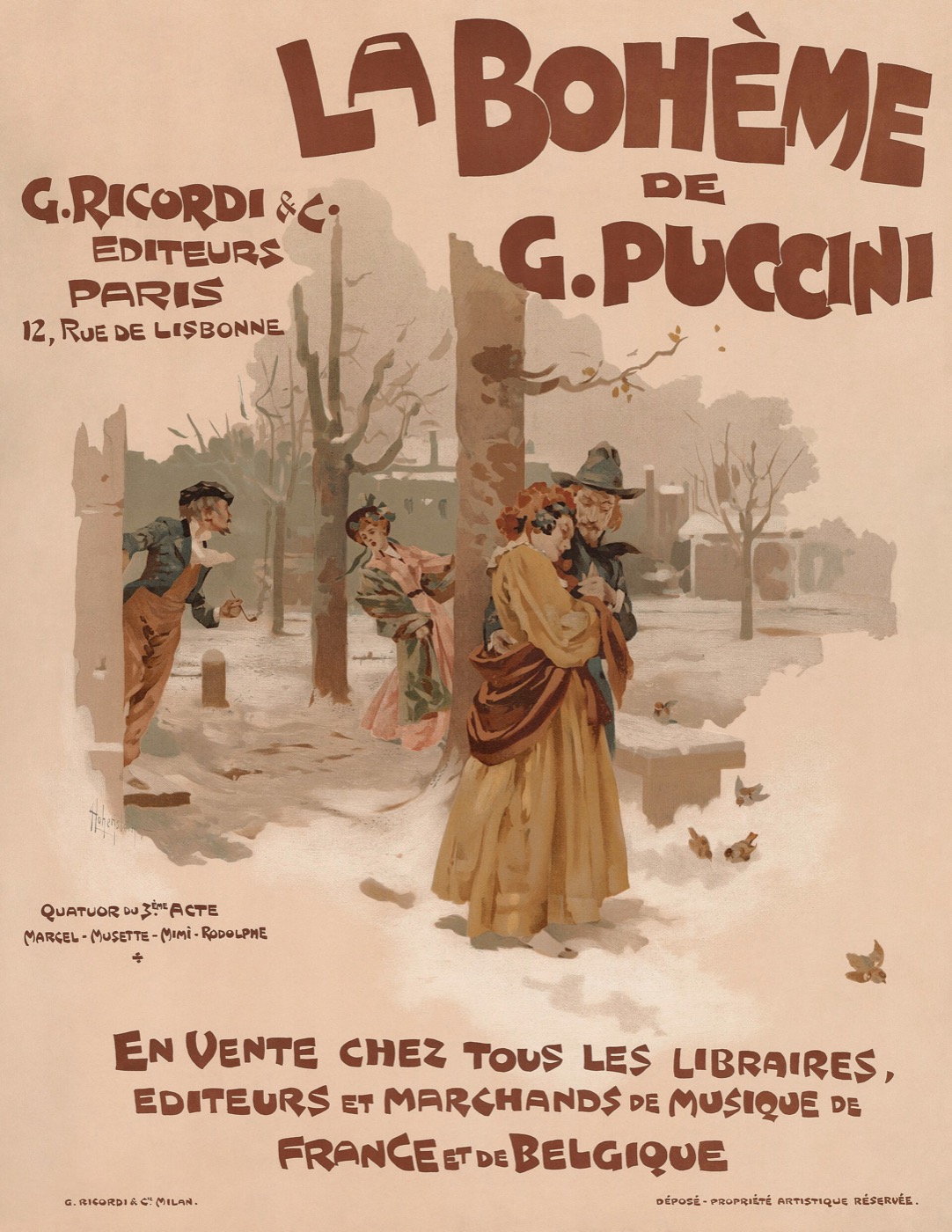
Puccini’s La bohème has become part of the standard Italian opera repertory and is among the most frequently performed operas worldwide1. Opera North ranks it as the fourth most frequently performed opera worldwide5. This page gives the facts you need before you open the score, one of many guides in the operas section.
At a glance
Giacomo Puccini composed La bohème between 1893 and 1895 to an Italian libretto by Luigi Illica and Giuseppe Giacosa1. By December 1895 the score was finally finished5. The opera has four acts and is based on Henri Murger’s Scènes de la vie de bohème (1851)1. The story is set in Paris around 18301. The title means “The Bohemian”3.
The world premiere took place on 1 February 1896 at the Teatro Regio in Turin, conducted by the 28-year-old Arturo Toscanini1. Puccini labeled the divisions quadri, tableaux or images, rather than atti (acts)1. This page uses “act” because that is how the libretto sections are commonly cited.
Roles and voice types
Two principals carry the score: Mimì, a seamstress and soprano, and Rodolfo, a poet and tenor5. Musetta, a singer and Marcello’s on/off lover, is a second soprano5. Marcello, a painter, is a baritone5. Colline, a philosopher, is a bass5.
| Role | Voice type | Notes | Premiere singer |
|---|---|---|---|
| Rodolfo | Tenor | A poet1 | Evan Gorga1 |
| Mimì | Soprano | A seamstress1 | Cesira Ferrani1 |
| Marcello | Baritone | A painter1 | Tieste Wilmant1 |
| Musetta | Soprano | A singer1 | Camilla Pasini1 |
| Schaunard | Baritone | A musician1 | Antonio Pini-Corsi1 |
| Colline | Bass | A philosopher1 | Michele Mazzara1 |
| Benoît | Bass | The friends’ landlord1 | Alessandro Polonini1 |
| Alcindoro | Bass | A state councillor1 | |
| Parpignol | Tenor | A toy vendor1 | Dante Zucchi1 |
| Customs sergeant | Bass | Small role1 | Felice Foglia1 |
The first Rodolfo, Gorga, was unable to accommodate the high tessitura, and the music had to be transposed down for him1. Leoncavallo completed his own version of the story in which Marcello was sung by a tenor and Rodolfo by a baritone1. Each character has a signature tune, a leitmotif5.
Synopsis
Act 1
On Christmas Eve, Marcello and Rodolfo try to work in their freezing loft4. Marcello is painting while Rodolfo gazes out of the window, and they complain of the cold1. Rodolfo volunteers to warm them both up by burning the manuscript of his play3. Schaunard, the musician of the group, arrives with food, wine and cigars1. The rent money is divided for their evening out at Cafe Momus1. The friends get the landlord Benoît drunk, draw out the story of his marital infidelity and throw him out in mock indignation4. They leave Rodolfo behind to finish an article3.
Mimì appears at the door. Her candle goes out, Rodolfo helps her up and relights it, and their hands touch4. She realizes she has dropped her key somewhere and the two search for it in the darkness6. Rodolfo, eager to spend time with the girl, finds the key and pockets it, feigning innocence1. He sings Che gelida manina, and the girl gives her name in Sì, mi chiamano Mimì1. The act closes with their duet, O soave fanciulla1. Act 1 features three showstoppers back to back5. In Che gelida manina Rodolfo introduces himself5. The love duet O soave fanciulla culminates in a floated high C for the soprano5.
Act 2
The friends dine at Cafe Momus1. A great crowd, including children, has gathered with street sellers announcing their wares1. Musetta sings her waltz, Quando me’n vo’1. To be rid of Alcindoro for a bit, she pretends to be suffering from a tight shoe and sends him to the shoemaker1. Musetta instructs the Bohemians to add their bill to hers, and Alcindoro can settle them both3. When a military parade passes by, the reunited lovers and their friends slip away into the crowd and leave Alcindoro to pay the bill6.
Act 3
Marcello and Musetta are now living together in a tavern on the outskirts of Paris, near a toll-gate6. Mimì appears, coughing violently, and her persistent coughing gives away her hiding place1,6. Rodolfo believes she is so ill that her only chance of recovery is to leave him and his life of poverty3. Rodolfo, in his poverty, can do little to help Mimì and hopes that his pretended unkindness will inspire her to seek another, wealthier suitor1. As a compromise, they agree to remain together until the spring, when the world is coming to life again1. Mimì sings Donde lieta uscì1.
Act 4
Back in the garret some months later, Musetta and Marcello leave to sell Musetta’s earrings in order to buy medicine1. Colline decides to sell his beloved overcoat to pay for a doctor, and Schaunard goes with him6. Mimì, who took up with a wealthy viscount after leaving Rodolfo in the spring, has left her patron1. Musetta found her in the street, severely weakened by her illness, and Mimì begged Musetta to bring her to Rodolfo1. Left alone, Rodolfo and Mimì recall their first meeting6. Mimì tells Rodolfo that her love for him is her whole life1. Schaunard discovers that Mimì has died, and Rodolfo sobs helplessly as the curtain falls1.
The famous arias
| Aria (first line) | Role | Act | Meaning |
|---|---|---|---|
| Che gelida manina | Rodolfo | 1 | “How cold this little hand is”1 |
| Sì, mi chiamano Mimì | Mimì | 1 | “They name me Mimì”1 |
| O soave fanciulla | Rodolfo and Mimì (duet) | 1 | “O sweet young girl”1 |
| Quando me’n vo’ | Musetta | 2 | “When I walk about”1 |
| Addio dolce svegliare alla mattina | Mimì, Rodolfo, Musetta, Marcello (quartet) | 3 | “Farewell, sweet waking in the morning”1 |
| Donde lieta uscì | Mimì | 3 | “Out of this place she left happy”1 |
| O Mimì, tu più non torni | Rodolfo and Marcello (duet) | 4 | “O Mimì, you come back no more”1 |
| Vecchia zimarra | Colline | 4 | “Aged overcoat”1 |
Enrico Caruso, who was closely associated with the role of Rodolfo, recorded Che gelida manina in 19061. That aria has been recorded by nearly 500 tenors in at least seven different languages between 1900 and 19801. Caruso and Antonio Scotti recorded O Mimì, tu più non torni in 19071. The 1973 RCA Victor recording conducted by Sir Georg Solti, with Montserrat Caballé as Mimì and Plácido Domingo as Rodolfo, won the 1974 Grammy Award for Best Opera Recording1. A 1936 recording in English, released by Columbia Records, features Lisa Perli as Mimì and Heddle Nash as Rodolfo1.
Lines to study
| Original | Our translation |
|---|---|
| Che gelida manina1 | How cold this little hand is |
| Sì, mi chiamano Mimì1 | Yes, they name me Mimì |
| O buon Marcello, aiuto!1 | Kind Marcello, help! |
| Sono andati?1 | Are they gone? |
Both librettists are long dead: Giacosa died on 1 September 1906 and Illica on 16 December 19192,7.
Language and diction notes
The libretto is in Italian, so the rules in Italian diction for singers apply throughout. Puccini wrote the opera in his native Italian3. ENO performs it in English with the words displayed above the stage, which is a useful reminder that a singing translation is a different text from the libretto3.
Background, premiere and versions
Murger’s book was in the public domain at the time, Murger having died without heirs1. The libretto is largely the librettists’ own work: major sections of acts two and three are their invention1. As in the play, it combines two characters from the novel, Mimì and Francine, into the single character of Mimì1. Illica supplied the plot and dialogue, and Giacosa polished the libretto into verses2. Giacosa (1847 to 1906) was a poet, playwright and librettist2. Illica (1857 to 1919) wrote for Puccini, and his most famous libretti are those for La bohème, Tosca, Madama Butterfly and Andrea Chénier7. The partnership was not easy: Giacosa resigned three times and Illica also came close5.
The libretto for a missing act, discovered in 1957, fits between Acts 2 and 3 and is set at Musetta’s house, where Mimì is introduced to a wealthy viscount5. It explains Rodolfo’s jealous remarks to Marcello in Act 31.
Puccini studied at the Milan Conservatoire from 1880 to 18835. He had never actually been to Paris when he wrote the opera5.
The initial response of the audience at the first performance was subdued, and critical responses were polarized1. The first performance outside Italy was at the Teatro de la Ópera in Buenos Aires on 16 June 18961. The Metropolitan Opera staged the work for the first time on 26 December 1900 with Nellie Melba as Mimì1. The Opéra-Comique alone had presented the opera one hundred times by 19031. La bohème was the last opera performed in the Met’s original 1883 building, on 16 April 19661.
Puccini was born in Lucca in 1858 and died in Brussels on 29 November 1924, aged 658. The news of his death reached Rome during a performance of La bohème, and the orchestra played Chopin’s Funeral March for the stunned audience1. In 1946, 50 years after the premiere, Toscanini conducted a commemorative performance on radio1. The musical Rent by Jonathan Larson, which won the 1996 Tony Award for Best Musical, is based on La bohème, with tuberculosis replaced by AIDS1,5.
Productions move the setting. Luhrmann’s version was set in 1957 rather than the original period of 18301. A production on Opera North’s page transports the action to late 1950s Paris5. The libretto’s period stays Paris around 18301.
Where to go next
Two more Puccini operas to study next are Tosca and Madama Butterfly. Illica and Giacosa wrote the libretti for both2,7. For another synopsis, read the LA Opera guide to La bohème and Opera Colorado’s characters and plot guide.
