Opera guides
Tosca: synopsis, roles, arias and diction notes
Puccini's Tosca in one page: librettists, premiere, voice types, who the villain is, the famous arias and Italian diction notes for singers.
By Diction Desk editors · Published · Updated · Checked against 8 sources
Tosca is an opera in three acts by Giacomo Puccini to an Italian libretto by Luigi Illica and Giuseppe Giacosa1. It premiered at the Teatro Costanzi in Rome on 14 January 19001. Its arias include Cavaradossi's Recondita armonia and E lucevan le stelle and Tosca's Vissi d'arte, with two great arias in Vissi d'arte and E lucevan le stelle1.
- Composer
- Giacomo Puccini1
- Librettists
- Luigi Illica and Giuseppe Giacosa1
- Premiere
- 14 January 1900, Teatro Costanzi, Rome1
- Language
- Italian1
- Acts
- 31
- Running time
- Approximately 2 hours 40 minutes2
Contents
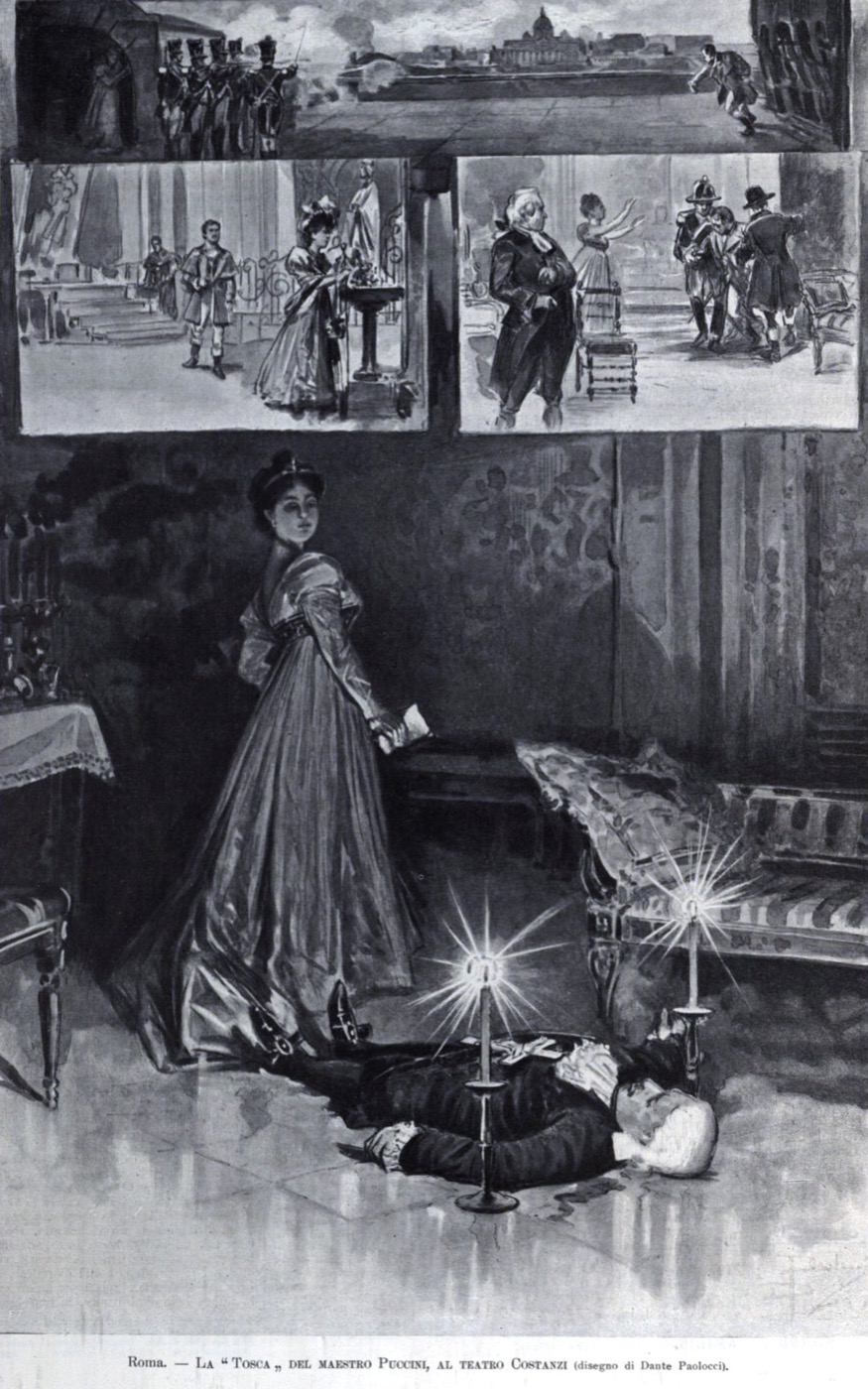
Puccini composed the political thriller Tosca directly after La bohème4, and it is now the fifth most frequently performed opera worldwide2. This page gives the facts to check before you open the score, one of the guides in the operas section.
At a glance
Puccini wrote the opera in three acts to an Italian libretto by Luigi Illica and Giuseppe Giacosa1. It is based on Victorien Sardou’s 1887 French-language play La Tosca1. Sardou (1831 to 1908) was a French dramatist who collaborated with the actress Sarah Bernhardt6. The opera is a melodramatic piece set in Rome in June of 18001,4. The action takes place over less than 24 hours2. Illica (1857 to 1919) was a librettist who wrote for Puccini7, and Giacosa (1847 to 1906) was a poet, playwright and librettist8.
Roles and voice types
The three main characters are Tosca, Cavaradossi and Scarpia5. Floria Tosca is Rome’s star opera singer, a soprano2. Mario Cavaradossi is a painter and Tosca’s lover, a tenor2. Baron Scarpia is the chief of police, a baritone2. Cesare Angelotti, an escaped political prisoner, is a bass, as is the Sacristan who looks after the church2.
| Role | Voice type | Notes | Premiere singer |
|---|---|---|---|
| Floria Tosca | Soprano | An opera singer3 | Hariclea Darclée1 |
| Mario Cavaradossi | Tenor | A painter, Tosca’s lover1,3 | Emilio De Marchi1 |
| Baron Scarpia | Baritone | Chief of police1 | Eugenio Giraldoni1 |
| Cesare Angelotti | Bass | Former Consul of the Roman Republic, an escaped political prisoner1 | Ruggero Galli1 |
| Spoletta | Tenor | A police agent1 | Enrico Giordano1 |
| Sciarrone | Bass | Another agent1 | Giuseppe Gironi1 |
| A Shepherd boy | Boy soprano | Sings offstage in Act 31 | Angelo Righi1 |
| A Jailer | Bass | Appears in Act 31 | Aristide Parassani1 |
| A Sacristan | Bass | Looks after the church2 | Ettore Borelli1 |
Scarpia is the villain: the sadistic police chief, and one of opera’s most depraved characters5. The young Enrico Caruso had hoped to create the role of Cavaradossi but was passed over in favor of the more experienced Emilio De Marchi1.
Synopsis
Act 1
Act 1 takes place in the church of Sant’Andrea della Valle2. Cesare Angelotti, former consul of the Roman Republic and now an escaped political prisoner, takes refuge in the church1. The painter Mario Cavaradossi arrives to continue work on his picture of Mary Magdalene1. He sings Recondita armonia, the “hidden harmony”1. Cavaradossi gives Angelotti a key to his villa, suggesting that he hide in a disused well in the garden1. Cavaradossi and Angelotti flee just before the arrival of the police chief Baron Scarpia5. Later the empty food basket and a fan bearing the Attavanti coat of arms are found in the chapel1. When Tosca arrives, Scarpia, sensing her tendency towards jealousy, decides to play the two lovers against each other4. He convinces her Cavaradossi has been unfaithful and sends her chasing after him in a jealous rage4. The act ends as a procession enters the church singing the Te Deum1. The Te Deum, which closes Act 1, contrasts the sacred and the profane2.
Act 2
The act is set in Scarpia’s apartment in the Palazzo Farnese1. When Cavaradossi cries out in pain as he is tortured, Tosca reveals where Angelotti is hidden5. She tells Scarpia to search the well in the garden of Cavaradossi’s villa1. Scarpia, now alone with Tosca, proposes a bargain: if she gives herself to him, Cavaradossi will be freed1. Scarpia explains there will be a mock execution, but slyly he orders his men to prepare a real one4. She sings Vissi d’arte, “I lived for the sake of art”1. Tosca spies a dagger, which she quietly palms4. She stabs him, crying “this is Tosca’s kiss!”1. Once she is certain he is dead, she says ruefully “now I forgive him”1. She leaves with the letter of safe conduct4.
Act 3
The voice of a shepherd is heard as church bells signal dawn5. The shepherd boy sings offstage, in Romanesco dialect, Io de’ sospiri1. A jailer informs Cavaradossi that he has one hour to live1. He bribes the jailer for pen and paper to write Tosca a final love letter4. He sings E lucevan le stelle, “The stars were glittering”1. Tosca rushes in with news that the two of them have safe passage and that the execution will only be for show4. Cavaradossi must feign death, after which the lovers can flee together before Scarpia’s body is discovered1. Unlike Floria, Cavaradossi knows that Scarpia never yields, though he pretends to believe in order to delay the pain for Tosca1. The firing squad shoots and Cavaradossi drops to the ground4. Tosca leaps from the parapet of the Castel Sant’Angelo, crying out that she will meet Scarpia in God’s presence4,5. The 1896 libretto also offers a different ending, in which Tosca does not die but instead goes mad1. Sardou refused to consider this change, insisting that as in the play, Tosca must throw herself from the parapet to her death1.
The famous arias
| Aria (first line) | Role | Act | Meaning |
|---|---|---|---|
| Quale occhio al mondo | Cavaradossi | 1 | “What eye anywhere on earth”1 |
| Recondita armonia | Cavaradossi | 1 | “Secret harmony”1 |
| Vissi d’arte | Tosca | 2 | “I lived for the sake of art”1 |
| Io de’ sospiri | Shepherd boy | 3 | Offstage song in Romanesco dialect1 |
| E lucevan le stelle | Cavaradossi | 3 | “The stars were glittering”1 |
| O dolci mani | Cavaradossi | 3 | “O tender hands”1 |
Vissi d’arte is sung by Tosca during Act 22. Puccini almost cut it, because he believed the aria held up the action2. Some of the music for Cavaradossi’s Act 3 aria O dolci mani was borrowed from music Puccini had cut from his early opera Edgar1. Puccini, who always sought to put local color in his works, wanted the shepherd’s song to be in Roman dialect1. Maria Jeritza was the first to deliver Vissi d’arte from a prone position, having fallen to the stage while eluding the grasp of Scarpia1.
Lines to study
| Original | Our translation |
|---|---|
| Recondita armonia1 | Secret harmony |
| Vissi d’arte1 | I lived for the sake of art |
| E lucevan le stelle1 | The stars were glittering |
| O dolci mani1 | O tender hands |
| Mario, su presto!1 | Mario, get up, hurry! |
| O Scarpia, avanti a Dio!1 | Scarpia, we stand before God! |
Giacosa died in 1906 and Illica in 19198,7.
Language and diction notes
The libretto is in Italian, so the rules in Italian diction for singers apply throughout. The shepherd’s song in Act 3 is sung in Romanesco dialect1.
Background and premiere
Puccini saw Sardou’s play when it was touring Italy in 1889 and, after some vacillation, obtained the rights to turn the work into an opera in 18951. In 1891, Illica advised Puccini against the project, most likely because he felt the play could not be successfully adapted to a musical form1. After a falling out with Sardou in 1891, Puccini abandoned the project2. Sardou’s five-act play contains a large amount of dialogue and exposition1. Turning it into an opera took four years, during which the composer repeatedly argued with his librettists and publisher1. Franchetti surrendered the rights in May 1895, and in August Puccini signed a contract to resume control of the project1. Giacosa and Puccini repeatedly clashed over the condensation1. Illica condemned Puccini for treating his librettists like stagehands1. When nothing they provided satisfied him, Puccini supplied the words himself1. The first draft libretto that Illica produced for Puccini resurfaced in 2000 after being lost for many years1. The power of Tosca is owed chiefly to Puccini’s determination to cut the story to the bone5.
Puccini began the score in 1897 and finished it in 18995. He adapted the music to the exact pitch of the great bell of St. Peter’s Basilica1. He had bells for the Roman dawn cast to order by four different foundries1. He visited Rome’s Castel Sant’Angelo2. It was not until 29 September 1899 that he marked the final page of the score as completed1. In performance, the bells can involve 11 different bells played by five different percussionists and two offstage conductors2.
The opera premiered at the Teatro Costanzi in Rome on 14 January 19001. Its first performance was delayed for a day for fear of disturbances1. The conductor was the highly respected Leopoldo Mugnone5. Many Roman dignitaries attended, as did Queen Margherita, though she arrived late, after the first act1. The premiere was followed by twenty performances, all given to packed houses1. The work was shocking in the extreme to its first audiences5.
Productions and reception
The first known performance outside Italy was in Buenos Aires, at the Teatro de la Opera on 16 June 19001. The British premiere followed at Covent Garden on 12 July1. The Metropolitan Opera premiere was on 4 February 19011. By the outbreak of war in 1914 it had been performed in more than 50 cities worldwide1. Opera enthusiasts tend to consider Maria Callas the supreme interpreter of the role1. Callas first sang Tosca at age 18 in a performance given in Greek1. A Franco Zeffirelli production remained in continuous use at Covent Garden for more than 40 years1. Pavarotti’s last stage performance was as Cavaradossi at the Met, on 13 March 20041. The musicologist Joseph Kerman famously dismissed the opera as a shabby little shocker1.
Where to go next
Two more Puccini operas to study next are La bohème and Madama Butterfly. Read the full ENO guide to Tosca, the Opera North summary and the Sarasota Opera synopsis and background for production-side views of the same story.
