Opera guides
Madama Butterfly: synopsis, roles, arias and diction notes
Puccini's Madama Butterfly in one page: librettists, 1904 premiere, voice types, act-by-act synopsis, the famous arias and Italian diction notes.
By Diction Desk editors · Published · Updated · Checked against 7 sources
Madama Butterfly is an opera in three acts, originally two, by Giacomo Puccini to an Italian libretto by Luigi Illica and Giuseppe Giacosa1,2. The original two-act version premiered on 17 February 1904 at La Scala in Milan1. Its best-known aria is Butterfly's Un bel dì, vedremo in Act 21.
- Composer
- Giacomo Puccini1
- Librettists
- Luigi Illica and Giuseppe Giacosa1
- Premiere
- 17 February 1904, La Scala, Milan1
- Revised premiere
- 28 May 1904, Brescia1
- Language
- Italian1
- Acts
- 3, originally 21
Contents
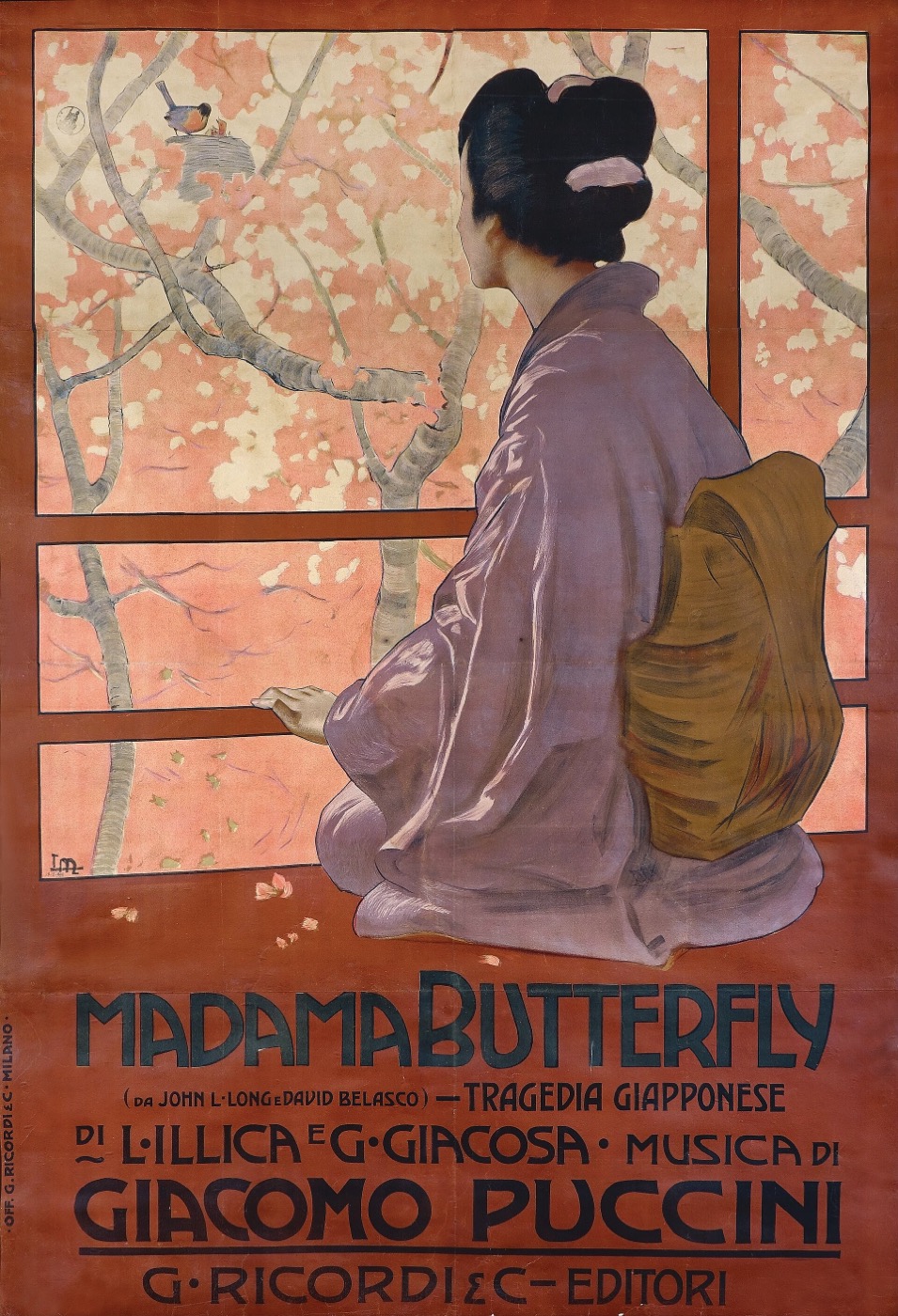
Madama Butterfly ranks sixth among the most performed operas in the world1. This page gives the facts to check before you open the score, one of the guides in the operas section.
At a glance
Puccini wrote the opera with an Italian libretto by Luigi Illica and Giuseppe Giacosa1. Giacosa (1847 to 1906) was a poet, playwright and librettist2. Illica (1857 to 1919) was a librettist who wrote for Puccini5. Giacosa also wrote the librettos used by Puccini for La bohème, Tosca and Madama Butterfly, in conjunction with Illica2.
The sources are John Luther Long’s 1898 story Madame Butterfly and Pierre Loti’s 1887 novel Madame Chrysanthème1. Long’s story was dramatized by David Belasco as the one-act play Madame Butterfly: A Tragedy of Japan1. The opera is in three acts, originally two1. It is set in Nagasaki, Japan, in the Rokumeikan era of 1883 to 18876. Cio-Cio-San takes the first part of her name from the Japanese word for butterfly1. “Cio-Cio” is an Italian transliteration of the Japanese chō-chō, and the “-san” is an honorific6. A performance runs about 2 hours 50 minutes with one interval3.
Puccini was born on 22 December 1858 and died on 29 November 19246.
Roles and voice types
Butterfly is a young Japanese geisha and a soprano6. Pinkerton is an American naval officer visiting Japan, set to marry her, and a tenor6. Opera Colorado calls him the opera’s antagonist6. Suzuki, Butterfly’s devoted maid, is a mezzo-soprano6. Sharpless, the American consul in Nagasaki, is a baritone6. Goro, the Japanese marriage broker who helps arrange the union, is a tenor6.
| Role | Voice type | Notes | Premiere singer |
|---|---|---|---|
| Cio-Cio-San (Madama Butterfly) | Soprano | A 15-year-old Japanese girl1 | Rosina Storchio1 |
| Pinkerton | Tenor | A U.S. naval officer1 | Giovanni Zenatello1 |
| Suzuki | Mezzo-soprano | Her maid1 | Giuseppina Giaconia1 |
| Sharpless | Baritone | U.S. consul at Nagasaki1 | Giuseppe De Luca1 |
| Goro | Tenor | A matchmaker1 | Gaetano Pini-Corsi1 |
| Prince Yamadori | Tenor | A wealthy prince vying for Butterfly’s attention6 | Emilio Venturini1 |
| The Bonze | Bass | Cio-Cio-San’s uncle, a Buddhist monk1,6 | Paolo Wulman1 |
| Kate Pinkerton | Mezzo-soprano | Pinkerton’s American wife1 | Margherita Manfredi1 |
| Dolore | Silent | Cio-Cio-San’s son1 | Ersilia Ghissoni1 |
Dolore’s name means Trouble, or Pain, in Italian1. Butterfly calls her son Sorrow and plans to change the name to Joy when his father returns6. Zenatello also sang in the Brescia cast, where Solomiya Krushelnytska was Cio-Cio-San1.
Cio-Cio-San is practically a child when we meet her in Act 14. By Act 2 she is 184. Puccini’s orchestration has been praised as limpid, fluent and refined1. It includes three flutes, the third doubling piccolo1.
Synopsis
Act 1
A U.S. naval officer named Pinkerton rents a house on a hill in Nagasaki, Japan, for himself and his soon-to-be wife, “Butterfly”1. His full name is Benjamin Franklin Pinkerton4. The marriage broker Goro shows him the house7. The lease is valid for 999 years but can be annulled at the end of each month7. Butterfly is a 15-year-old Japanese girl whom he is marrying for convenience, since Japanese divorce laws are very lenient1. Sharpless fears Pinkerton will destroy Butterfly, who is deeply in love3. Pinkerton laughs off the fear and waits for the day he will make a “genuine” marriage to an American woman3. Butterfly comes from a noble family reduced to penury, and she has worked as a geisha3. Her father had committed suicide at the request of the Emperor6. At fifteen, she tells Sharpless, a geisha is already an old woman7.
Butterfly had been so excited to marry an American that she had earlier secretly converted from Buddhism to Christianity1. She tells Pinkerton she is willing to give up her own gods and adopt his religion7. The Imperial Commissioner and the Registrar perform the civil wedding ceremony7. Her uninvited uncle, a bonze, has found out about the conversion; he comes to the house, curses her and orders all the guests to leave1. He calls all her relatives to renounce her7. Pinkerton orders them away and then tries to comfort the weeping Butterfly7. Pinkerton and Butterfly sing a love duet and prepare to spend their first night together1.
Act 2
Three years later, Butterfly is still waiting for him to return1. Butterfly is confident he will keep his promise to return in the spring, when the robins nest6. Her maid Suzuki doubts it7. She and her maid Suzuki are living in utter poverty in the house on the hill7. She gave birth to Pinkerton’s son after he had left1. Goro, the marriage broker who arranged her marriage, keeps trying to marry her off again1. Goro points out that under Japanese law a deserted woman is automatically divorced3. Butterfly answers that she is American and recognizes only American law3. She brushes aside Prince Yamadori’s offer, insisting that she is already married7.
Sharpless comes to the house with a letter from Pinkerton, but he cannot bring himself to finish it1. The letter asks him to tell Butterfly that Pinkerton is not coming back to Japan1. Sharpless asks what she would do if Pinkerton never returned1. Become a geisha again, she answers, or better, die7. Butterfly would rather die by her own hand than go on living without Pinkerton6. Sharpless suggests she reconsider Yamadori, and Butterfly goes out and returns with Pinkerton’s child7. She assures Sharpless that Pinkerton would never abandon such a beautiful child7. Butterfly threatens Goro with a dagger and drives him away7. A cannon shot is heard, and Butterfly takes up the telescope and recognizes Pinkerton’s ship7. She and Suzuki decorate the house with flowers7. Suzuki and the child fall asleep, but Butterfly stays up all night waiting for him to arrive1. The original two-act version put all of this in one very long second act1.
Act 3
Puccini revised the opera, splitting the second act in two, with the Humming Chorus as a bridge to what became Act 31. Suzuki finds Pinkerton with an American woman6. Pinkerton has returned with his new American wife, Kate, who has agreed to raise the child1. As Pinkerton sees how Butterfly has decorated the house for his return, he realizes he has made a huge mistake1. He admits that he is a coward and cannot face her1. Sharpless chastises him for his thoughtlessness6.
Butterfly agrees to give up her child if Pinkerton comes himself to see her1. She instructs them to return for the child in half an hour7. Butterfly hugs the child close and sends him out to play, and then, left alone, she performs ritual suicide7. Butterfly prays before statues of her ancestral gods, says goodbye to her son and blindfolds him1. She places a small American flag in his hands and goes behind a screen, stabbing herself with her father’s tantō1. The blade is the dagger with which her father had committed hara-kiri at the Mikado’s orders7. Pinkerton rushes in, but he is too late, and Butterfly dies1.
The famous arias
| Number (first line) | Act | Meaning |
|---|---|---|
| Dovunque al mondo | 1 | “Everywhere on earth”1 |
| Ancora un passo | 1 | “One more step”1 |
| Vieni, amor mio! | 1 | “Come to me, my love”1 |
| Un bel dì, vedremo | 2 | “Some fine day we will see”1 |
| Il cannone del porto! | 2 | “The cannon at the harbor”, known as the Flower Duet1 |
| Coro a bocca chiusa | end of 2, before 3 | “Humming Chorus”1 |
| Addio, fiorito asil | 3 | “Goodbye, flower-covered haven”1 |
| Con onor muore | 3 | “To die with honor”1 |
| Tu? Tu? Piccolo iddio! | 3 | “You? You? My little god”1 |
Cio-Cio-San sings Un bel dì, vedremo in Act 21,4. In it she imagines the day she will see his ship on the horizon4. It opens on a very high G-flat4. The first note must be in tune and very soft4. Hardly anything happens in the orchestra at the start4. She pictures the white ship entering the port, “Poi la nave bianca entra nel porto”4. The soprano does not need to scream or sing heroically here4. It ends in a climactic high B-flat as she tells Suzuki to keep her doubts while she waits for him4. The orchestra then restates the theme in fortissimo while she embraces Suzuki4.
The Humming Chorus, Coro a bocca chiusa, is the bridge between the old second act and the new third act1.
Lines to study
| Original | Our translation |
|---|---|
| Un bel dì, vedremo1 | On some bright day we will see |
| Dovunque al mondo1 | All over the globe |
| Addio, fiorito asil1 | Goodbye, flower-covered haven |
| Ancora un passo1 | Another step |
Both librettists died long ago, Giacosa in 1906 and Illica in 19192,5. Learn each line as speech first, then add the pitch.
Language and diction notes
The libretto is Italian, so the rules in Italian diction for singers apply to every number.
The title is Madama Butterfly, with the Italian form Madama. Long’s story is called Madame Butterfly1. In the opera, many characters call Cio-Cio-San “Butterfly” in English, even though the opera is sung in Italian6. The Italian title is pronounced [maˈdaːma ˈbatterflai]1.
Premiere, versions and performance history
The original version, in two acts, had its premiere on 17 February 1904 at La Scala in Milan1. It was poorly received, despite having such notable singers as soprano Rosina Storchio, tenor Giovanni Zenatello and baritone Giuseppe De Luca1. It was one of the most terrible flops in the history of Italian opera1. The premiere was beset by several bad staging decisions, including the lack of an intermission during the second act1. Late completion by Puccini gave inadequate time for rehearsals1. Audience plants were given nightingale whistles to deepen the sense of sunrise in the final scene, and the audience took the noise as a cue to make its own animal noises1.
Success ensued, starting with the first performance of the revision on 28 May 1904 in Brescia, at the Teatro Grande1,6. The first performance outside Italy was at the Teatro de la Opera in Buenos Aires on 7 July 1904, with Storchio again in the title role1. The first performance in Britain was in London on 10 July 1905 at the Royal Opera House1. The first US performance was presented in English on 15 October 1906 in Washington, D.C.1. New York heard it on 12 November 1906 at the Garden Theatre1. The Metropolitan Opera first performed it on 11 February 1907 under Puccini’s supervision, with Geraldine Farrar as Cio-Cio-San, Enrico Caruso as Pinkerton, Louise Homer as Suzuki and Antonio Scotti as Sharpless1. Madama Butterfly has since been heard virtually every season at the Met except for a hiatus during World War II from 1942 through 19451. The first Canadian performance was in Toronto in April 1907, and the first Australian performance was at the Theatre Royal in Sydney on 26 March 19101.
Puccini wrote five versions of the opera1. The original two-act version (SC 74.A) was withdrawn after the disastrous premiere1. In 1906, Puccini wrote a third version (SC 74.C), which was performed at the Metropolitan Opera on 11 February 19071. It was the second version (SC 74.B) that premiered in the United States in 19061. The fifth version (SC 74.E) has become known as the Standard Version and is the one most often performed today1. The original 1904 version is still occasionally performed: it opened La Scala’s 2016-17 season on 7 December 2016, with Riccardo Chailly conducting1.
Japan’s best-known opera singer, Tamaki Miura, won international fame for her performances as Cio-Cio-San between 1915 and 19201. A memorial to her and one to Puccini stand in Glover Garden in Nagasaki, where the opera is set1.
Reading the story today
One of the classic readings of Madame Butterfly is in the context of Orientalism4. The Aria Code episode on Puccini’s Madama Butterfly reads the opera as a psychosexual fantasy about the nature of Asian women and of Asia itself4. Opera Colorado lists death, suicide, violence and sexual exploitation of a minor among the opera’s content warnings6. Katherine Hu criticized the opera for orientalism in a New York Times op-ed and argues that opera houses should serve as museums and classrooms for such works1. Ask your director early how the production handles these themes.
Afterlife on stage and screen
The opera inspired a 1915 silent film with Mary Pickford and the musical Miss Saigon in 19891. Weezer’s album Pinkerton is based loosely on it1. The score calls for onstage bird whistles and an onstage viola d’amore1.
Where to go next
Two more Puccini operas to study next are La bohème and Tosca. Giacosa wrote the librettos for La bohème, Tosca and Madama Butterfly together with Illica2. For another synopsis, read the San Francisco Opera synopsis and the ENO guide to Madame Butterfly.
