Opera guides
La traviata: synopsis, roles, arias and diction notes
Verdi's La traviata in one page: librettist, premiere, Violetta and Alfredo, act-by-act synopsis, the famous arias with Italian first lines and diction notes.
By Diction Desk editors · Published · Updated · Checked against 7 sources
La traviata is an opera in three acts by Giuseppe Verdi to an Italian libretto by Francesco Maria Piave, first performed on 6 March 1853 at La Fenice in Venice1. The leads are Violetta Valéry, a soprano, and Alfredo Germont, a tenor1. Its best-known numbers are the Brindisi and Violetta's Act 1 aria Sempre libera4,5.
- Composer
- Giuseppe Verdi1
- Librettist
- Francesco Maria Piave1
- Premiere
- 6 March 1853, La Fenice, Venice1
- Language
- Italian1
- Acts
- 31
- Based on
- La Dame aux camélias (1852), a play by Alexandre Dumas fils1
Contents
La traviata is among the most frequently performed of all operas and is often ranked highly on annual lists of most performed operas1. This page gives the facts you need before you open the score, one of many guides in the operas section.
At a glance
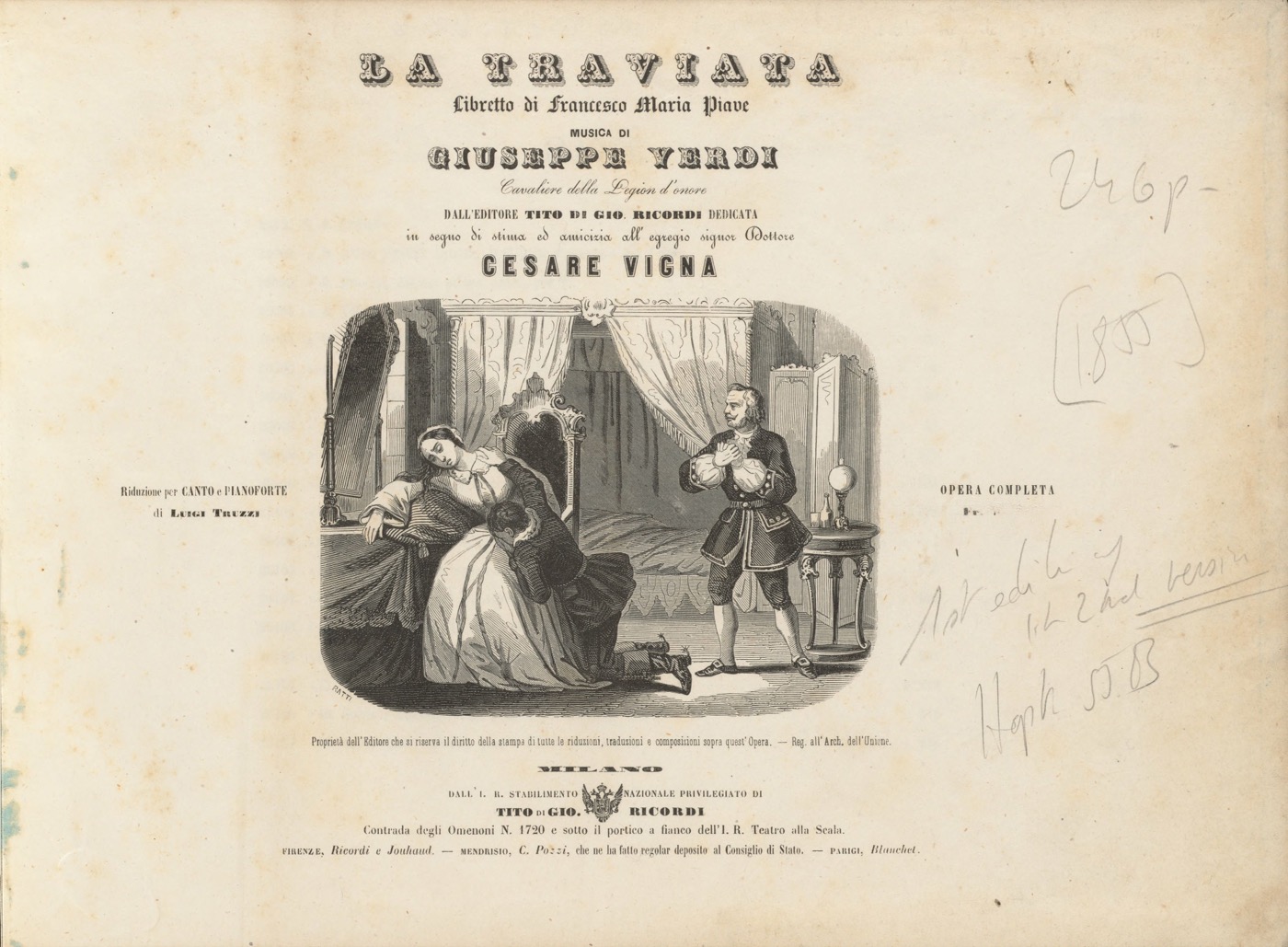
Giuseppe Verdi set an Italian libretto by Francesco Maria Piave in three acts1. The libretto title page calls it a melodramma in three acts3. It was written in 1853 and premiered at La Fenice in Venice later that year5. The opera is based on La Dame aux camélias (1852), a play by Alexandre Dumas fils1. The printed libretto sets the action in Paris and its vicinity around 17003. Verdi and Piave had wanted the story’s own time, the 1850s1,6.
Verdi’s previous opera, Rigoletto, premiered in Venice in March 18511. See the Rigoletto guide for that score.
The opera was originally titled Violetta, after the main character1. The premiere in March 1853 was not a huge success, mainly due to casting4. The Opera North guide covers the story, music and history in short form. The audience jeered at times and directed some of their scorn at Fanny Salvini-Donatelli in the lead role of Violetta1. The first Violetta did not apparently make a believable consumption sufferer and was heckled4. La traviata is now one of Verdi’s best-known works5.
How it was written
Rigoletto premiered in Venice in March 1851, and after its success an additional commission was offered by Brenna, the secretary of La Fenice1. For Verdi, the years 1851 to 1853 were filled with operatic activity1. In February 1852 he saw a play adaptation of Dumas fils’s The Lady of the Camellias1,4. Verdi told Piave he wanted none of those everyday subjects that one can find by the hundreds1. A synopsis went to Venice under the title Amore e morte, Love and Death1. Verdi then wrote that for Venice he was doing La Dame aux camélias, which would probably be called La traviata: “a subject for our own age”1.
The contract set the premiere for the first Saturday in March 18531. Verdi arrived in Venice on 21 February for rehearsals, filled with premonitions of disaster1. He had tried to persuade the manager of La Fenice to recast Violetta with a younger woman, with no success1. The chosen soprano was the 38-year-old Fanny Salvini-Donatelli1.
Piave and Verdi wanted a contemporary setting, but the authorities at La Fenice insisted that it be set in the past, around 17001. Verdi’s wish for contemporary dress did not survive the censors4. Realistic productions followed only in the 1880s1.
Premiere and revival
The first act met applause and cheering at the end of the premiere, but in the second act the audience began to turn against the performance1. The audience considered Salvini-Donatelli too old, at 38, and overweight to play a young woman dying of consumption1. Verdi wrote the next day: La traviata last night a failure, and was the fault his or the singers’1.
Verdi revised the work. The revisions between 1853 and May 1854 mostly affected acts 2 and 31. The opera returned on 6 May 1854 at Venice’s Teatro San Benedetto and was a great success, largely due to Maria Spezia-Aldighieri’s Violetta1. Piave summed it up: it was a fiasco, and now it had created a furore1. The revised version reached Madrid on 1 February 18551. Vienna, London, Paris and New York followed by 18564. London first heard it on 24 May 1856 at His Majesty’s Theatre, where it was considered morally questionable1. New York’s Academy of Music gave it on 3 December 18561.
What “traviata” means
Traviata is commonly translated as “the woman gone astray” or “the led-astray woman”1. In English it is often rendered, in the ENO opera guide, as “the fallen woman” or “the woman who strayed”5. The title names Violetta, the courtesan at the center of the story.
Roles and voice types
Violetta is a high-class courtesan and the most celebrated figure of a glamorous social scene4. She is also seriously ill, and that shapes the whole opera4. The music for Violetta changes throughout the opera as her character develops, which makes the role very challenging4.
| Role | Voice type | Notes | Premiere singer |
|---|---|---|---|
| Violetta Valéry | Soprano | A courtesan; the lead1 | Fanny Salvini-Donatelli1 |
| Alfredo Germont | Tenor | A young bourgeois from a provincial family1 | Lodovico Graziani1 |
| Giorgio Germont | Baritone | Alfredo’s father; begs Violetta to end the relationship and sings Di Provenza il mar in Act 21,5,3 | Felice Varesi1 |
| Flora Bervoix | Mezzo-soprano | Violetta’s friend1 | Speranza Giuseppini1 |
| Annina | Soprano | Violetta’s maid1 | Carlotta Berini1 |
| Baron Douphol | Baritone | Violetta’s lover, a rival of Alfredo1 | Francesco Dragone1 |
| Marchese d’Obigny | Bass | Arnaldo Silvestri1 | |
| Doctor Grenvil | Bass | Andrea Bellini1 |
Act 1 asks for coloratura effects, but the character does not need them after the first act1. Her music runs from the hectic, almost hysterical coloratura of the first act, to the more dramatic passages of the second, and the spiritual quality of her music as she dies in Act 31. In Act 2 Violetta has expansive passages expressing huge emotions as real love and real heartbreak change her4. In Act 3 Verdi sometimes breaks up her vocal line with rests, depicting her struggle to breathe4. Verdi offers a sympathetic portrayal of the heroine, highlighting Violetta’s noble nature and her devotion to Alfredo7.
Synopsis
Act 1
Violetta hosts a party at her house6. Baron Douphol, her current lover, is asked to give a toast but refuses, and the crowd turns to Alfredo, who agrees to sing a brindisi, the drinking song Libiamo ne’ lieti calici, with Violetta and the chorus1. Alfredo Germont has been in love with her for over a year, since her illness began, and is introduced to her at the party5. He is pressured to give a toast, and Violetta joins him, urging everyone to enjoy life’s pleasures5. The Brindisi is sung in rip-roaring waltz time4.
Violetta suddenly grows ill, and the guests retire to other rooms5. She gives Alfredo a flower and tells him to return it when it has wilted, which will be the very next day1. As dawn breaks, the gentlemen must all go home5. Left alone, Violetta wonders if Alfredo could actually be the one in her life, in Ah, forse è lui che l’anima1,3. She concludes that she needs freedom to live her life, and the act ends with her solo Sempre libera (“Always free”)1. From offstage, Alfredo’s voice is heard singing about love as he walks down the street1. She suspects that a true love like the one Alfredo offers would only end in tragedy6.
Act 2
Three months later, Alfredo and Violetta are living together in a peaceful country house outside Paris1. Annina tells Alfredo she went to Paris to sell the horses, carriages and everything owned by Violetta to support their country lifestyle1. Giorgio Germont comes to Violetta and begs her to end their relationship5. The relationship has threatened his daughter’s engagement, and he insists that her future depends on Violetta giving Alfredo up1,6. He is impressed by Violetta’s nobility, which he did not expect from a courtesan1. Violetta must face an impossible choice between her happiness and Alfredo’s reputation6. Giorgio kisses her forehead before leaving her weeping alone1. His aria Di Provenza il mar, il suol chi dal cor ti cancellò? belongs to this act3.
Believing Violetta has abandoned him for her ex, Baron Douphol, Alfredo plots revenge6. At a party enlivened by a masque of gypsies and bullfighters, Alfredo throws his winnings at Violetta’s feet in payment for her services, and Violetta collapses1,5,6. Germont reappears to admonish his son for treating a woman so cruelly6.
Act 3
During the annual Paris Carnival, Violetta remains inside, living alone with her maid Annina6. Doctor Grenvil tells Annina that Violetta will not live long since her tuberculosis has worsened1. A letter from Germont reports that the Baron was only wounded in his duel with Alfredo1. She believes it is now too late for a reunion with Alfredo5. Alone in her room, she sings Addio, del passato bei sogni ridenti1,3. The lovers are reunited and Alfredo suggests that they leave Paris; they sing Parigi, o cara, noi lasceremo1. Violetta knows her death approaches and sings Gran Dio!…morir sì giovane1. She revives briefly, then dies in Alfredo’s arms1.
Arias and ensembles
| Number | First line (Italian) | Character | Act |
|---|---|---|---|
| Brindisi | Libiamo ne’ lieti calici1 | Alfredo, Violetta and chorus1 | 1 |
| Violetta’s reflection | Ah, forse è lui che l’anima3 | Violetta | 1 |
| Sempre libera | Sempre libera degg’io3 | Violetta | 1 |
| Di Provenza il mar | Di Provenza il mar, il suol3 | Giorgio Germont | 2 |
| Addio, del passato | Addio, del passato bei sogni ridenti3 | Violetta | 3 |
| Duet | Parigi, o cara, noi lasceremo3 | Alfredo and Violetta | 3 |
| Dying cry | Gran Dio!…morir sì giovane1 | Violetta | 3 |
Sempre libera is Violetta’s powerful Act 1 aria and one of the most famous pieces from the opera5. It is full of vocal fireworks, mirroring her whirlwind of a life4. The concluding part of her solo scene is full of vocal decoration and feverish ornamentation as she swears to stay free1. The Brindisi is one of opera’s most famous tunes, sung in Act 14. Its name can be roughly translated as “let’s get drunk”4.
Lines to study
Piave died in 1876, so his libretto is in the public domain2. These are short passages from the librettidopera.it text. The translations are our own and literal.
| Original | Our translation |
|---|---|
| Libiamo; amor fra i calici più caldi baci avrà.3 | Let us drink; love among the cups will have warmer kisses. |
| Sempre libera degg’io3 | I must always be free |
| Ah, forse è lui che l’anima3 | Ah, perhaps it is he whom the soul |
| Addio, del passato bei sogni ridenti3 | Farewell, beautiful smiling dreams of the past |
| Parigi, o cara noi lasceremo3 | Paris, my dear, we will leave |
Music
The prelude opens with very soft, very high strings depicting the frail heroine1. A lonely and ominously tragic melody in B minor, played by the violins only, opens the opera4. The main love theme follows on lower strings while the higher instruments decorate the melody1. Waltz rhythms pervade the first act1. After the Brindisi, an offstage band plays a series of waltzes that set a Parisian atmosphere1.
Verdi did not fully orchestrate the on-stage band parts; they were written in piano-reduction style1. Over the years many versions of the on-stage band were created, varying from theater to theater1. The orchestra uses 2 flutes, with the second doubling piccolo, plus 2 oboes, 2 clarinets, 2 bassoons, 4 horns, 2 trumpets, 3 trombones, harp, cimbasso, timpani, cymbals, bass drum, triangle and strings1.
La traviata is the only one of Verdi’s many operas to be set entirely indoors1. The long duet between the elder Germont and Violetta in Act 2 is multi-sectioned, and the music follows the changing dramatic situation1.
Language and diction notes
The libretto is in Italian, so the rules in Italian diction for singers apply from the first bar. Libiamo ne’ lieti calici means “Let’s drink from the joyful cups”1. Sempre libera means “Always free”1. Parigi, o cara, noi lasceremo means “We will leave Paris, O beloved”1.
Background: the story and the censors
Verdi always looked for strong subjects featuring relatable, human characters, often breaking with convention4. A courtesan suffering from tuberculosis, a disease that was rampant at the time, is the perfect example4. Consumption was thought of as a romantic disease in the literature, art and opera of the 19th century4. In 1852, Verdi saw a play adaptation of Dumas fils’s scandalous 1848 novel The Lady of the Camellias4. The opera was controversial because it placed a courtesan at its center and treated her with sympathy rather than judgment5. It explores desire, reputation, and the conflict between personal happiness and public expectation5.
A courtesan held a higher social status than most female sex workers of the period, and typically had only one patron6. Violetta was inspired by Marie Duplessis, a Parisian courtesan who died of tuberculosis at 235. In the 1840s she rose from poverty to be one of the most glamorous figures in Paris4. A 2014 production models Violetta on two notable courtesans of the period, La Belle Otero and Liane de Pougy4. That production moves the action to Belle Epoque Paris, with opium dens and nightclubs, and by Act 3 her party guests from Act 1 have abandoned her4.
Setting an opera in the present day was a very unusual choice by Verdi6. Strict censorship in Venice threw a spanner in the works4. The censors pushed the action back to around 1700, which made it harder for audiences to see any connection to their own society1,6. Verdi’s wish that the opera be in contemporary dress was several steps too far4.
Piave (18 May 1810 to 5 March 1876) was an Italian opera librettist2. He and Verdi worked together on ten operas between 1844 and 18622.
Where to go next
Read the Italian text of La bohème, for another Italian opera, and the Rigoletto guide for the opera Verdi wrote two years earlier1.
