Opera guides
Rigoletto: synopsis, roles, arias and diction notes
Verdi's Rigoletto in one page: librettist, premiere, voice types, the story of the Duke, the jester and Gilda, the famous arias and Italian diction notes.
By Diction Desk editors · Published · Updated · Checked against 5 sources
Rigoletto is an opera in three acts by Giuseppe Verdi, his sixteenth, with an Italian libretto by Francesco Maria Piave after Victor Hugo's 1832 play Le roi s'amuse1. It premiered at La Fenice in Venice on 11 March 18511. Its best-known number is the Duke's aria La donna è mobile1.
- Composer
- Giuseppe Verdi1
- Librettist
- Francesco Maria Piave1
- Premiere
- 11 March 1851, La Fenice, Venice1
- Language
- Italian1
- Acts
- 31
- Source play
- Le roi s'amuse, Victor Hugo, 18321
Contents
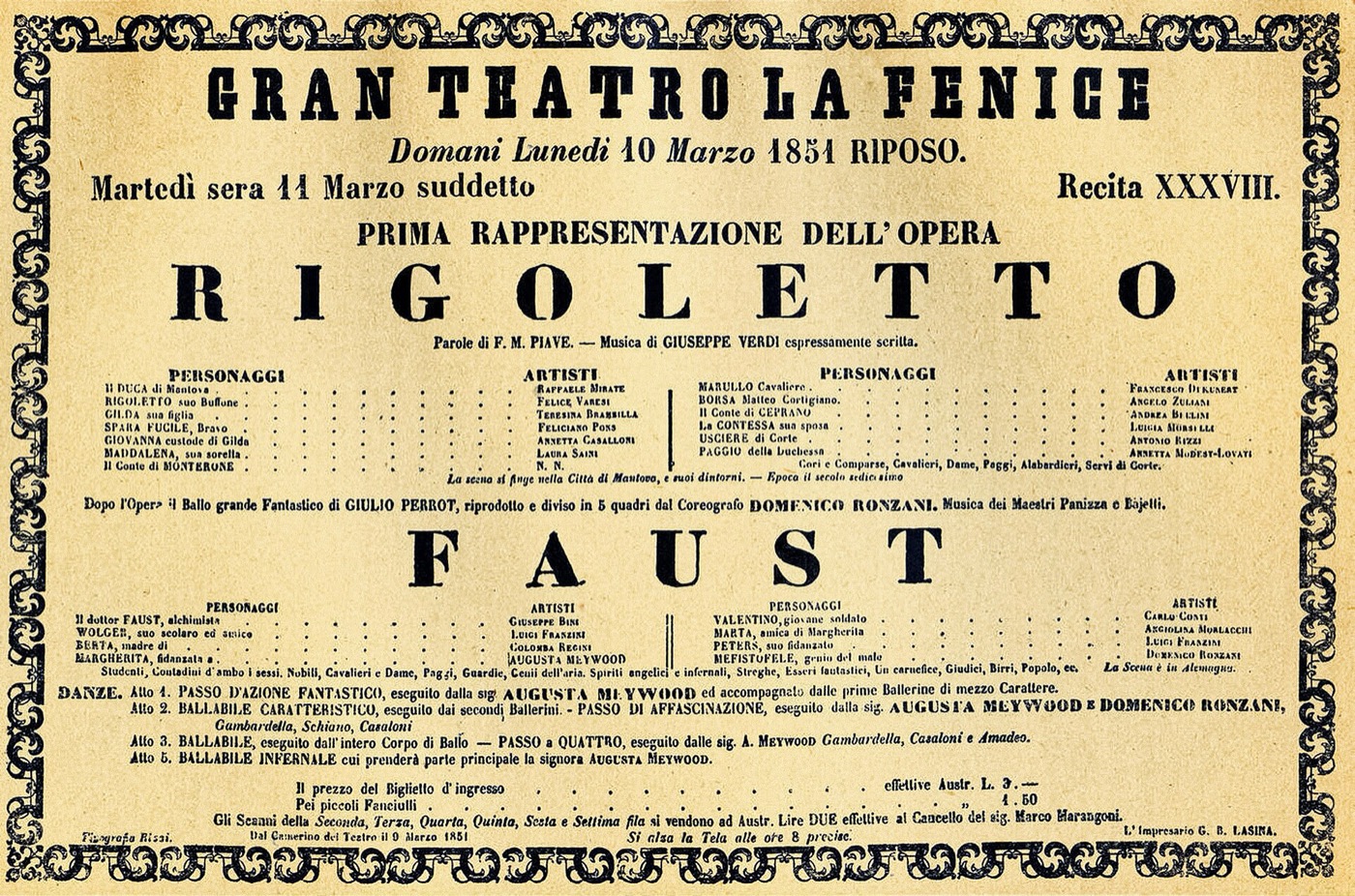
Rigoletto is Verdi’s sixteenth opera and is widely considered the first of the operatic masterpieces of his middle-to-late career1. It is one of his greatest, a tragedy of jealousy, vengeance and sacrifice, as the English National Opera synopsis puts it3. It ranked as the tenth most performed opera in the world over the last decade, by the count in the Sarasota Opera background notes5. This page gives the facts to have in hand before you open the score; it is one of many guides in the operas section.
At a glance
Piave wrote the Italian libretto, based on Victor Hugo’s 1832 play Le roi s’amuse1. Francesco Maria Piave (18 May 1810 to 5 March 1876) was an Italian opera librettist2. La Fenice of Venice commissioned Verdi in 1850 to compose a new opera1. He completed the score on 5 February 1851, a little more than a month before the premiere1.
The opera had a triumphant premiere at La Fenice on 11 March 18511. It is in three acts1.
Roles and voice types
The voice types below follow the premiere cast; the Opera Colorado character guide adds each role’s place in the story1,4.
| Role | Voice type | Premiere singer |
|---|---|---|
| Rigoletto, the Duke’s jester and Gilda’s father | Baritone | Felice Varesi1,4 |
| Gilda, his daughter, recently returned from a convent school | Soprano | Teresa Brambilla1,4 |
| Duke of Mantua | Tenor | Raffaele Mirate1,4 |
| Sparafucile, an assassin for hire and Maddalena’s brother | Bass | Paolo Damini1,4 |
| Maddalena, his sister, a tavern worker | Mezzo-soprano | Annetta Casaloni1,4 |
| Giovanna, Gilda’s nurse | Mezzo-soprano | Laura Saini1 |
| Count Monterone | Baritone | Feliciano Ponz1 |
| Count Ceprano | Bass | Andrea Bellini1 |
| Countess Ceprano | Mezzo-soprano | Luigia Morselli1 |
| Matteo Borsa, a courtier | Tenor | Angelo Zuliani1 |
| Marullo, a courtier | Baritone | Francesco De Kunnerth1 |
Synopsis
The story revolves around the licentious Duke of Mantua, the hunch-backed jester Rigoletto and Rigoletto’s daughter Gilda1. The original title, La maledizione (The Curse), refers to a curse placed on both the Duke and Rigoletto by Count Monterone1. After a short prelude, the opera opens with a dialogue between the Duke and Borsa, not the chorus and two-part aria an Italian opera of the period usually began with5.
Act 1
At a ball in his palace, the Duke sings of a life of pleasure with as many women as possible1. He tells Borsa of a young woman he sees each Sunday at church, who leaves her house only to pray4,5. Rigoletto mocks the husbands of the ladies the Duke pursues, including Count Ceprano1. Monterone arrives and curses the Duke and Rigoletto after the Duke seduced and abandoned his daughter4. The Duke declares the curse worthless and sentences Monterone to death4. The curse terrifies Rigoletto, who believes the popular superstition that an old man’s curse has real power1.
In scene 2, Rigoletto has been concealing his daughter from the Duke and the rest of the city, and she does not know her father’s occupation1. Gilda knows him only as her father and asks him to reveal his name4. Rigoletto sings Pari siamo as Sparafucile leaves4. After the Duke flees, Gilda sings Caro nome in the courtyard4. The courtiers sing Zitti, zitti during the abduction1. Blindfolded and deceived, Rigoletto holds the ladder steady while they climb to Gilda’s room and kidnap her1,5. Left alone, he removes his mask and blindfold and realizes that it was Gilda who was carried away1.
Act 2
The Duke is concerned that Gilda has disappeared, and the courtiers report that they have captured Rigoletto’s mistress1. The Duke finds that Gilda has been taken to the palace5. Monterone is led across the room on the way to prison and pauses before the Duke’s portrait, regretting that his curse has had no effect1. Rigoletto pleads with the courtiers to return Gilda, and they refuse1,5. He tries to run into the room where she is held, but the courtiers block his way1. Gilda enters weeping because the Duke has dishonored her, then describes to her father what has happened to her in the palace1,4,5. Rigoletto decides they will leave Mantua5.
Act 3
Gilda must dress as a man and leave for Verona; Rigoletto will follow later1. He strikes a bargain with the assassin Sparafucile, who is ready to murder the Duke for 20 scudi1. Rigoletto pays half the fee and promises to return at midnight for the balance and the body5. Sparafucile agrees to kill the Duke only if someone comes to the tavern to supply a replacement corpse5. Gilda, disguised as a man, overhears Maddalena plead for the Duke’s life and resolves to sacrifice herself by entering the house1,4. Sparafucile stabs her and she collapses, mortally wounded1.
At midnight Rigoletto arrives with money and receives a corpse wrapped in a sack1. As he is about to throw it into the river, he hears the Duke singing4. Gilda revives long enough to reveal what happened, saying she is glad to die for her beloved, and she dies in Rigoletto’s arms after asking for his blessing1,4,5. Rigoletto cries out in horror because Monterone’s curse has been fulfilled1.
The famous arias
| Aria | Role | Act | First line |
|---|---|---|---|
| Questa o quella | Duke of Mantua | 1 | Questa o quella (This one or that one)1 |
| È il sol dell’anima | Duke of Mantua | 1 | È il sol dell’anima (Love is the sun of the soul)1 |
| Caro nome | Gilda | 1 | Caro nome che il mio cor (Beloved name)1 |
| Cortigiani, vil razza dannata | Rigoletto | 2 | Cortigiani, vil razza dannata (Cursed breed of courtiers)1 |
| Possente amor mi chiama | Duke of Mantua | 2 | Possente amor mi chiama (Powerful love calls me)1 |
| Parmi veder le lagrime | Duke of Mantua | 2 | Parmi veder le lagrime (I think I see the tears)1 |
| Bella figlia dell’amore (quartet) | Duke, Gilda, Maddalena, Rigoletto | 3 | Bella figlia dell’amore (Fair daughter of love)1 |
| La donna è mobile | Duke of Mantua | 3 | La donna è mobile1 |
È il sol dell’anima belongs to the Duke’s courtship scene in Act 1, scene 21. Rigoletto’s Pari siamo is addressed to Sparafucile1. In Act 2 Rigoletto pleads with the courtiers in Cortigiani, vil razza dannata, then joins Gilda in the duet Sì! Vendetta, tremenda vendetta1.
The Act 3 quartet is a double duet that gives each character a musical identity1. It is among the opera’s most immediately recognizable songs3, and it is probably the most famous ensemble in all of opera5. Caro nome and La donna è mobile are the numbers audiences recognize first4. In the storm scene the quartet is followed by the Scena e Terzetto Tempesta, and the trio Se pria ch’abbia il mezzo la notte toccato leads into it1.
The Duke’s cynical La donna è mobile was sung in the streets the next morning1. Verdi had maximized its impact by revealing it to the cast and orchestra only a few hours before the premiere1. The Duke’s arias have long been showcases for the tenor voice and appear on numerous recital discs; both are among Enrico Caruso’s earliest recordings1. Stravinsky said La donna è mobile had more substance than the whole of Wagner’s Ring cycle1.
Lines to read aloud
These are good first exercises. Mark the double consonants and the stressed vowels before you speak them.
| Original | Our translation |
|---|---|
| Pari siamo!1 | We are the same! |
| Questa o quella1 | This one or that one |
| Cortigiani, vil razza dannata1 | Courtiers, vile damned breed |
| Sì! Vendetta, tremenda vendetta!1 | Yes! Vengeance, terrible vengeance! |
Background, premiere and versions
Hugo’s depiction of a venal, cynical, womanizing king was considered unacceptably scandalous by the Austrian censors1. Venice was under Austrian control at the time, which explains the censors5. Le roi s’amuse itself was banned after a single Paris performance in 1832 and was not given again in Paris for 50 years5. De Gorzkowski, the Austrian censor, refused consent under the working title La Maledizione and called the opera a repugnant example of immorality and obscene triviality1. The compromise followed: the hunchbacked jester, originally called Triboulet, was renamed Rigoletto, and the Duke would preside over Mantua and belong to the Gonzaga family1.
Verdi kept at least a third of the score at Busseto and refined the orchestration during rehearsals1. Because of a high risk of unauthorized copying, he demanded extreme secrecy from all his singers and musicians1. The tenor had his score for only a few evenings before the premiere1.
The Venice premiere was a popular success5. The opera initially ran for 13 performances and was revived in Venice the following year1. By 1852 it had premiered in all the major cities of Italy, sometimes under other titles1. The UK premiere took place on 14 May 1853 at what is now the Royal Opera House, Covent Garden, with Giovanni Matteo Mario as the Duke and Giorgio Ronconi as Rigoletto1. The US premiere followed on 19 February 1855 at New York’s Academy of Music1.
Not every critic agreed. A French critic called Rigoletto Verdi’s weakest work5. Musicologist Julian Budden took the opposite view: he regards the opera as revolutionary, just as Beethoven’s Eroica Symphony was, and says Verdi closed the door on a period of Italian opera with it1.
How the score is built
Verdi wrote to Piave that he conceived Rigoletto almost without arias and without finales, only an unending string of duets1. The score bears that out: there are no grand act finales5. Much of the singing is dialogue between two characters, so your preparation is mostly partnering work.
The orchestra calls for 2 flutes, 2 oboes, 2 clarinets, 2 bassoons, 4 horns and 3 trombones1. Offstage forces include a band, bass drum, 2 bells and a thunder machine1. In the storm scene, a male chorus behind the scenes hums through closed mouths to create the sound of the wind1. The Rigoletto and Sparafucile duet in Act 1, scene 2 puts melodies on solo cello, solo bass and low woodwinds for a sinister atmosphere1.
Modern productions move the story freely: Jonathan Miller’s 1982 English National Opera staging is set in the Mafia world, and Michael Mayer’s 2013 Metropolitan Opera staging is set in a casino in 1960s Las Vegas1.
Language and diction notes
The libretto is in Italian, so the rules in Italian diction for singers apply throughout. Before you sing an aria, mark each stressed e and o and each double consonant. The titles above are good first exercises: transcribe the first line of each into IPA, then check it with a coach.
The score rewards clear text. Verdi conceived the work as a string of duets, so much of your singing is dialogue with a partner1. Know what the other character just said before you answer.
Where to go next
Two more Verdi operas to study next are La traviata and Il trovatore.
