Opera guides
Il trovatore: synopsis, roles, arias and diction notes
Verdi's Il trovatore in one page: librettists, premiere, voice types, act-by-act highlights, the famous arias and Italian diction notes.
By Diction Desk editors · Published · Updated · Checked against 6 sources
Il trovatore (The Troubadour) is an opera in four acts by Giuseppe Verdi to an Italian libretto largely by Salvadore Cammarano, after Antonio García Gutiérrez's play El trovador (1836)1,2. It premiered on 19 January 1853 at the Teatro Apollo in Rome1. Its best-known number is the Anvil Chorus1.
- Composer
- Giuseppe Verdi1
- Librettists
- Salvadore Cammarano, with additions by Leone Emanuele Bardare1
- Premiere
- 19 January 1853, Teatro Apollo, Rome1
- Language
- Italian1
- Acts
- 41
- Setting
- Biscay and Aragon, Spain, fifteenth century1
Contents
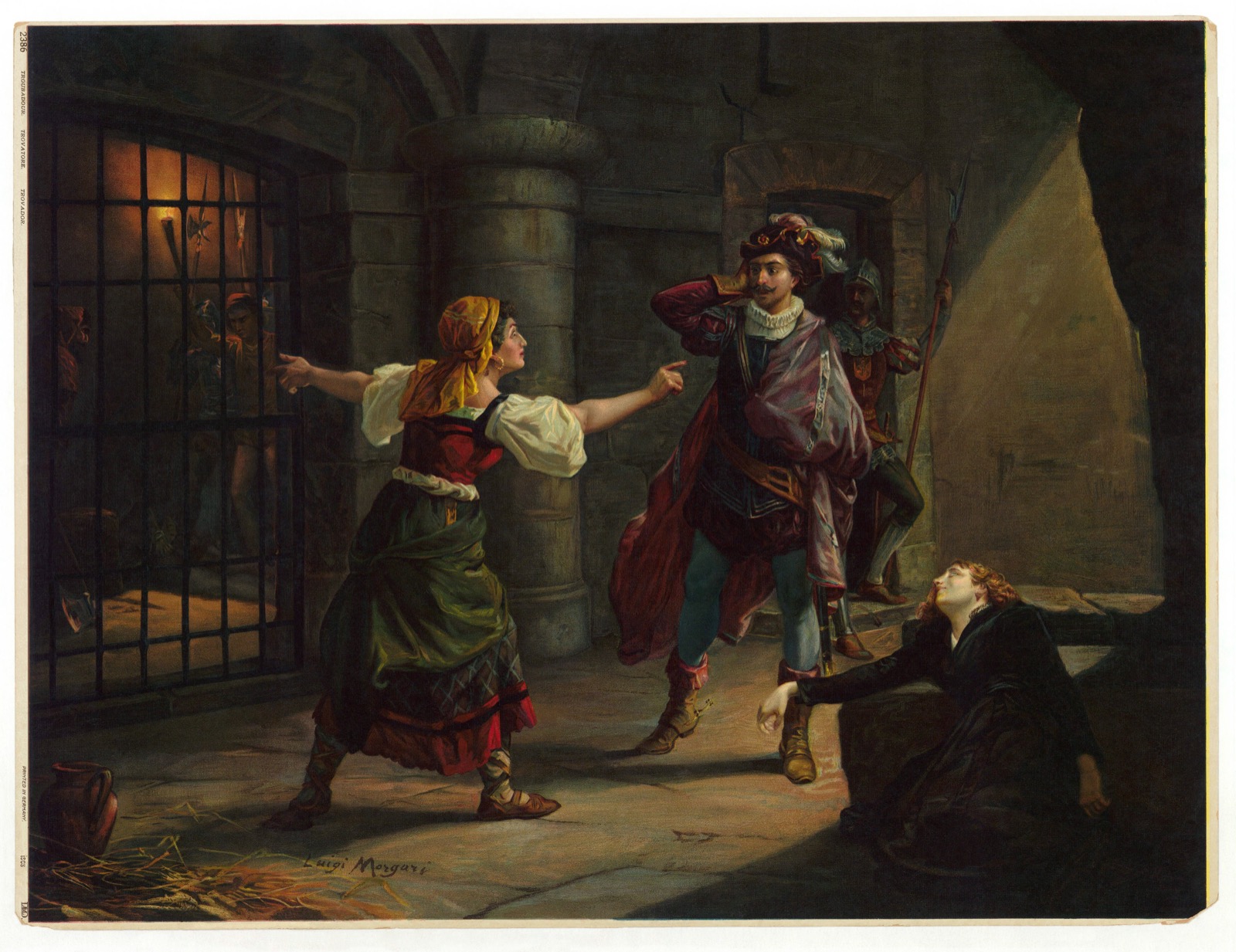
El trovador was García Gutiérrez’s most successful play1. Verdi’s opera took the story further: its premiere began a victorious march throughout the operatic world1. The plot is the hard part. The back story arrives in a single long monologue, which is why NPR’s World of Opera treats it as often thought confusing5. Learn the back story below before you open the score; this page is one of many guides in the operas section.
At a glance
Verdi’s opera has four acts and an Italian libretto largely written by Salvadore Cammarano1. It is based on the Spanish play El trovador (1836) by Antonio García Gutiérrez1. Cammarano (19 March 1801 to 17 July 1852) completed Manrico’s third-act aria Di quella pira just eight days before his death in mid-1852, and Leone Emanuele Bardare made additions to the libretto1,3.
The story is set in Biscay and Aragon in the fifteenth century1. The action runs around Zaragoza, the capital of Aragon, and the mountains of Vizcaya, as the OperaGlass synopsis at Stanford lays it out4. It is fictitious but set toward the end of a real civil war in Aragon1. King Martin I of Aragon died on 31 May 1410 leaving no heirs, and the Aragonese parliament elected Fernando king on 28 June 14124.
Roles and voice types
The Opera Colorado character guide lists each role’s voice and position in the plot3.
| Role | Voice type | Notes |
|---|---|---|
| Manrico | Tenor | A troubadour and officer in the army of the Prince of Urgel; leader of the rebel forces1,3 |
| Leonora | Soprano | A noblewoman in love with Manrico and courted by di Luna1,3 |
| Azucena | Mezzo-soprano | A gypsy, supposedly Manrico’s mother1,3 |
| Conte di Luna | Baritone | A nobleman in the service of the Prince of Aragon; commander of the Royalist troops1,3 |
| Ferrando | Bass | Luna’s officer1,3 |
| Ines | Soprano | Leonora’s confidante; premiere singer Francesca Quadri1,3 |
| Ruiz | Tenor | Manrico’s henchman; premiere singer Giuseppe Bazzoli1 |
| An old gypsy | Bass | Premiere singer Raffaele Marconi1 |
Verdi wrote to Barbieri-Nini that Azucena is the principal role, finer, more dramatic and more original than Leonora1. Leonora’s music moves in long soaring phrases, while Azucena’s melodies evolve in short, often commonplace phrases built on the repetition of short rhythmic patterns1. He sees Azucena as the first of a glorious line of mezzo roles1.
Synopsis
Il trovatore is a story of witchcraft, murder and vengeance that begins with the parents1. The Count’s father burned a woman at the stake for witchcraft3, after his nurse thought the gypsy was casting an evil spell on the baby4. Azucena, the woman’s daughter, kidnaps the Count’s infant brother, and later confesses that she had intended to burn him but threw her own child into the flames1,3. She raised the boy as her own, calling him Manrico1.
Act 1
The first scene is set in the guard room of the castle of Luna at the Palace of Aljafería in Zaragoza1. To keep the guards awake, Ferrando narrates the history of the Count1. Di Luna loves Leonora, who does not return his affection, and is jealous of his successful rival, a troubadour whose identity he does not know1,3. His troops hear the troubadour serenading Leonora3. Leonora’s cavatina opens with Tacea la notte placida1. In the dark Leonora embraces di Luna by mistake, and Manrico reveals himself as the rebel leader3. Manrico overcomes the Count in their duel and is about to kill him, but stops4.
Act 2
The gypsies sing the Anvil Chorus, and Azucena sings her canzone Stride la vampa1. Azucena berates Manrico for not killing the Count when he had the chance, and he swears to do so if they meet again4. Azucena admits that she kidnapped the Count’s infant brother and mistakenly killed her own child3. A messenger brings word that Leonora, who believes Manrico dead, is about to take the veil that night1,4. Manrico and Leonora escape together after the chaos at the convent3.
Act 3
Di Luna and his army attack the fortress where Manrico has taken refuge with Leonora1. Ferrando drags in Azucena, who has been captured wandering near the camp, and recognizes her as the woman who burned the Count’s brother1,4. Di Luna orders his men to build a pyre and burn her before the walls1. Inside the castle, Manrico and Leonora are preparing to be married1. When news of Azucena’s capture reaches him, and he sees the pyre already lit from the castle window, he summons his men and desperately prepares to attack with Di quella pira1,4.
Act 4
Leonora offers herself to the Count in place of her lover Manrico1. She secretly swallows poison from her ring in order to die before di Luna can possess her, and she will belong to him only as a corpse1,4. As she dies in Manrico’s arms, she confesses that she prefers to die with him than to marry another1. The Count understands he has been deceived and orders Manrico beheaded4. When Azucena learns Manrico is dead, she cries that he was the Count’s brother and that her mother is avenged1,3.
The famous arias
| Piece | Role | Act | First line |
|---|---|---|---|
| Racconto | Ferrando | 1 | Di due figli vivea padre beato1 |
| Cavatina | Leonora | 1 | Tacea la notte placida (The calm night was hushed)1 |
| Anvil Chorus | Gypsies | 2 | Vedi le fosche notturne1 |
| Canzone | Azucena | 2 | Stride la vampa (The blaze leaps up)1 |
| Di quella pira | Manrico | 3 | Di quella pira1 |
| Aria | Leonora | 4 | D’amor sull’ali rosee (On love’s pink wings)1 |
| Trio | Leonora, di Luna and Manrico | 4 | Prima che d’altri vivere (Before I live as someone else’s)1 |
| Duet | Manrico and Azucena | 4 | Ai nostri monti ritorneremo (We shall be returning to our mountains)1 |
D’amor sull’ali rosee leads into the Miserere chorus, and then Leonora sings Tu vedrai (You will see)2. Manrico and Azucena sing their duet in the dungeon1. The extreme formalism of the musical language serves to concentrate and define the stages of the drama1.
Lines to read aloud
| Original | Our translation |
|---|---|
| Tacea la notte placida1 | The night lay quiet and still |
| Stride la vampa1 | The blaze leaps up |
| D’amor sull’ali rosee1 | On love’s pink wings |
| Ai nostri monti ritorneremo1 | We shall be returning to our mountains |
Composition history
Verdi scholar Julian Budden called the play a high flown, sprawling melodrama flamboyantly defiant of the Aristotelian unities1. Budden calls Cammarano the born operatic poet and Verdi’s first choice of librettist1. Giuseppina Strepponi, with whom Verdi had been living in Busseto since September 1849, had translated the play1. Before the libretto was completed, Verdi had four operatic projects in various stages of development1.
Cammarano died before the score was finished, so Bardare completed the libretto1. A translation of Cammarano’s libretto was made by Émilien Pacini under the title Le trouvère1. In the revised version Leonora has a cantabile for the Miserere, and Verdi’s aim was a two-women opera that enhances her role1.
Performance history
The opera had some 229 productions worldwide in its first three years1. In Naples it had eleven stagings in six theaters in that time1. The Paris premiere in Italian was on 23 December 1854 at the Salle Ventadour1. Buenos Aires heard it on 4 January 1855 at the Teatro Argentino1. The US premiere followed on 2 May 1855 at the Academy of Music in New York1. The opera has been a staple of the Met repertoire since 26 October 18831.
The Paris Opera’s 1857 version, Le trouvère, added ballet music for Act 3, which Osborne praised: Verdi could have been the Tchaikovsky of Italian ballet1. Today almost all performances use the Italian version, and it is one of the most frequently performed operas1. Osborne judges the opera formally a step backward after Rigoletto1.
Modern stagings reinterpret the plot. The Guardian’s review covers a Royal Opera House revival with Alagna as Manrico and Hvorostovsky as Di Luna: the staging opens with a Risorgimento riot at a performance of Il Trovatore in Austrian-occupied Venice and ends with Di Luna stabbing Manrico in blind rage6. NPR’s Houston Grand Opera broadcast retells the back story in modern terms: a day care owner is wrongly convicted, and the baby’s charred bones turn up in an incinerator5.
Language and diction notes
The libretto is in Italian, so the rules in Italian diction for singers apply throughout. Before you sing an aria, mark each stressed e and o and each double consonant. The first lines in the table above are good first exercises: transcribe each into IPA, then check it with a coach.
Note the double consonants in Stride la vampa and the stress pattern of ritorneremo. Say each line at speaking pace before you add the melody.
Where to go next
Two more Verdi operas to study next are Rigoletto and La traviata.
