Opera guides
Faust: synopsis, roles, arias and diction notes
Gounod's Faust: premiere cast, voice types, synopsis by act, the Jewel Song, Golden Calf and other famous numbers with first lines, and French diction notes.
By Diction Desk editors · Published · Updated · Checked against 7 sources
Faust is a grand opera in five acts by Charles Gounod to a French libretto by Jules Barbier and Michel Carré1. It debuted at the Théâtre Lyrique in Paris on 19 March 18591. Marguerite's Jewel Song is one of the most famous soprano arias in all opera, and Méphistophélès sings Le veau d'or in Act 22,3.
- Composer
- Charles Gounod1
- Librettists
- Jules Barbier and Michel Carré1
- Premiere
- 19 March 1859, Théâtre Lyrique, Paris1
- Language
- French2
- Acts
- 51
- Genre
- Grand opera1
Contents
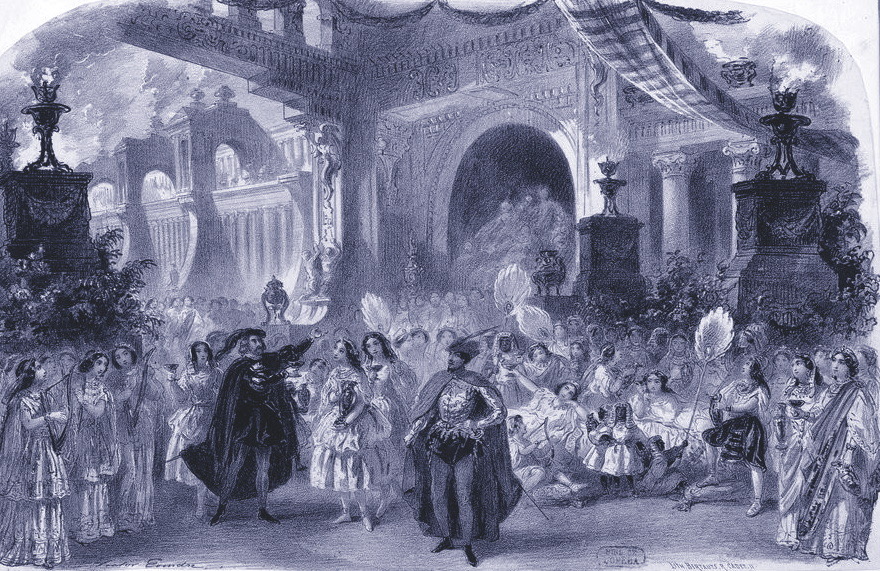
Faust is a grand opera, a genre that emerged in Paris during the first half of the 19th century and is typically five acts long2. This guide covers the roles, the synopsis by act, the arias with their first lines and the performance history; more guides are in the operas section.
Origins and composition
Gounod wrote the opera in five acts to a French libretto by Jules Barbier and Michel Carré1. The text is drawn from Carré’s play Faust et Marguerite, itself loosely based on Goethe’s Faust, Part One1. Barbier was a French poet, writer and opera librettist who often worked in collaboration with Carré6.
Faust debuted at the Théâtre Lyrique on the Boulevard du Temple in Paris on 19 March 18591. The first version included spoken dialogue in addition to the singing1,4. The tenor Hector Gruyer was first cast as Faust but proved inadequate in rehearsal, and Joseph-Théodore-Désiré Barbot replaced him shortly before opening night1. After a successful initial run, the publisher Antoine Choudens, who purchased the copyright for 10,000 francs, took the work, now with recitatives replacing the spoken dialogue, on tour through Germany, Belgium, Italy and England1. Faust achieved success only after the dialogue was replaced with recitatives, and it then spread to many European stages4. The manager of the Théâtre Lyrique, Léon Carvalho, cast his wife Caroline Miolan-Carvalho as Marguerite1.
In 1861 the opera appeared in Dresden under the title Margarethe, the first house to bill it that way rather than as Faust1,4. Its first Italian performance was at La Scala in 1862, and England saw it at Her Majesty’s Theatre, London, in Italian in 18631. In 1869 a ballet was inserted into the Walpurgis Night scene before the work could be played at the Opéra, which solidified its status as a grand opéra1,4. It then became the most frequently performed opera at that house1. The Walpurgisnacht ballet from Act 5 is usually omitted from modern staged performances1.
Roles and voice types
Faust is a tenor, a philosopher and metaphysician1. Méphistophélès is a bass-baritone, the devil who tempts Faust and facilitates his desires2,1. Siebel is a breeches role: a young man’s part sung by a mezzo-soprano1. The Polish bass Edward Reszke became renowned for his interpretation of Méphistophélès4.
| Role | Voice type | Character | Premiere singer |
|---|---|---|---|
| Faust | Tenor | A philosopher and metaphysician1 | Joseph-Théodore-Désiré Barbot1 |
| Méphistophélès | Bass-baritone | A familiar spirit of Hell1 | Mathieu-Émile Balanqué1 |
| Marguerite | Soprano | A young maiden1 | Caroline Miolan-Carvalho1 |
| Valentin | Baritone | A soldier, Marguerite’s brother1 | Osmond Raynal1 |
| Siebel | Mezzo-soprano (breeches role) | A youth in love with Marguerite1 | Amélie Faivre1 |
| Marthe Schwerlein | Mezzo-soprano or contralto | Marguerite’s guardian1 | not listed1 |
For the baritone Charles Santley, Gounod wrote a new aria for Valentin in 1864, which was later translated into French as Avant de quitter ces lieux1. It has become one of the most familiar pieces from the opera1.
Synopsis
Act 1
Faust, an aging scholar, determines that his studies have come to nothing1. Méphistophélès appears in the duet Me voici with a tempting image of Marguerite at her spinning wheel1. He offers Faust youth and the love of a beautiful woman, and asks for Faust’s soul in return2. Faust makes a fateful pact with Méphistophélès: his soul in exchange for youth and sensual pleasure5.
Act 2
A chorus of students, soldiers and villagers sings a drinking song1. Valentin entrusts the care of his sister Marguerite to his youthful friend Siebel1. Méphistophélès sings Le veau d’or, the Golden Calf, in this act2. The Soldiers’ Chorus is also in Act 22.
Act 3
Marguerite enters, pondering her encounter with Faust at the city gates1. Faust sends Méphistophélès in search of a gift for Marguerite and sings the cavatina Salut, demeure chaste et pure, idealizing her as a pure child of nature1. Marguerite sings a melancholy ballad about the King of Thule, Il était un roi de Thulé1. She sings the Jewel Song in this act2. She allows Faust to kiss her1.
Act 4
After being made pregnant and seemingly abandoned by Faust, Marguerite has given birth and is a social outcast1. Méphistophélès sings a mocking burlesque of a lover’s serenade under her window, Vous qui faites l’endormie1. With his dying breath Valentin blames Marguerite for his death and condemns her to hell1.
Act 5
Méphistophélès and Faust are surrounded by witches on Walpurgis Night1. Méphistophélès then helps Faust enter the prison where Marguerite is being held for killing her child1. Faust’s passion leads to her ruin, and also to her salvation5. A voice on high sings Sauvée! (Saved!)1. Anges purs, anges radieux is the trio for Marguerite, Faust and Méphistophélès3.
The famous arias
| Number | Character | Act | Type |
|---|---|---|---|
| Le veau d’or | Méphistophélès | Act 22,3 | Bass-baritone aria3 |
| Quel trouble inconnu me pénètre | Faust | Act 33 | Tenor aria3 |
| Salut, demeure chaste et pure | Faust | Act 31 | Cavatina1 |
| Il était un roi de Thulé | Marguerite | Act 31 | Ballad1 |
| Jewel Song (Ah! je ris de me voir si belle) | Marguerite | Act 32,3 | Soprano aria3 |
| Vous qui faites l’endormie | Méphistophélès | Act 41 | Serenade1 |
| Anges purs, anges radieux | Marguerite, Faust, Méphistophélès | Act 53 | Trio3 |
The Jewel Song begins Ah! je ris de me voir si belle en ce miroir1. Le veau d’or begins Le veau d’or est toujours debout3.
Barbier died on 16 January 1901, so his text is in the public domain6. Here are lines in the original, each with our own plain translation:
| Original | Our translation |
|---|---|
| Salut, demeure chaste et pure1 | Greetings, dwelling chaste and pure |
| Il était un roi de Thulé1 | There was once a king of Thule |
| Ah! je ris de me voir si belle en ce miroir1 | Ah! I laugh to see myself so lovely in this mirror |
| Le veau d’or est toujours debout3 | The golden calf still stands |
| Vous qui faites l’endormie1 | You who pretend to be asleep |
What the opera is about
Faust’s passion for Marguerite leads to her ruin, and also to her salvation5. Temptation, redemption and the price of desire are the themes of the opera5. David McVicar’s production at Houston Grand Opera, running 30 October to 15 November 2026, reimagines Faust as a tormented composer in Belle Époque Paris5.
Performance history and background
The Metropolitan Opera opened for the first time on 22 October 1883 with Faust, performed in Italian1. The opera stayed so popular there in its first few decades that the Met was nicknamed the “Faustspielhaus”1. It is the Met’s eighth most frequently performed opera, with 753 performances through the 2012-2013 season1,4. The full version was not performed until the period between 1965 and 19771.
A 2018 recording by Les Talens Lyriques, conducted by Christophe Rousset, presents the 1859 version1.
Gounod, a French composer, conductor and organist of the Romantic era, lived from 17 June 1818 to 18 October 18937.
Language and diction notes
Faust is sung in French2, so the rules in French diction for singers apply throughout.
Further reading: Royal Ballet and Opera, Houston Grand Opera and Polish Opera Now.
Where to go next
Two more French scores to study are Manon and Werther. For the sounds behind your transcription, start with IPA for singers.
