Opera guides
Aida: synopsis, roles, arias and diction notes
Verdi's Aida: librettist, Cairo premiere, premiere cast and voice types, synopsis by act, the famous arias with first lines, and diction notes for singers.
By Diction Desk editors · Published · Updated · Checked against 8 sources
Aida is a tragic opera in four acts by Giuseppe Verdi to an Italian libretto by Antonio Ghislanzoni1. It was commissioned by Cairo's Khedivial Opera House and premiered there on 24 December 18711. Its best-known arias are Radamès' Celeste Aida and Aida's Ritorna vincitor and O patria mia2.
- Composer
- Giuseppe Verdi1
- Librettist
- Antonio Ghislanzoni1
- Premiere
- 24 December 1871, Khedivial Opera House, Cairo1
- European premiere
- 8 February 1872, La Scala, Milan3
- Language
- Italian4
- Acts
- 41
Contents
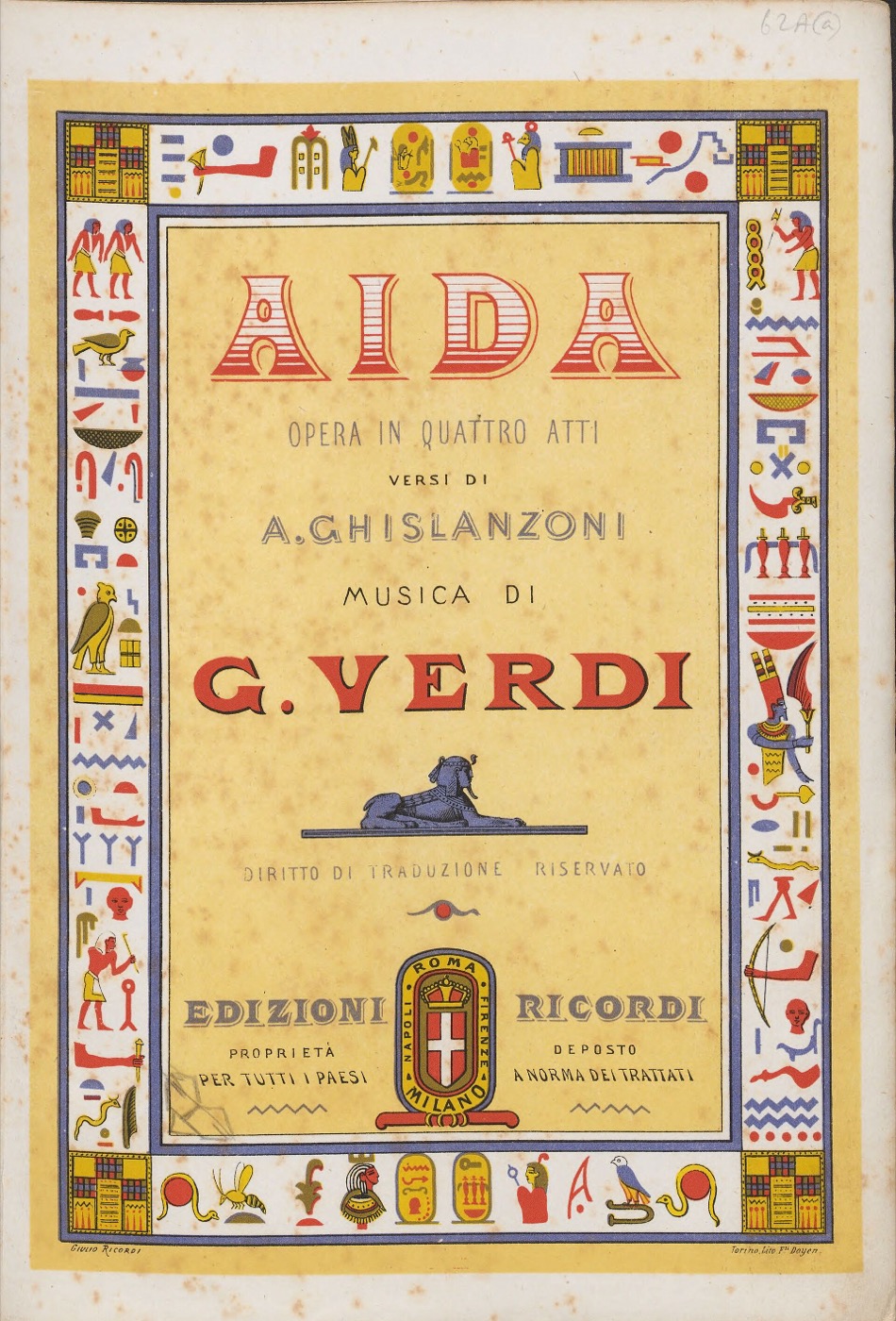
Aida is a tragic opera set in the Old Kingdom of Egypt1. This page collects the facts to check before you open the score, one of many guides in the operas section.
At a glance
Verdi wrote the opera in four acts to an Italian libretto by Antonio Ghislanzoni1. The opera was commissioned by Cairo’s Khedivial Opera House, where it had its premiere on 24 December 1871 under the conductor Giovanni Bottesini1. Angelo Mariani was approached first and declined, so Bottesini filled the gap1. Aida met with great acclaim when it finally opened in Cairo1.
Verdi did not attend the Cairo premiere1. The first European performance followed at La Scala, Milan, on 8 February 1872, conducted by Franco Faccio1,3. Verdi wrote the role of Aida for the voice of Teresa Stolz, who sang it at the Milan premiere1.
How the opera came to be
Verdi was fascinated by the subject but adamant that the libretto be in Italian, so he hired a journalist to translate du Locle’s draft5. Ghislanzoni crafted the text under Verdi’s intense supervision3. He had already written the libretto of La forza del destino3. His scheme follows a scenario often attributed to the French Egyptologist Auguste Mariette1.
The siege of Paris in 1870 and 1871 delayed the premiere, because the scenery and costumes, designed by Mariette himself, were trapped in the French capital5. The costumes and accessories for the premiere were designed by Mariette1. Verdi was most dissatisfied that the Cairo audience consisted of invited dignitaries, politicians and critics1. Verdi wrote Aida in 1871 for the Cairo Opera House3.
The idea did not start with Verdi. Isma’il Pasha, Khedive of Egypt, commissioned him to write an opera to celebrate the opening of the Suez Canal, and Verdi declined1. Auguste Mariette, a French Egyptologist, then proposed to the Khedive a plot for a celebratory opera set in ancient Egypt1. The Khedive referred Mariette to the theatre manager Camille du Locle, who sent the story idea to Verdi1. Verdi agreed to compose an opera on that story for 150,000 francs1. The biographer Mary Jane Phillips-Matz argues that the real source is Temistocle Solera, not Mariette1.
Verdi first wrote a brief orchestral prelude instead of a full overture1. He then composed a “potpourri” overture to replace it, and dropped it too, calling it “pretentious silliness”1. Arturo Toscanini and the NBC Symphony Orchestra gave that overture a rare broadcast performance on 30 March 19401.
Verdi considered the Milan performance of 8 February 1872 the real premiere, because he was heavily involved at every stage1. The Milan Amneris, Maria Waldmann, was his favorite in the role, and she repeated it a number of times at his request1.
Who’s who
| Role | Voice type | Premiere singer | Notes |
|---|---|---|---|
| Aida | Soprano | Antonietta Anastasi-Pozzoni1 | An Ethiopian princess, enslaved by the Egyptians1 |
| Radamès | Tenor | Pietro Mongini1 | Captain of the Guard; Aida’s secret lover1 |
| Amneris | Mezzo-soprano | Eleonora Grossi1 | Daughter of the Pharaoh1 |
| Amonasro | Baritone | Francesco Steller1 | King of Ethiopia1 |
| Ramfis | Bass | Paolo Medini1 | High Priest of Egypt1 |
| The King of Egypt | Bass | Tommaso Costa1 | Proclaims Radamès leader of the army1 |
Radamès is a tenor, Amonasro a baritone and Ramfis a bass5. Radamès is the Egyptian general and Aida’s lover5. The Egyptians have captured and enslaved Aida, an Ethiopian princess1. Her captors are unaware of her true identity1.
Synopsis
Radamès hopes to command the Egyptian army, and he believes that victory would enable him to marry Aida4.
Act 1
Ramfis, the high priest of Egypt, tells the young warrior Radamès that war with the Ethiopians seems inevitable1. The god Isis has chosen the general who will lead the Egyptian armies into battle8. Aida is the captured daughter of the Ethiopian King Amonasro, and her father has invaded Egypt to deliver her from servitude1. Radamès dreams both of victory on the battlefield and of Aida, an Ethiopian slave, with whom he is secretly in love1. His aria Se quel guerrier io fossi leads into Celeste Aida1.
When Aida appears and Radamès sees her, Amneris notices that he looks disturbed1. The trio Vieni, o diletta, appressati joins Amneris, Aida and Radamès1. The King declares war and proclaims that Radamès is the man chosen by the goddess Isis to lead the army1. Alone in the hall, Aida feels torn between her love for her father, her country and Radamès1. A messenger announces that the Ethiopians, led by Amonasro, are marching towards Thebes1. Solemn ceremonies and dances by the priestesses take place in the Temple of Ptah, and Radamès is installed as commander-in-chief1.
Act 2
Amneris is still in doubt about Radamès’ love and wonders whether Aida loves him1. She tries to forget her doubt with the dance of Moorish slaves1. By falsely telling Aida that Radamès has died in battle, she tricks her into professing her love for him1. Aida’s grief turns to joy when Amneris admits that she lied8. Aida confesses that her heart belongs to Radamès eternally1. The confession fires Amneris with rage, and she plans revenge on Aida1.
The Egyptian king decrees that on this day the triumphant Radamès may have anything he wishes1. The triumphal entry follows, celebrating Radamès’ victory8. The march uses a martial rhythm and layers brass upon brass as the melodic line rises, getting steadily louder until the full chorus enters5. The Ethiopian captives are led onstage in chains, Amonasro among them1. Radamès pleads with the King to spare the prisoners and set them free, and asks for the freedom of the Ethiopians as his reward1,8. The King presents Radamès with the hand of his daughter, Amneris8. Aida rushes to her father, who whispers to her to conceal his identity as King of Ethiopia1. Amonasro tells the Egyptians that the Ethiopian king has been slain in battle1. Aida and Amonasro remain as hostages so that the Ethiopians do not avenge their defeat1.
Act 3
The scene is the eve of Amneris and Radamès’ wedding in the Temple of Isis1. Radamès has chosen a place nearby for a final rendezvous with Aida8. Amonasro appears and orders Aida to find out the location of the Egyptian army from Radamès1. Amonasro hides behind a rock and listens as Radamès suggests a secure route and discloses where his army plans to attack1. Amonasro, armed with a dagger, intends to kill Amneris and Ramfis before they can alert the guards, but Radamès disarms him1. Radamès, horrified, realizes he has inadvertently divulged a critical military secret to the enemy1. He instructs Amonasro to flee with Aida and surrenders himself to the guards, who arrest him as a traitor1.
Act 4
Amneris asks Radamès to deny the accusations, but he does not wish to live without Aida and refuses1. The priests condemn him to be entombed alive for treason8. Offstage, Ramfis recites the charges and calls on Radamès to defend himself, but he stands mute and is condemned as a traitor1. Amneris weeps and curses the priests as he is taken away1. In the final scene Radamès is sealed in a tomb, where he is surprised to discover Aida waiting for him8. Aida has hidden in the vault to share his fate4. The scene ends with the duet “Invan! Tutto è finito … O terra addio”1. Aida dies in Radamès’ arms as the priests, offstage, pray to the god Ptah1.
The famous arias
| Aria | Role | Act | First line |
|---|---|---|---|
| Se quel guerrier io fossi | Radamès | 11 | Se quel guerrier io fossi1 |
| Celeste Aida | Radamès | 12 | Celeste Aida1 |
| Vieni, o diletta, appressati | Amneris, Aida, Radamès (trio) | 11 | Vieni, o diletta, appressati1 |
| Ritorna vincitor | Aida | 12 | Ritorna vincitor1 |
| Gloria all’Egitto, ad Iside | Chorus | 21 | Gloria all’Egitto, ad Iside1 |
| O patria mia | Aida | 32 | O patria mia1 |
| La fatal pietra | Final scene | 41 | La fatal pietra1 |
Verdi opens Aida with a hushed prelude instead of a big, bold overture5. Celeste Aida is the first big aria in the opera, a soaring declaration of forbidden love for an Ethiopian prisoner of war3. In Act 3 “O patria mia” repeats the words “mai più”, never more, until the aria becomes dreamlike and leads to a floated top C2,5. The final scene of Act 4 opens and closes with La fatal pietra and Morir! Sì pura e bella1.
Ghislanzoni died in 1893, so the libretto is in the public domain6. Here are lines in the original, each with our own plain translation:
| Original | Our translation |
|---|---|
| Se quel guerrier io fossi1 | If only I were that warrior |
| Celeste Aida1 | Celestial Aida |
| Ritorna vincitor1 | Return as a victor |
| Vieni, o diletta, appressati1 | Come, dear one, come near |
| O patria mia1 | O my homeland |
| Nume, custode e vindice1 | God, guardian and avenger |
| La fatal pietra1 | The deadly stone |
| Morir! Sì pura e bella1 | To die! So pure and beautiful |
Setting and orchestra
The libretto does not specify a precise time period, so the opera sits no more precisely than the Old Kingdom1. The score calls for three flûtes d’amour, a cimbasso, and an on-stage banda of six Egyptian trumpets, a military band and harp1.
Performances: 19th century premieres and later stagings
Aida was soon mounted at major opera houses throughout Italy1. The early Italian productions included the Teatro Regio di Parma on 20 April 18721. The first French performance took place on 22 April 1876 at the Théâtre-Lyrique Italien in Paris1. The UK premiere followed at Covent Garden on 22 June 1876, with Adelina Patti as Aida and Ernesto Nicolini as Radamès1.
The first US performance was on 26 November 1873 at the Academy of Music in New York City, with Ostava Torriani as Aida and Italo Campanini as Radamès1. Berlin followed on 20 April 1874 and Vienna on 29 April 18741. In Paris, Verdi conducted the elaborate production himself1. The Palais Garnier staged it in French on 22 March 1880, with Gabrielle Krauss as Aida1.
The opera reached the Metropolitan Opera in New York on 12 November 1886, conducted by Anton Seidl1. It has been performed there more than 1,100 times since 18861. Aida is frequently performed in the Verona Arena1. La Scala mounted a lavish new production designed by Franco Zeffirelli for its 2006/2007 opening night, and Roberto Alagna was booed for his Celeste Aida at the second performance1. At the Rio de Janeiro premiere on 30 June 1886, the 19-year-old cellist and assistant chorus master Arturo Toscanini was persuaded to conduct, and he led the opera from memory with great success1.
Toscanini conducted a complete concert version in New York in 1949, with Herva Nelli as Aida and Richard Tucker as Radamès, televised on NBC1. Maria Callas sang Aida in a 1955 performance conducted by Tullio Serafin, and Renata Tebaldi sang it in 1959 under Herbert von Karajan1. Alagna was dismissed from the rest of the 2006/2007 La Scala run after he walked off the stage1.
On screen and stage
A 1953 film starred Sophia Loren as Aida and Lois Maxwell as Amneris, but Renata Tebaldi sang Aida and Ebe Stignani sang Amneris on the soundtrack1. The 1942 Egyptian film Aydah stars Umm Kulthum in the title role1. The 1998 musical by Elton John and Tim Rice uses the story but not the music1. The 2022 Royal Opera House production directed by Robert Carsen set the opera in a modern, Soviet-style, totalitarian state1.
Background and reception
Aida was critically acclaimed when it premiered in Cairo later in 18715. The Milan premiere was received with great enthusiasm1. By the early 1870s it had also drawn charges of being simultaneously old-fashioned and imitative of newer trends1. Ghislanzoni was an Italian journalist, poet and novelist who wrote librettos for Verdi, among other composers6. He died in 1893, aged 686. Verdi was born on 9 or 10 October 1813 and died on 27 January 1901 in Milan7.
Language and diction notes
The libretto is sung in Italian4, so the rules in Italian diction for singers apply throughout. Cincinnati Opera stages the work in Italian with projected English translations4. Mark the first lines in the tables above before you add the music, then check your IPA with a coach.
Where to go next
Another Verdi score to study is Il trovatore, and Rigoletto sets another Italian text for the same composer. For the sounds shared by all of them, start with IPA for singers.
