Opera guides
Turandot: synopsis, roles, arias and history of the unfinished score
Puccini's Turandot for singers: composition history, voice types, act-by-act synopsis, the arias with act and character, Alfano's ending and reception.
By Diction Desk editors · Published · Updated · Checked against 7 sources
Turandot is an Italian-language opera by Giacomo Puccini to a libretto by Giuseppe Adami and Renato Simoni, left unfinished when he died in 19241. Franco Alfano completed the music, and it premiered at La Scala, Milan, on 25 April 1926 under Arturo Toscanini1. Calaf sings its best-known aria, Nessun dorma, in Act III2.
- Composer
- Giacomo Puccini, 1858 to 19243
- Librettists
- Giuseppe Adami and Renato Simoni, after Carlo Gozzi1
- Premiere
- 25 April 1926, Teatro alla Scala, Milan1
- Language
- Italian1
- Length
- About 2 hours 55 minutes with two intervals2
- Setting
- Peking, in legendary times4
Contents
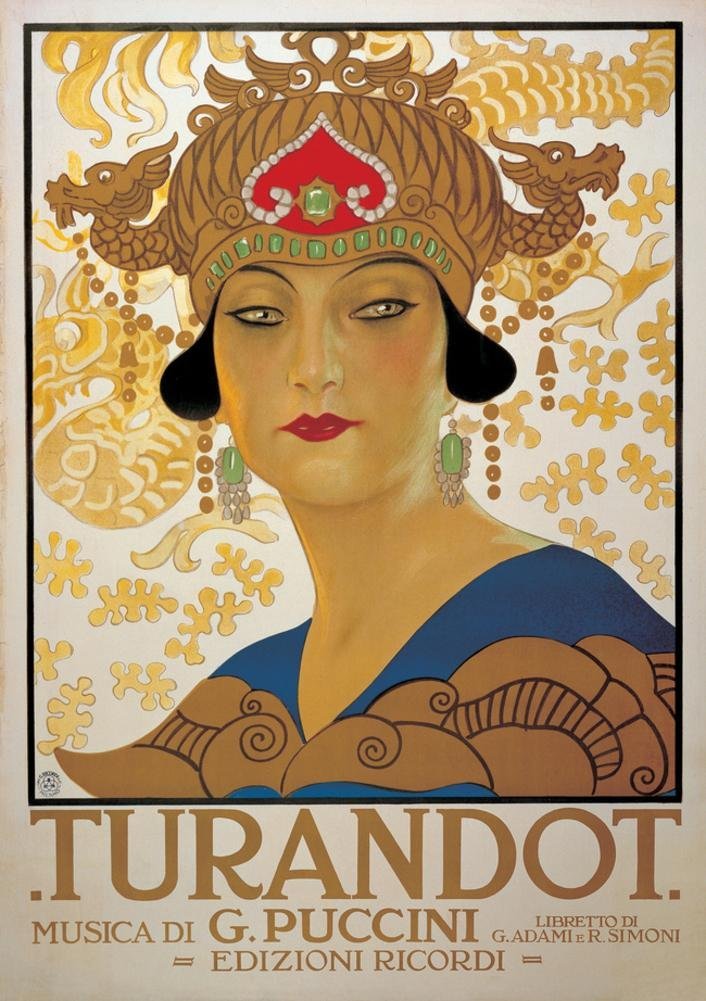
Turandot sets a cold princess and a deadly riddle test against a slave girl’s loyalty, and it is a score that another composer had to finish. It is one of the guides in the operas section.
At a glance
Giacomo Puccini, an Italian opera composer, lived from 1858 to 19243. The libretto is Italian, by Giuseppe Adami and Renato Simoni, and is based on Carlo Gozzi’s play Turandot1. Turandot lasts approximately 2 hours 55 minutes, including two intervals2. The setting is Peking, in legendary times4, and the story follows the cold-hearted Princess of Peking, Turandot, and the young Prince of Tartary, Calaf, who falls in love with her at first sight5.
Composition history: how Turandot was written and finished
Puccini began working on Turandot in March 1920, after meeting the librettists Giuseppe Adami and Renato Simoni1. It was his twelfth and final opera2. Carlo Gozzi wrote the source play in 1762, and Friedrich Schiller adapted it into another play in 18011. The beginnings of the story can likely be found in Haft Peykar1, and in 1722 François Pétis de la Croix published his Les Mille et un jours1.
Puccini wanted Chinese color in the music. Baron Edoardo Fassini-Camossi, the former Italian diplomat to China, gave him a music box that played four Chinese melodies1, and Puccini incorporated three of these melodies into his opera1. Eight of the themes from Turandot appear to be based on traditional Chinese music and anthems1. It was his most ambitious opera, combining exoticism, Chinese musical elements and a grand orchestral style2.
The work proved challenging, particularly the development of the title character and the love story2. By March 1924 Puccini had completed the opera up to the final duet1. While working on it, he was diagnosed with throat cancer2, and he died of a heart attack on 29 November 19241. The first two of the three acts were fully composed, including the orchestration1. He left behind 36 pages of sketches on 23 sheets for the end of the opera1.
Completion by Alfano
Toscanini recommended that Riccardo Zandonai be engaged to finish the opera, and Puccini’s son Tonio objected1. Tito Ricordi II decided on Franco Alfano because his opera La leggenda di Sakùntala resembled Turandot in its setting and heavy orchestration1. After the severe criticisms by Ricordi and the conductor Arturo Toscanini, Alfano was forced to write a second, strictly censored version of the ending1. About three minutes of this version were cut for performance by Toscanini, and the shortened version is usually performed today1.
Premiere and later endings
Turandot premiered at La Scala in Milan on 25 April 1926, a year and five months after Puccini’s death1. Puccini had fully orchestrated act three up until Liù’s death and funeral cortege1. At the premiere Toscanini turned to the audience and announced that the Maestro had laid down his pen1. The second and subsequent performances of the 1926 La Scala season included Alfano’s ending1. Tenors Miguel Fleta and Franco Lo Giudice alternated in the role of Prince Calaf1.
Newer completions have followed. In 2001 Luciano Berio made a new completion sanctioned by Casa Ricordi and the Puccini estate1. In late 2007 the Chinese composer Hao Weiya made another completion before the opening of the National Centre for the Performing Arts1. In 2024 Washington National Opera premiered a newly commissioned ending by composer Christopher Tin and librettist Susan Soon He Stanton1, Opera Delaware premiered a completion by composer Derrick Wang1, and Daniela Kerck made another version for the Hessisches Staatstheater Wiesbaden1.
Roles and voice types
| Role | Voice type | Character | Premiere singer, 1926 |
|---|---|---|---|
| Turandot | Dramatic soprano | Princess of Peking; she sees herself as the reincarnation of Lo-u-Ling1,2 | Rosa Raisa1 |
| Calaf (the Unknown Prince) | Tenor | A prince in exile, Timur’s son1,6 | Miguel Fleta1 |
| Liù | Soprano | A devoted servant of the exiled king Timur1,6 | Maria Zamboni1 |
| Timur | Bass | The exiled king of Tartary1,6 | Carlo Walter1 |
| Emperor Altoum | Tenor | Turandot’s father1 | Francesco Dominici1 |
| Ping | Baritone | Grand Chancellor6 | Giacomo Rimini1 |
| Pang | Tenor | Chief Administrator6 | Emilio Venturini1 |
| Pong | Tenor | Head Chef6 | Giuseppe Nessi1 |
| A Mandarin | Baritone | Proclaims the law to the crowd1 | Aristide Baracchi1 |
Arturo Toscanini conducted the premiere1. Turandot is the cold and ruthless princess of China who has vowed never to marry2. Liù is a former slave who has cared for Timur since their exile2.
Synopsis
Act 1
The opera opens at the walls of the Imperial City, the great Violet City4. The Prince of Persia has just failed to answer the riddles and is sentenced to be beheaded when the moon rises5. Heads roll as suitor after suitor is unable to pass the test7. A young man comes to help a blind old man and recognizes him as the exiled King Timur of Tartary2. He reveals himself as Timur’s son Calaf, who was separated from his father after the loss of their kingdom2. Timur tells his son that, of all his servants, only Liù has remained faithful to him1. The young Prince is overjoyed at seeing Timur alive, but urges him not to speak his name1.
The crowd calls upon Turandot to grant mercy, but she refuses4. Overcome by her beauty, Calaf decides to challenge for her hand himself6. Despite the warnings of the ministers Ping, Pong and Pang, he vows to win Turandot2. Liù, who is secretly in love with him, joins his father in the warnings5, and she implores him to leave with her and Timur in Signore, ascolta2. Calaf tries to console her with Non piangere, Liù but remains determined2. He strikes the gong that signals his challenge4.
Act 2
Ping, Pang and Pong discuss the preparations for what will be either a wedding or a funeral4. Weary of planning funerals for executed princes, they long to plan a wedding6. The Emperor Altoum sits on his grand throne in his palace1, and the Emperor asks Calaf to withdraw; Calaf declares he is determined to go forward with his attempt6.
Turandot enters and explains in In questa reggia that her ancestress of millennia past, Princess Lo-u-Ling, reigned over her kingdom1. Lo-u-Ling was raped and murdered by Tartar invaders4, and Turandot sees herself as her reincarnation and has therefore vowed that no one will possess her2. The riddles are her one concession2. Death shall be the price of even attempting to gain her hand6.
Calaf answers each of the three riddles correctly: hope, blood and Turandot6. Turandot is furious when Calaf solves it4. She pleads with her father not to force her to accept this man, but the Emperor holds her to the bargain6. Calaf makes a counter-offer: if she can discover his name before daybreak, he will consent to die4,6.
Act 3
The Prince waits for dawn and anticipates his victory1, while the decree rings out that none shall sleep in Peking that night1. Soldiers drag in Timur and Liù for questioning, declaring they were seen talking to the stranger6. Liù steps forward, claiming that she alone knows the prince’s name4. The slave girl refuses to yield under torture, and when asked what gives her such strength, she replies that it is love4.
Liù seizes a dagger from a soldier’s belt and stabs herself1. Timur curses those who have brought about her death4. When Timur warns that the gods will be offended by Liù’s death, the crowd becomes subdued, very afraid and ashamed1. Puccini’s own score runs up to this point, Liù’s death and funeral cortege1.
Calaf and Turandot are left alone, and Calaf accuses Turandot of inhumanity2. He tears off her veil and kisses her4. Overwhelmed by new feelings, Turandot confesses that she is weeping her first tears7. Calaf tells her his name and places himself in her power2. Turandot summons the Emperor and the people, and proudly declares that she now knows the name of the foreigner2.
The famous arias
Nessun dorma is sung by Calaf in Act III and is one of the opera’s most famous arias2. Its title translates to None shall sleep, referring to the decree that no one in the city can sleep2. The aria has long been a staple of operatic recitals1.
| Aria | Character | Act |
|---|---|---|
| Popolo di Pechino! | The Mandarin | Act 11 |
| O giovinetto! | Prince of Tartary (Calaf) | Act 11 |
| Signore, ascolta | Liù | Act 12 |
| Non piangere, Liù | Calaf | Act 12 |
| Un giuramento atroce | The Emperor and the Prince | Act 21 |
| Ho una casa nell’Honan (trio) | Ping, Pang and Pong | Act 21 |
| In questa reggia | Turandot | Act 21 |
| Figlio del cielo (duet) | Turandot, Altoum and the Prince | Act 21 |
| Nessun dorma | Calaf | Act III2 |
| Tu che di gel sei cinta | Liù | Act 31 |
| Principessa di morte (duet) | The Prince and Turandot | Act 31 |
| Del primo pianto (duet) | Turandot and Calaf | Act 31 |
Luciano Pavarotti helped popularize Nessun dorma in the 1990s, following his performance of it for the 1990 FIFA World Cup2. He sang it live with The Three Tenors in Los Angeles in 19944, and The Three Tenors performed the aria at three subsequent World Cup Finals1. The score gives the orchestra and chorus every opportunity to shine4.
Reception, standing and the China ban
Turandot is a staple of the standard operatic repertoire1. Soon after its premiere in Milan, it spread to other cities1. It is long recognized as the most tonally adventurous of Puccini’s operas1, written when he found himself completely outside his normal genre of verismo1.
Critics have found fault with the work: an inadequate buildup for Turandot’s change of heart, combined with an overly successful treatment of a secondary character1, and nothing in the text of the final duet suggests that Calaf’s love for Turandot amounts to more than a physical obsession1. The new ending by Berio is preferred by some critics for making a more satisfactory resolution of Turandot’s change of heart1.
For many years the government of the People’s Republic of China forbade performance of Turandot because they said it portrayed China and the Chinese unfavourably1. In the late 1990s they relented1, and in September 1998 the opera was performed for eight nights as Turandot at the Forbidden City, with director Zhang Yimou as choreographer and Zubin Mehta as conductor1.
Language and diction notes
The libretto is Italian, so the rules in Italian diction for singers apply throughout. For reading a text like this line by line, see how to read a libretto. Fuller synopses: English National Opera, Royal Ballet and Opera, Opera Colorado.
For another Puccini heroine, try Tosca or Madama Butterfly.
Read next
Tosca: synopsis, roles, arias and diction notes
Puccini's Tosca in one page: librettists, premiere, voice types, who the villain is, the famous arias and Italian diction notes for singers.
Opera guidesMadama Butterfly: synopsis, roles, arias and diction notes
Puccini's Madama Butterfly in one page: librettists, 1904 premiere, voice types, act-by-act synopsis, the famous arias and Italian diction notes.
Lyric dictionItalian diction for singers: vowels, consonants, IPA and double-consonant rules
Italian lyric diction in one page: the 7 vowels, open and closed E and O, the c and g rules, gli, gn, sc, double consonants and the rolled r.
Questions singers ask
What is the most famous aria in Turandot?
Nessun dorma, sung by Calaf in Act III, is one of the opera's most famous arias2, and it has long been a staple of operatic recitals1. Luciano Pavarotti helped popularize it in the 1990s, following his performance of it for the 1990 FIFA World Cup2. The title translates to None shall sleep2.
What is the deeper meaning of the opera Turandot?
Set in mythical Peking, Turandot explores themes of love and redemption, power and sacrifice2. The cold-hearted princess requires her suitors to answer three riddles correctly, and the slave girl Liù takes her own life to save Calaf5.
Why was Turandot banned in China?
For many years the government of the People's Republic of China forbade performance of Turandot because they said it portrayed China and the Chinese unfavourably1. In the late 1990s they relented1, and in September 1998 the opera was performed for eight nights at the Forbidden City1.
What are the three questions in Turandot?
Princess Turandot has sworn that no man shall marry her unless he can correctly answer three riddles4. Calaf answers each correctly: hope, blood and Turandot6. A suitor who fails is executed1.
Who finished Turandot after Puccini died?
Franco Alfano completed the music, and it premiered on 25 April 1926, almost a year and a half after Puccini's death1. Tito Ricordi II chose him because his opera La leggenda di Sakùntala resembled Turandot in its setting and heavy orchestration1. Luciano Berio made a new completion in 20011.
Is Turandot a good opera?
Turandot is a staple of the standard operatic repertoire1 and the most tonally adventurous of Puccini's operas1. Critics have faulted the final duet and the buildup to Turandot's change of heart1, while Berio's 2001 ending is preferred by some critics as a more satisfactory resolution1.
Sources
- Turandot - Wikipedia · Wikipedia · en.wikipedia.org · checked 19 October 2026
- Opera Essentials: Turandot - Royal Ballet and Opera · Royal Ballet and Opera · rbo.org.uk · checked 19 October 2026
- Giacomo Puccini - Wikipedia · Wikipedia · en.wikipedia.org · checked 19 October 2026
- Turandot: Synopsis, Songs & More - ENO · English National Opera · eno.org · checked 19 October 2026
- Turandot (Opera) Plot & Characters - StageAgent · StageAgent · stageagent.com · checked 19 October 2026
- Turandot 101—Characters and Plot - Opera Colorado · Opera Colorado · operacolorado.org · checked 20 October 2026
- Turandot | Lyric Opera of Chicago (via Wayback) · Lyric Opera of Chicago · lyricopera.org · checked 20 October 2026
Photos (1)
- Leopoldo Metlicovitz, Public domain

Translations of libretto lines on this page are our own. How we check facts · Report an error.