Opera guides
Cavalleria rusticana: synopsis, roles, arias and the Easter plot
Mascagni's Cavalleria rusticana for singers: title, roles and voice types, the Easter plot scene by scene, the Siciliana, Easter Hymn and Intermezzo.
By Diction Desk editors · Published · Updated · Checked against 7 sources
Cavalleria rusticana, Italian for Rustic Chivalry, is an opera in one act by Pietro Mascagni to an Italian libretto by Giovanni Targioni-Tozzetti and Guido Menasci1. It premiered on 17 May 1890 at the Teatro Costanzi in Rome and is considered one of the classic verismo operas1.
- Composer
- Pietro Mascagni, 1863 to 19452
- Librettists
- Giovanni Targioni-Tozzetti and Guido Menasci1
- Premiere
- 17 May 1890, Teatro Costanzi, Rome1
- Language
- Italian1
- Structure
- One act, about seventy-five minutes3
- Setting
- A 19th-century Sicilian village on Easter morning1
Contents
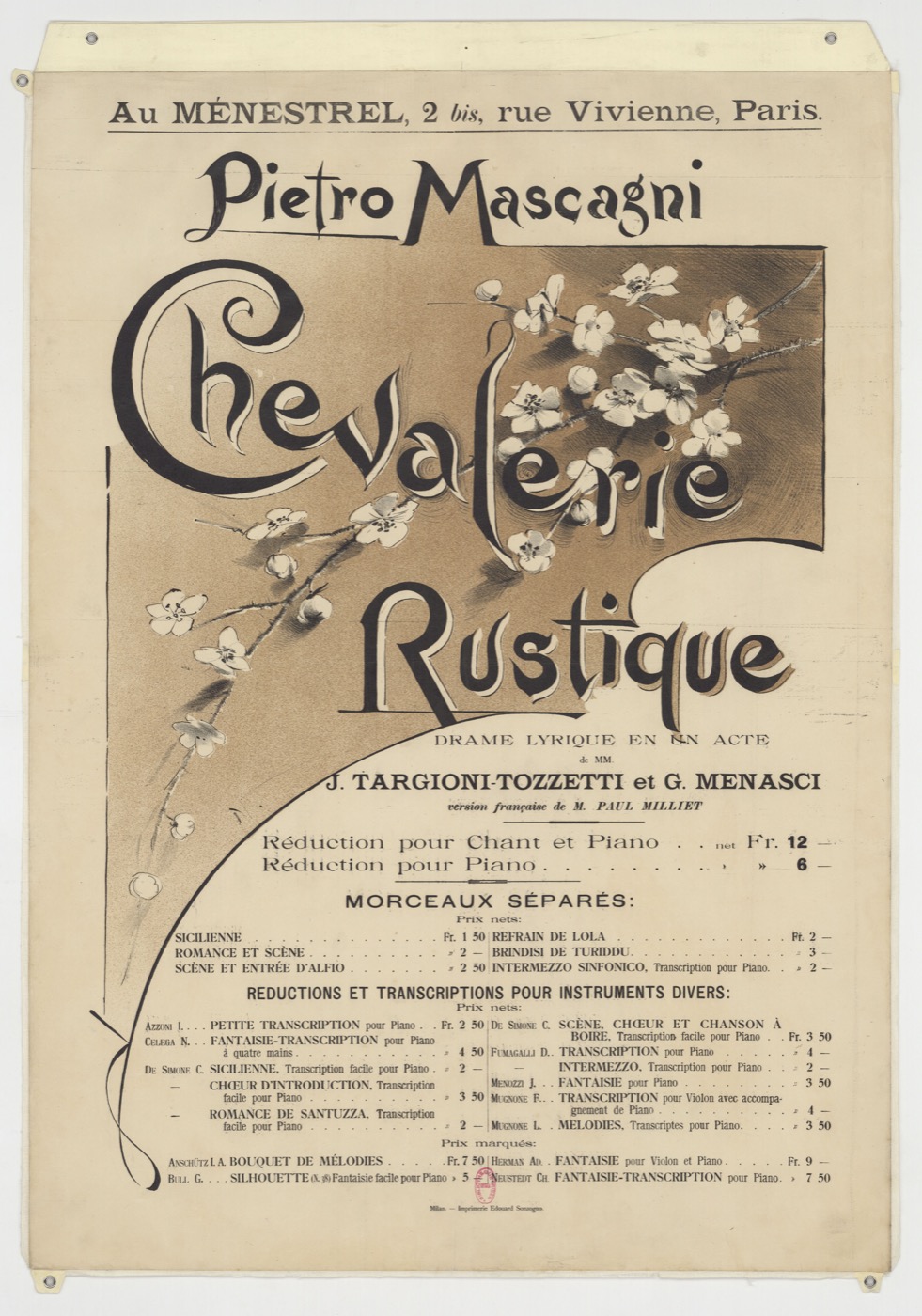
Cavalleria rusticana is over in one act, and its power comes from compression: an Easter morning, one village square, and a challenge that ends in death. Singers know it from the Easter Hymn, the Siciliana and the Intermezzo, and they meet it most often as half of a double bill. It is one of the guides in the operas section.
At a glance
Pietro Mascagni, an Italian composer who lived from 1863 to 1945, wrote the music2. He was a contemporary and friend of Giacomo Puccini4. Cavalleria rusticana is considered one of the classic verismo operas1. It is the best known of Mascagni’s fifteen operas and one operetta1.
The opera is adapted from an 1880 short story of the same name and a subsequent play by Giovanni Verga1. The story was collected in the volume Vita dei campi in 18816. The setting is a 19th-century Sicilian village on Easter morning1, and the work zooms in on the intricacies of small-town life in nineteenth-century Sicily3. The one-act opera runs about seventy-five minutes3.
Roles and voice types
| Role | Voice type | Premiere singer | Notes |
|---|---|---|---|
| Santuzza | Mezzo-soprano3 | Gemma Bellincioni1 | A Sicilian peasant girl3 |
| Turiddu | Tenor | Roberto Stagno1 | A young villager recently returned from the army; seducer of Santuzza, and having an affair with Lola1,4 |
| Lucia | Contralto | Federica Casali1 | Turiddu’s mother1 |
| Alfio | Baritone | Gaudenzio Salassa1 | A carter; Lola’s husband1 |
| Lola | Mezzo-soprano | Annetta Gulì1 | Alfio’s wife1 |
The premiere was conducted by Leopoldo Mugnone1.
Synopsis
The action takes place in a Sicilian village on Easter morning7, in one continuous act.
Before the curtain
The young villager Turiddu returns from military service to find that his fiancee, Lola, has married the carter Alfio1. Lola chose to marry Alfio while Turiddu was at war3. Turiddu is now the seducer of Santuzza and is having an affair with Lola4. Santuzza is his discarded lover5.
Easter morning in the square
The opera begins with a serenade from Turiddu, singing about his former lover Lola3. It is the siciliana he sings offstage, “O Lola ch’ai di latti la cammisa”1. The villagers sing the Easter Hymn, “Inneggiamo, il Signor non è morto”, and Santuzza joins them1. The Easter Hymn is a chorus over which a solo soprano line soars, rising higher and higher, and it expresses Santuzza’s religious devotion4.
Santuzza has been abandoned by her lover Turiddu and asks his mother, Lucia, where she can find him7. She balks at entering the tavern, as she has been excommunicated for her affair and ensuing pregnancy3. Santuzza exclaims “Voi lo sapete” and tells Lucia the story of her seduction by Turiddu and his affair with Lola1.
Santuzza, Turiddu and Alfio
Alfio arrives as a carriage driver and boasts about his faithful wife Lola and the joys of his work7. Santuzza seeks revenge by telling Alfio about Lola3. Alfio swears he will exact vengeance7. Turiddu denies being unfaithful, but Santuzza continues to accuse him7, and she curses him with an evil Easter3. In the tavern Turiddu encourages the gathered villagers to join him in a drinking song3. Alfio refuses the wine, saying it might poison him7. Understanding his meaning, Turiddu challenges him to a duel7.
The challenge and the finale
Alfio and Turiddu agree to a formal duel5. Following Sicilian custom the two men embrace, and Turiddu, in a token of acceptance, bites Alfio’s ear, drawing blood, which signifies a fight to the death1. In a farewell to his mother, Turiddu asks her to take care of Santuzza7. Lucia and Santuzza wait for the result of the duel and hear distant cries before the news arrives3. Before he goes out to fight he cries, “Un bacio, mamma! Un altro bacio!”1.
The square is empty as the orchestra plays the famous Intermezzo1. Shouts are heard, and Turiddu is announced as being killed5. A woman cries, “They have murdered Turiddu!”1.
The famous arias
The opera is one act, so every number below belongs to the same continuous act1.
| Number | Character | First line or title |
|---|---|---|
| Siciliana (Turiddu, offstage) | Turiddu | O Lola ch’ai di latti la cammisa1 |
| Easter Hymn | Villagers, Santuzza | Inneggiamo, il Signor non è morto1 |
| Romanza and Scena | Santuzza, Lucia | Voi lo sapete, o mamma5 |
| Duet | Turiddu, Santuzza | Tu qui Santuzza?5 |
| Aria | Alfio, chorus | Il cavallo scalpita5 |
| Drinking song | Turiddu, villagers | Turiddu leads the villagers in song3 |
| Farewell | Turiddu | Un bacio, mamma! Un altro bacio!1 |
| Intermezzo | Orchestra | Played while the square is empty1 |
| Finale | Alfio, Turiddu, Lola, Lucia, Santuzza, chorus | A voi tutti, salute!5 |
| Original | Our translation |
|---|---|
| Voi lo sapete1 | You are well aware of it. |
The Siciliana was encored on the first night, as were several other numbers1. The Intermezzo has a life of its own: it has figured in the soundtrack of several films, most notably in the opening and closing credits of Raging Bull1. The tragic final scene of The Godfather Part III is soundtracked by it4. An adaptation of the melody was soon made to convert it into an Ave Maria1.
Background, premiere and reception
Music publisher Edoardo Sonzogno announced the competition in July 1888 for young Italian composers who had not yet had an opera staged, and the best three entries would be staged in Rome at his expense1. Mascagni heard about it only two months before the closing date1. He and his friend Giovanni Targioni-Tozzetti entered on a whim5. The libretto reached him in fragments, sometimes only a few verses at a time on the back of a postcard1. Mascagni thought the work hastily written, put the draft in a drawer, and his wife Lina removed it and submitted it on the last day entries were accepted1. Of 73 operas submitted, the judges chose three finalists on 5 March 1890, and Cavalleria rusticana won, earning Mascagni instant fame1,4. It made him internationally famous at the age of 265.
The first night, 17 May 1890 at the Teatro Costanzi in Rome, opened to a half empty house1. After the sensational premiere, “Cav fever” spread like wildfire across Europe and America4. Since 1893 the opera has often been performed in a so-called Cav/Pag double bill with Pagliacci1, and today it is most often performed that way4. The audience that night included the leading music critics and Queen Margherita1. The Siciliana, sung behind the curtain by Stagno, brought the house to its feet1. Mascagni took 40 curtain calls1.
Performance history and recordings
The opera played throughout Italy and in Berlin after its Rome run1. By Mascagni’s death in 1945 it had been performed more than 14,000 times in Italy alone1. The Western Hemisphere premiere was at the Teatro Nacional in Buenos Aires on 28 February 18911. London followed at the Shaftesbury Theatre on 19 October 18911. The American premiere was in Philadelphia on 9 September 1891, and New York saw two rival productions on 1 October 1891, one at the Casino and one at the Lenox Lyceum1. The Metropolitan Opera first staged it on 30 December 1891 and has given it over 700 performances since1.
There are over 100 full-length recordings, the first made in Germany in 19091. Mascagni conducted two, the better known being the 1940 recording for the opera’s 50th anniversary, with Lina Bruna Rasa as Santuzza and Beniamino Gigli as Turiddu1. A Cavalleria and Pagliacci double bill was the Metropolitan Opera’s first radio broadcast, on 11 December 19101. The 1982 Franco Zeffirelli film cast Elena Obraztsova as Santuzza and Plácido Domingo as Turiddu1. The other half of the usual pairing is Pagliacci.
Language and diction notes
The libretto is Italian, so the rules in Italian diction for singers apply throughout. The title means Rustic Chivalry1,5. For work on the Italian text of other scores, see how to read a libretto. Fuller synopses: Opera North, Opera Colorado, Sarasota Opera.
For another verismo-era tragedy, try Tosca.
