Role preparation
Opera audition package: how many arias, which languages, what to prepare
Build an opera audition package: how many arias to carry, which languages, how to contrast the list, and what UCLA and UNCSA require of applicants.
By Diction Desk editors · Published · Updated · Checked against 4 sources
Collect five arias you can sing really well, and vary the language and style4. Quality matters more than quantity4. University requirements set the floor: UCLA's first-year audition asks for at least three pieces from memory in contrasting languages and styles1, and UNCSA's Master of Music asks for six selections in four languages, three of them opera arias2.
- Core package
- 5 arias you sing really well, varied in language and style4
- UCLA first-year
- At least 3 pieces from memory1
- UCLA upper-level
- 5 pieces from memory, 2 of them opera arias1
- UNCSA M.M. Voice
- 6 selections in 4 languages, 3 of them arias2
- UCLA upper-level languages
- Italian, French, German and English all represented1
- Rule of thumb
- Quality over quantity4
Contents
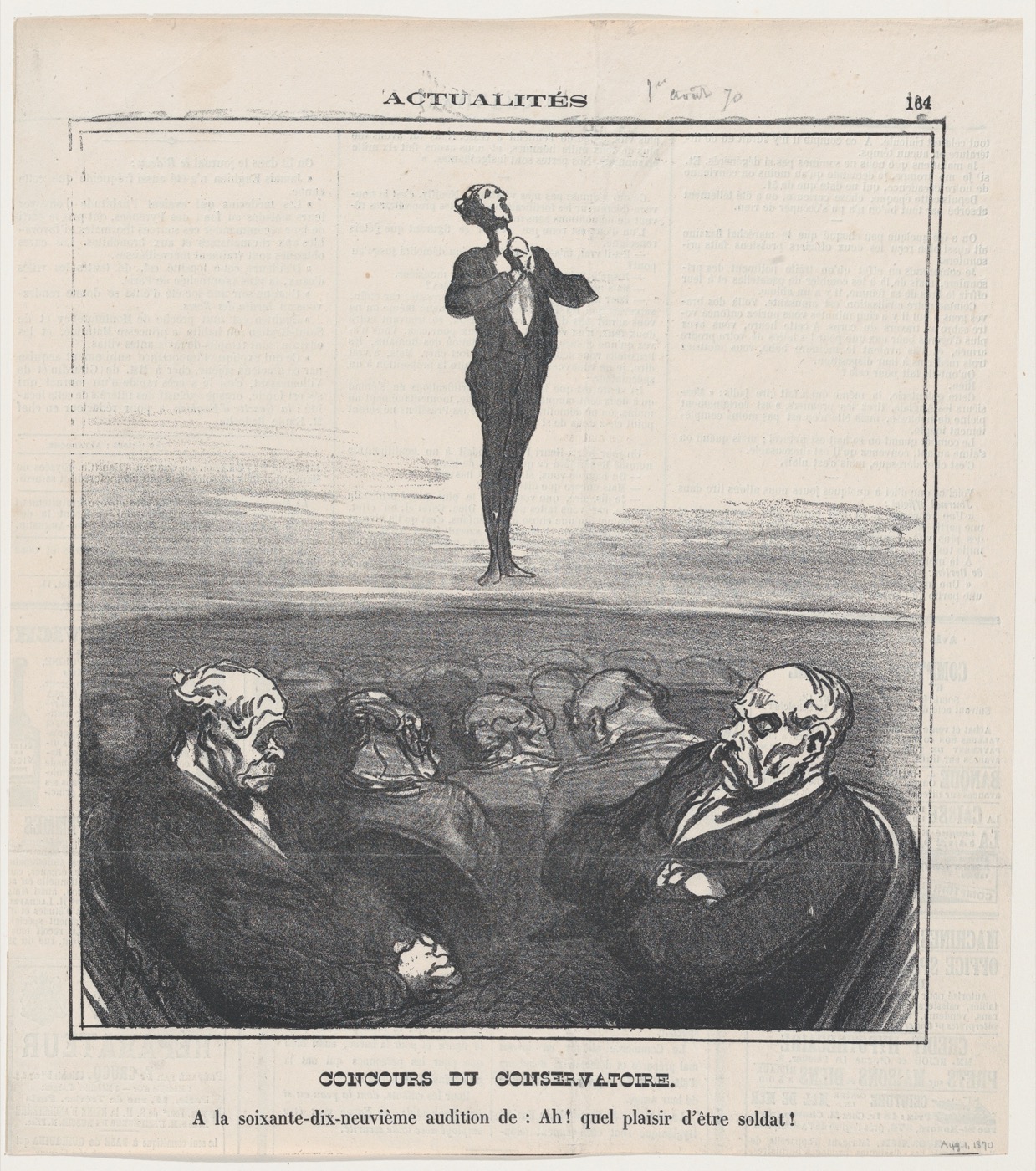
An audition package is the short list of arias you can sing on request. Panels pick from it, so every piece on it must be ready. This page combines what conservatories require with a young-singer guide from the opera publication Schmopera. It is part of the roles section.
The core package
Schmopera’s 2015 guide to audition arias says to collect five arias you can sing really well and vary the language and style4. It is always more important to have quality of arias than quantity4. Three comfortable arias go much farther than a padded aria package of five4.
Language versus repertoire
Do not choose a piece only to tick a language box. Singing the right kind of repertoire is more important than covering all the language bases4. Young mezzo-sopranos might have a hard time finding anything to sing in Russian4. Match each language to a piece your voice can carry, and use your Fach as the filter.
Singers under 25 will have a very hard time convincing an audition panel that their voice suits the Countess but not Susanna4. Your first couple of auditions will likely be for a summer opera workshop or something similar, not for an opera company or an agent4. The young artist programs comparison shows where those auditions are held. The Schmopera audition arias guide covers the same ground in more detail.
What conservatories require
University requirements are the clearest numbers available. The UCLA rows below come from its audition requirements titled for 2021 and revised August 20201; the UNCSA rows come from its audition process page, seen 19 October 20262.
| School and level | Pieces | Rules |
|---|---|---|
| UCLA, first-year | At least 3 from memory | Art songs or arias from opera or oratorio; one in Italian and one in English; contrasting languages, historical periods, styles, tempi and moods1 |
| UCLA, upper-level (MM and DMA) | 5 from memory; 2 must be opera arias | One piece before 1800, one between 1800 and 1899, one after 1900; Italian, French, German and English all represented1 |
| UNCSA, Master of Music in Voice | 6 selections in 4 languages | 3 must be opera arias; 1 must be written after 1950; pre-screening video of 2 contrasting arias in 2 languages2 |
| UNCSA, Graduate Certificate | 7 selections | 4 must be opera arias2 |
| UNCSA, Professional Artist Certificate | 8 selections in 4 languages | Pre-screening video of 4 arias2 |
UCLA’s list of sample repertoire is grouped by language and composer, for example Italian songs and arias by Mozart, Bellini, Donizetti, Rossini and Donaudy1. It is intended merely as a guide: present only pieces that are suited to your level and voice type1. The list includes selections from the 24 Italian Songs and Arias1. The UCLA voice requirements are a PDF.
UCLA first-year details
The first-year mix is one piece in Italian, one piece in English and one in your choice of French, German, Spanish, Latin or Russian1. The three selections must represent contrasting languages, historical periods and musical styles, tempi and moods1.
UNCSA details
UNCSA voice auditions require one selection in Italian and one musical theatre selection2. Auditions are conducted in three parts2. The live audition includes musical and dramatic work on your pre-screen selections and audition repertoire list, and you are tested on sight singing and diction2. The application also asks for three letters of recommendation from professionals in the field of opera, and transcripts from all secondary institutions attended2. See the Fletcher Opera Institute audition process for the full list.
How to pick the arias
Start from contrast. UCLA asks that the selections contrast in language, historical period, musical style, tempo and mood1. Then work down the list.
- Fit first. Present only pieces that are suited to your level and voice type1.
- Spread the languages. Italian and English come first for a first-year; the UCLA upper-level audition adds French and German1.
- Spread the centuries. When a school asks for it, cover each period it names: before 1800, 1800 to 1899 and after 19001.
- Spread the mood. UCLA asks for contrasting tempi and moods1.
Know the aria types
Arias in ternary form (A-B-A) were known as da capo arias, with the opening section repeated, often in a highly decorated manner3. Types of aria were named by character, for example aria di bravura, typically given to a heroine3. Aria buffa is an aria of a comic type, typically given to a bass or bass-baritone3. A favoured form of aria in the first half of the 19th century in Italian opera was the cabaletta3. Arias in opera buffa were often specific in character to the nature of the character being portrayed3.
Plan by audition type
A summer workshop, a conservatory entrance audition and a graduate audition ask for different things, so keep the package flexible. For a first-year university audition, UCLA asks for at least three pieces from memory1. For an upper-level audition, UCLA asks for five pieces from memory, two of them opera arias1.
At graduate level the numbers grow. UNCSA asks for six selections of contrasting style in four languages for the Master of Music in Voice, and for the Graduate Certificate four of the selections must be opera arias2. For the Professional Artist Certificate the number is eight selections of contrasting style in four languages2. Applicants send a pre-screening video of two contrasting arias in two languages before the live audition for the Master of Music, and four arias for the Professional Artist Certificate2.
Prescreening videos
Video is required for all UCLA prescreening recordings, and piano accompaniment is preferred but not required1. For the upper-level audition, UCLA asks for up to 20 minutes of video with 3 pieces showing contrasting languages1.
After you choose
The live audition at UNCSA tests sight singing and diction2. Start with the Italian diction guide, because UCLA asks every first-year applicant for an Italian piece1. For the work that follows an accepted audition, see how to learn a role.
Read next
The Fach system: voice types for opera singers explained
What Fach means, how opera houses use it to cast roles, the main soprano and mezzo categories, and how to use the system without being limited by it.
Role preparationOpera young artist programs compared: Merola, Santa Fe, Glimmerglass and more
Compare opera young artist programs: Merola, Santa Fe, Houston YAVA, Chautauqua, Glimmerglass and Jette Parker, with dates, eligibility and stipend.
Role preparationHow to learn an opera role: a step-by-step method from working singers
A practical order for learning an opera role: edition, text and IPA, rhythms and notes, recordings, coaching, memorization and staging.
Questions singers ask
How many arias should be in an audition package?
Collect five arias you can sing really well, varying the language and style4. Three comfortable arias go much farther than a padded package of five4. University auditions set their own counts, from three pieces to six selections1,2.
What are good arias for beginners?
Choose pieces suited to your level and voice type: UCLA's sample repertoire list is only a guide, and applicants present only pieces suited to their level and voice type1. Singers under 25 will have a very hard time convincing a panel that their voice suits the Countess but not Susanna4.
What is the hardest opera aria to sing?
Difficulty depends on your voice, so choose by suitability: the right kind of repertoire is more important than covering all the language bases4. UCLA applicants present only pieces suited to their level and voice type1.
What is an aria?
An aria is a self-contained piece for one voice, normally part of a larger work, and its typical context is opera3. Arias in ternary form (A-B-A) were known as da capo arias3. Types were named by character, such as the aria di bravura, typically given to a heroine3.
How many languages does an opera audition package need?
UCLA's upper-level audition requires Italian, French, German and English all to be represented1. UNCSA's Master of Music asks for six selections in four languages2, and the first-year UCLA audition asks for contrasting languages, with one piece in Italian and one in English1.
Sources
- 2021 Audition Requirements - Voice (UCLA School of Music) · UCLA School of Music · schoolofmusic.ucla.edu · checked 19 October 2026
- Audition Process - Fletcher Opera Institute (UNCSA) · UNC School of the Arts · uncsa.edu · checked 19 October 2026
- Aria · Wikipedia · en.wikipedia.org · checked 19 October 2026
- Audition arias 101: the young singer's guide · Schmopera · schmopera.com · checked 19 October 2026
Photos (1)
- Honoré Daumier, CC0

Translations of libretto lines on this page are our own. How we check facts · Report an error.