Opera guides
Otello: synopsis, roles, arias and the Boito libretto
Verdi's Otello in one page: Boito's libretto, the 1887 premiere, voice types, the plot act by act, the key arias and the Italian text to prepare.
By Diction Desk editors · Published · Updated · Checked against 4 sources
Otello is an opera in four acts by Giuseppe Verdi to an Italian libretto by Arrigo Boito, based on Shakespeare's play Othello1. It was Verdi's penultimate opera and was first performed at La Scala, Milan, on 5 February 18871. Its three leading roles, Otello, Desdemona and Iago, are among Verdi's most demanding, vocally and dramatically1.
- Composer
- Giuseppe Verdi1
- Librettist
- Arrigo Boito1
- Premiere
- 5 February 1887, La Scala, Milan1
- Acts
- 41
- Place in Verdi's output
- Penultimate opera, after Aida in 18712
- Pairing
- Otello and Falstaff are the last two operas Verdi wrote3
Contents
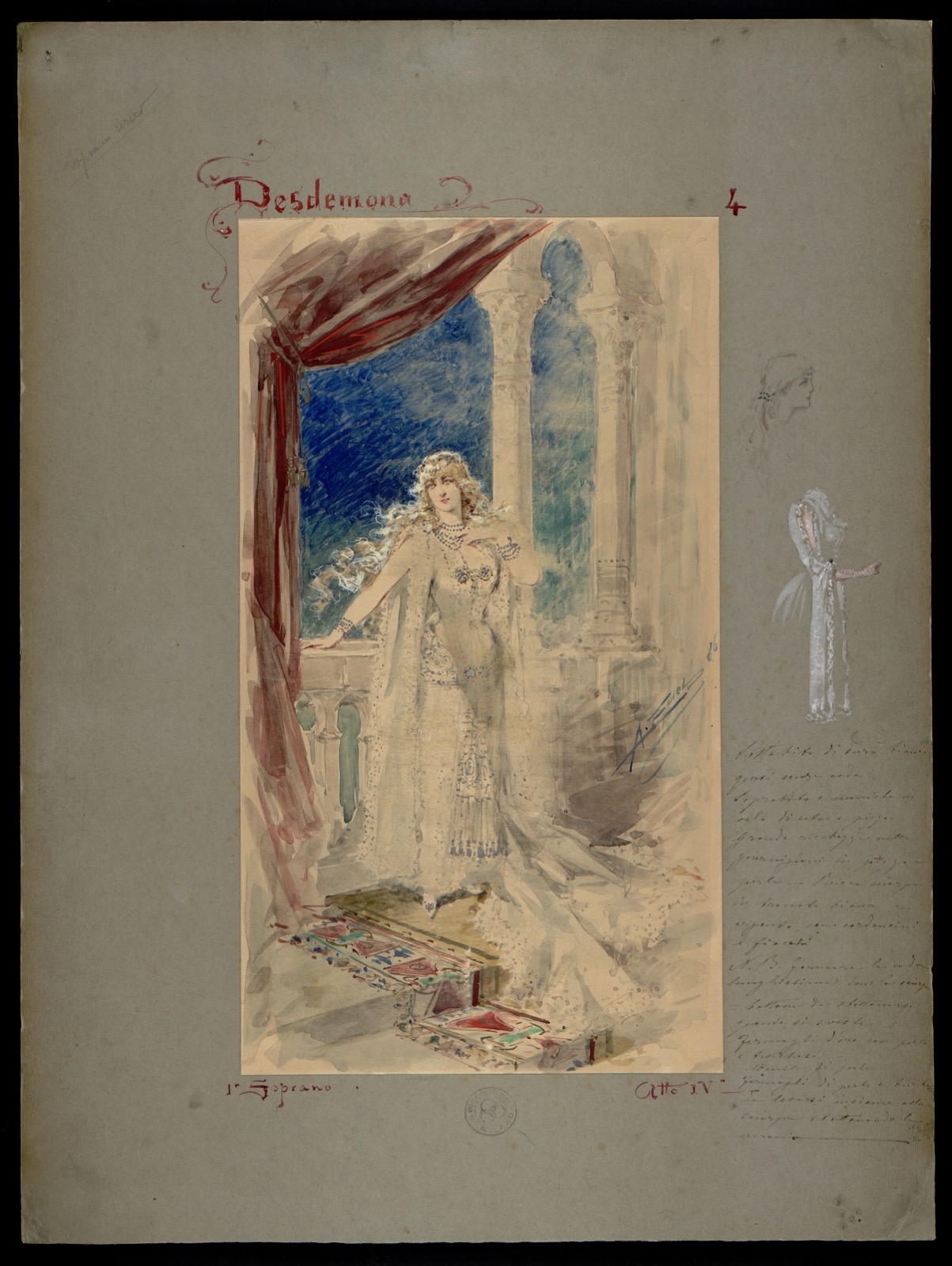
Otello is a work of late Verdi: composed after 15 years of silence, it is the result of an unlikely collaboration between the composer and the librettist Arrigo Boito4. The title role is a crushing and terrible tenor part, totally different from the tenor roles Verdi wrote before4. This page gives the cast, the plot act by act, the numbers worth knowing and the libretto history; it is one of many guides in the operas section.
Roles and voice types
Verdi’s three leading roles are among his most demanding, both vocally and dramatically1. The Opera Online profile of the opera covers what each voice must do4. The Kennedy Center Education overview covers the story of Verdi’s 1887 opera of Shakespeare’s tragedy2.
| Role | Voice type | What to know |
|---|---|---|
| Otello, the new governor of Cyprus | Tenor | Most often played by dramatic or even Wagnerian tenors; Francesco Tamagno was the trumpet-voiced creator of the role1,4 |
| Desdemona, his wife | Dramatic soprano | Romilda Pantaleoni was the first Desdemona1,4 |
| Iago, his ensign | Baritone | Victor Maurel was the first Iago, chosen by Verdi1,4 |
Otello has been called the role of roles. It requires of any tenor the ability to cover a broad range of expressions, from the victor’s assurance to the jealous meanderings that follow4. Verdi wrote this crushing and terrible tenor role as totally different from those he wrote previously4. Placido Domingo was able to bring out all of the character’s fragility4. Before the Second World War, Wagnerian tenors such as Lauritz Melchior also took the part, usually singing it in German1. Tamagno, the role’s trumpet-voiced creator, is among the famous Otellos of the past1.
Desdemona is a dramatic soprano who is supposed to be a very young woman4. She is a saintly idealisation, and Iago is a cynical villain on a diabolical scale3. A long lineage of renowned baritones has sung Iago since 1887, from Maurel, the role’s first exponent, to Tito Gobbi, a diabolical Iago in the 20th century1,4.
Beyond the three leads, the cast is small.
| Role | Place in the story |
|---|---|
| Cassio | Appointed captain of the navy by Otello; Iago insinuates that he is also in love with Desdemona1,2 |
| Roderigo | Another Venetian who is jealous of Otello; Iago’s scheme uses him2 |
| Emilia | Desdemona’s companion, who reveals the truth about Iago’s plot3 |
| Montano | The man to whom Iago lies about Cassio’s evenings1 |
| Lodovico | Holds Otello back when he almost strikes Desdemona1 |
| Bianca | Cassio’s real love2 |
Otello, the operatic version of Shakespeare’s tragic hero, is a character with a Moorish background2. The tenor cast as Otello may not always be a person of color2. For many years white singers wore dark makeup to play the role; the Metropolitan Opera stopped the practice in 20151. The Metropolitan decision led to calls for casting more people of color in opera1.
Synopsis
Iago envies Otello’s success and longs to destroy the Moor1. The opera is set on a coastal city on the island of Cyprus in the late 16th century1. Iago, Otello’s ensign, launches a malicious scheme to lead his chief to believe that his wife Desdemona is unfaithful2.
Act 1
On a stormy evening, the people of Cyprus anxiously await the arrival of the new governor, Otello, from a naval battle with the Turks1. Iago, a Venetian officer, carries a massive grudge against Otello2. Iago is outraged that Otello has appointed Cassio to be the captain of the navy1. His scheme uses Roderigo, another Venetian who is jealous of Otello2.
Iago lies to Montano, telling him that this is how Cassio spends every evening, drunk1. After the brawl, Otello fires Cassio on the spot2. Otello declares that Cassio is no longer Captain1. The act ends with a love duet: together Otello and Desdemona recall why they fell in love1. Act 1 closes on one of the most beautiful love duets in all the lyric repertoire4.
Act 2
Iago insinuates that Captain Cassio is also in love with Desdemona2. Knowing that Otello suffers from epilepsy, Desdemona tries to calm him by wiping his brow with a handkerchief2. It is the handkerchief Otello once gave her, linen embroidered with strawberries1. Otello throws it to the ground, and Iago forcibly takes it from Emilia1.
In Iago’s lie, Cassio carries the very handkerchief Otello once gave Desdemona2. Iago concedes that dreams prove nothing, yet he convinces Otello that he heard Cassio saying Desdemona’s name in his sleep1,3. At the end of the act, Otello swears vengeance on Desdemona and Cassio, and Iago joins him in his vow1. Act 2 ends with a diabolical oath4.
Act 3
A herald brings news of the approach of ambassadors from Venice1. Iago explains to Otello that he will lure Cassio here and talk with him while Otello watches, hidden1. The general conceals himself and listens as Iago gets Cassio talking about his real love, Bianca2.
Otello announces he is being called back to Venice with his wife2. Otello promotes Iago to Captain1. Otello humiliates Desdemona, commanding that she kneel before the crowd2. Otello calls her a demon and almost strikes her violently, but is held back by Lodovico1. Enraged, Otello throws Desdemona to the ground1. At the end of the act he collapses in an epileptic fit brought on by jealous rage, and Iago presses Otello’s forehead with his heel1,2.
Act 4
Desdemona asks Emilia to put out the bridal gown she used on her wedding day1. She recalls how she used to sing the Willow Song, then says a prayer to the Virgin Mary for protection1,2. Emilia, Desdemona’s companion, walks away when Otello appears3.
Otello kisses his wife three times; she awakens1. He accuses her of sin, saying that he must kill her because she loves Cassio1. He tells her that Cassio is already dead1. Otello tells her it is too late and strangles her1.
Emilia announces that Cassio has killed Roderigo, and Otello retorts that Iago gave him proof of Desdemona’s infidelity1. The plan to murder Cassio fails because Emilia reveals the truth about the plot devised by Iago3. Iago, brandishing his sword, runs away1. Distraught, Otello takes his own life3. He stealthily draws a dagger from his robe and dies beside Desdemona1.
The handkerchief
One prop carries the plot. The handkerchief is linen embroidered with strawberries, and Otello once gave it to Desdemona1. Knowing that Otello suffers from epilepsy, she tries to calm him by wiping his brow with it2. Iago forcibly takes it from Emilia1. He then claims to have seen Cassio with it, which turns it into proof in Otello’s mind2,3. At the end of the opera Otello retorts that Iago gave him proof of Desdemona’s infidelity1.
Before any of this, Otello is victorious in battle, admired by his men and loved by his wife, and fate seems to smile on him3. The tragedy is how quickly Iago reverses that, turning a loving husband into a man who strangles his wife before the final curtain and then takes his own life1,3.
The famous arias and scenes
Esultate! is Otello’s entrance in Act 1, one of the most famous entrances in all opera1.
| Number | Character | Act | Note |
|---|---|---|---|
| Esultate! | Otello and chorus | 1 | Otello announces that the Turkish fleet has been destroyed, and the Cypriots cheer1 |
| Love duet | Otello and Desdemona | 1 | Closes the act as one of the most beautiful love duets in the lyric repertoire1,4 |
| Credo in un Dio crudel | Iago | 2 | Iago voices his nihilistic beliefs and hatred of humankind1 |
| Vengeance oath | Otello and Iago | 2 | Otello swears vengeance on Desdemona and Cassio, and Iago joins him in the vow1 |
| Willow Song | Desdemona | 4 | She recalls how she used to sing it1,4 |
| Ave Maria | Desdemona | 4 | An almost angelic prayer in the final act2,4 |
| Niun mi tema | Otello | 4 | Otello’s last aria, the finale of the opera1,3 |
Niun mi tema is Otello’s last aria, the finale of the opera3. The OperaVision Poznan Opera production has Dario Solari as Iago in the Credo and Gwyn Hughes Jones in Niun mi tema3. Tamagno’s recording of Niun mi tema dates from 1903, two years before his death1.
The Willow Song and the Ave Maria give Desdemona an almost angelic line in the final act4.
Libretto
Arrigo Boito wrote the Italian libretto, based on Shakespeare’s play Othello1. Boito was influenced by translations of Shakespeare, by François-Victor Hugo for example3. Shakespeare himself had picked up the outline of a novella by an Italian author, Giovan Battista Giraldi Cinthio4.
Boito eliminated all the secondary characters, so that the confrontations are between Iago and Otello4. He abandoned the first act that Shakespeare had set in Venice in favor of a unity of time and place4. The unity of time and place brings Otello closer to being a classic tragedy4.
Boito’s text is in the public domain. The short lines below are our own glosses of the opening words of each number, not a stage translation.
| Original | Our translation |
|---|---|
| Niun mi tema3 | Let no one dread me |
| Credo in un Dio crudel3 | I put my faith in a merciless god |
| Ave Maria4 | Hail Mary |
Five years passed between the first drafts of the libretto and the start of composition in 18841. While the work was in progress the opera was called Iago, because by an unwritten law of the theater a new opera could not carry the title of one still in the repertoire, here Rossini’s1. Verdi’s January letter to Boito settled the title: he would find it hypocritical not to call it Otello1.
How Verdi came to Otello
The composer was reluctant to write anything new after the success of Aida in 18711. He had retired after that success, and Otello became his penultimate opera2. The score that followed was composed after 15 years of silence, and Falstaff, written with the same librettist, closed his career3,4. Verdi and Boito met for the first time in July 1879 in Milan, thanks to the conductor Franco Faccio3. Verdi had visited Milan on 30 June 1879 and conducted his Requiem Mass in a benefit performance at La Scala1.
A dinner in Milan did the rest. Verdi, his wife Giuseppina, the conductor Franco Faccio and Giulio Ricordi discussed adapting Shakespeare’s Othello, and those present noted Verdi’s interest at once4. Giuseppina Strepponi noted that Verdi went blindly, without intending to, into the trap4. It was not until 1884, five years after the first drafts of the libretto, that composition began1.
Emanuele Muzio, Verdi’s long-time assistant, told Ricordi in March that the love duet in Act 1 was finished and performed1. On 1 November 1886 Verdi wrote to Boito: “It is finished! All honour to us!”1.
First performances
In January 1887, Verdi arrived in Milan to personally oversee the preparations for the premiere3. The staging of Otello on 5 February 1887 at Milan’s La Scala was an international event4. The premiere performance, given in the evening on Saturday, 5 February 1887, was Verdi’s great, undisputed triumph3.
Further stagings soon followed at leading theaters throughout Europe and America1. The opera was first seen in the US at the Academy of Music in New York on 16 April 18881. Otello was first performed in Buenos Aires in 1888 by two opera companies in quick succession1. The UK premiere was on 5 July 1889 in London1.
Otello was given its Paris premiere by the Opéra at the Palais Garnier on 12 October 18941. For the Paris production Verdi composed a short ballet for the finale of Act 31.
Standing in the repertoire
Despite its immense fame, Otello has never been a popular opera, like Nabucco or La Traviata, because the writing style Verdi favored deviates too much from what the public considers his work4. Today the opera is frequently performed throughout the world, a staple of the standard repertoire1. The two Verdi operas to read next are La traviata and Aida.
Enrico Caruso was studying Otello when he died unexpectedly in 19211. Placido Domingo has appeared in more video productions of Otello than any other tenor1.
Otello and Falstaff are the last two operas ever written by Verdi, both from his collaboration with Boito3. After the London premiere in 1889, George Bernard Shaw declared that Verdi favored “harmonic elegances and orchestral sonorities” to mask his inability to rediscover the inspiration of “La donna e mobile”4. Opera Online calls that reaction excessively cut-and-dried4. The title role runs from wrath to the terrible calm of irony4.
The score
In 1894, Verdi composed a short ballet for a French production of Otello1. The opera as a whole follows the unity Boito built into the text: a unity of time and place, with the secondary characters cut4.
He hit upon the precise form of Otello’s entrance in Act 1, one of the most famous entrances in all opera1. Act 2 ends with a diabolical oath4. Act 1 closes with the love duet1,4. The confrontations are between Iago and Otello4.
Language and diction notes
The libretto is in Italian, so the rules in Italian diction for singers apply throughout1. Niun mi tema and Credo in un Dio crudel are the Otello and Iago numbers in the OperaVision production3.
