Opera guides
L'elisir d'amore: synopsis, roles, arias and diction notes
Donizetti's L'elisir d'amore: premiere cast, voice types, synopsis by act, the famous arias with first lines, and Italian diction notes for singers.
By Diction Desk editors · Published · Updated · Checked against 8 sources
L'elisir d'amore is a melodramma giocoso in two acts by Gaetano Donizetti to an Italian libretto by Felice Romani1. It premiered at the Teatro della Canobbiana in Milan on 12 May 18321. Nemorino's romanza Una furtiva lagrima in Act 2 is among the most famous arias in all of opera4.
- Composer
- Gaetano Donizetti1
- Librettist
- Felice Romani1
- Premiere
- 12 May 1832, Teatro della Canobbiana, Milan1
- Language
- Italian1
- Acts
- 21
- Setting
- A small village in the Basque Country, end of the 18th century1
Contents
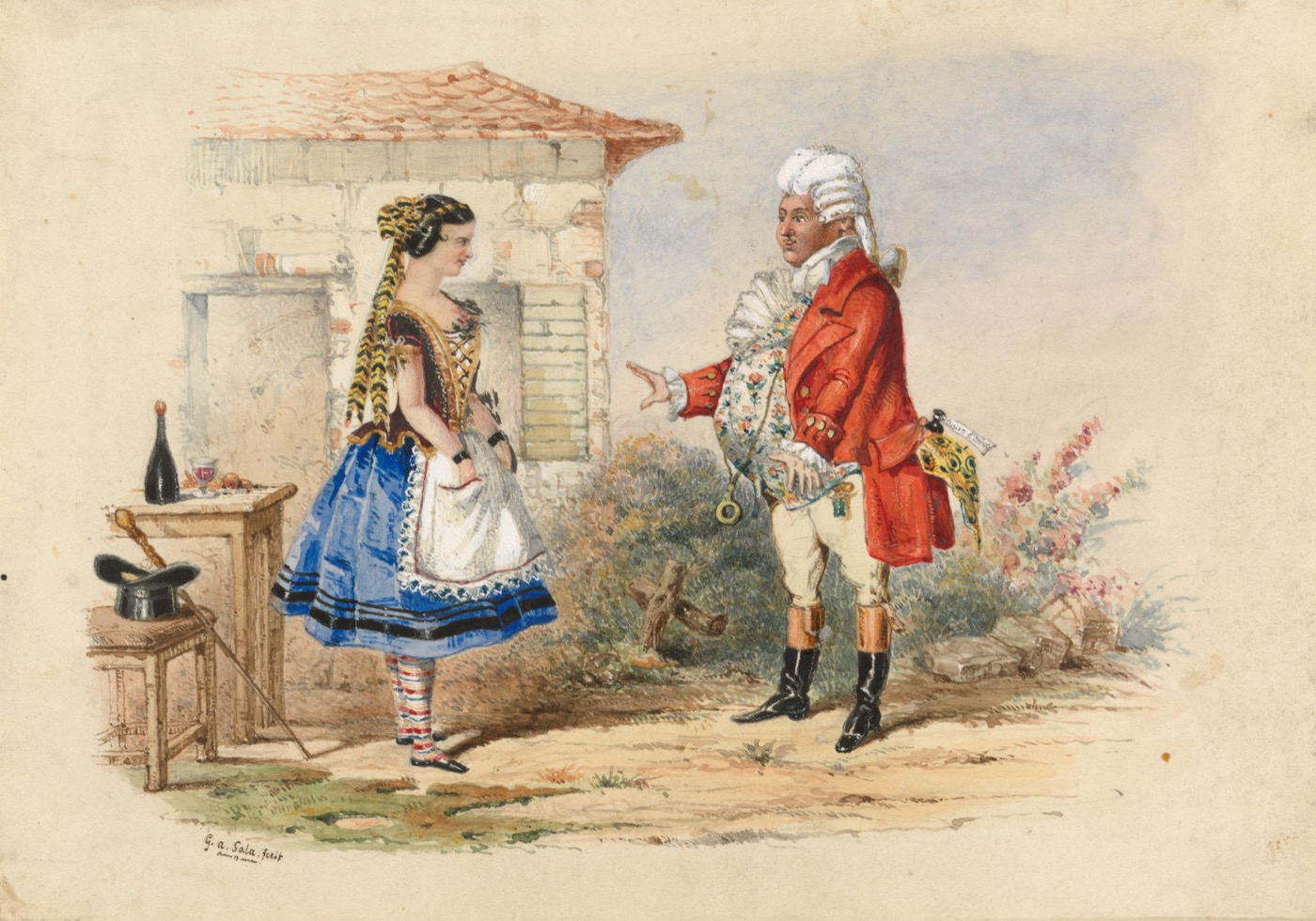
Romani built the libretto on a French comic text about a love potion, and Donizetti insisted on adding the romanza Una furtiva lagrima1,2. This guide covers the roles, the synopsis by act and the arias with their act and scene; more guides are in the operas section.
Composition and sources
The Italian libretto is by Felice Romani, after Eugène Scribe’s libretto for Daniel Auber’s Le philtre (1831)1. Romani chose to use and modify that existing French text about a love potion2. The libretto is a close adaptation of Scribe’s comic opera, first performed at the Paris Opéra in June 1831, but the tone of Romani’s text is quite different3.
Donizetti set to work with Romani in 1832 on his latest commission, and the opera was scribbled down in six weeks2. His success with Anna Bolena in 1830 had brought a flurry of commissions, this one included2. He insisted on a number of changes from Scribe’s original libretto1. The best known was the insertion of Una furtiva lagrima and the duet between Adina and Nemorino in the first act1. Nothing in Scribe’s libretto is comparable to Nemorino’s romanza3.
The opera premiered at the Teatro della Canobbiana in Milan on 12 May 1832 and was a triumph1,2. The second act was applauded less than the first3. The libretto is headed melodramma giocoso in two acts6. The action is set in a village in the Basque country6, at the end of the 18th century1.
L’elisir d’amore is written in the bel canto style, which literally means beautiful song2. In that style the orchestra supports the singer rather than competing with the voice2. Donizetti’s comic muse was less frenetic and more sentimental than Rossini’s3. He wrote almost 70 operas in the course of his career2.
Roles and voice types
The libretto lists four principal roles with their voice types, and Giannetta completes the cast6,1. Adina is a rich, capricious tenant farmer and a soprano6. Dulcamara is marked basso comico, a comic bass6.
| Role | Voice type | Character | Premiere singer |
|---|---|---|---|
| Nemorino | Tenor | A farmer and simple young man, in love with Adina6 | Gianbattista Genero1 |
| Adina | Soprano | A rich and capricious landowner6 | Sabine Heinefetter1 |
| Belcore | Baritone | The garrison sergeant; boastful and self-important6,1,3 | Henri-Bernard Dabadie1 |
| Dr. Dulcamara | Comic bass | An itinerant doctor6 | Giuseppe Frezzolini1 |
| Giannetta | Soprano | Adina’s friend and the town gossip1,2 | Marietta Sacchi1 |
Synopsis
Act 1
Nemorino, a poor peasant, is in love with Adina, a beautiful landowner, who torments him with her indifference1. He hears Adina read her workers the story of Tristan and Isolde and becomes convinced that a magic potion will win her love1.
Sergeant Belcore appears with his regiment and immediately sets about courting Adina in front of everyone1. He flirts with her as Nemorino looks on in despair3.
Dr. Dulcamara arrives selling his bottled cure-all and guarantees that it cures any ailment1,3. In an aside he reveals that the elixir is only a bottle of Bordeaux3. He tells Nemorino that the potion needs 24 hours to take effect1.
Act 2
Adina and Belcore’s wedding party is under way, and Dr. Dulcamara joins the celebration3. He encourages Adina to sing a duet with him to entertain the guests1.
Belcore convinces Nemorino to join the army, which will pay him immediately3. Nemorino has spent his military signing bonus on the fake elixir and has consumed a large amount of it1. The peasant girls gather to talk about the inheritance Nemorino has received from his rich uncle, who has just died3,1. Giannetta reveals that the uncle left his nephew a large fortune1.
Nemorino appears alone, pensive, reflecting on a tear he saw in Adina’s eye when he was ignoring her1. Adina has purchased back his military contract from Sergeant Belcore1. Belcore discovers the pair and is astonished at the turn of events, which Dulcamara claims is the result of his magic elixir1.
Having seen the notary, Nemorino appears depressed because he believes he has lost Adina1. Deeply moved by his fidelity, Adina finally declares that she will love him forever1. She recognizes his sincerity and realizes that she has loved him all along3. Belcore takes the news in his stride, noting that there are plenty of other women in the world1. Dulcamara returns and boasts that his elixir has made Nemorino both loved and rich1.
The famous arias
The numbers below carry their act and scene as the Stanford libretto prints them7,8. Adina’s Prendi; per me sei libero is her Act 2 aria8,4.
| Number | Character | Act and scene | Type |
|---|---|---|---|
| Quanto è bella, quanto è cara | Nemorino | Act 1, scene 17 | Tenor aria4 |
| Udite, udite, o rustici | Dr. Dulcamara | Act 1, scene 57 | Bass aria4 |
| Chiedi all’aura lusinghiera | Adina and Nemorino | Act 11 | Soprano-tenor duet4 |
| Io son ricco, e tu sei bella | Dulcamara and Adina | Act 2, scene 18 | Soprano-bass barcarolle duet4 |
| Venti scudi | Belcore and Nemorino | Act 2, scene 38 | Tenor-baritone duet4 |
| Una furtiva lagrima | Nemorino | Act 2, scene 78 | Tenor romanza1,4 |
| Prendi; per me sei libero | Adina | Act 2, scene 88 | Soprano aria4 |
Una furtiva lagrima is a romanza with a considerable performance history in the concert hall1. It is Nemorino’s aria in Act 2, and it was a particular favorite of Luciano Pavarotti2. Dulcamara’s Udite, udite, o rustici is a sales pitch in which he tries to convince the crowd to buy his magic elixir3.
The Nemorino and Belcore duet has Nemorino weighing whether to enlist for twenty coins, and its unusual key, D flat major, is the key of the quartet in Verdi’s Rigoletto3. Dulcamara sings the melody of the Act 2 duet Io son ricco e tu sei bella as a solo aria in the final scene, with new lyrics1. The opera has three big duets between the tenor and soprano1.
Romani lived from 31 January 1788 to 28 January 1865, so his text is in the public domain5. Here are lines in the original, each with our own plain translation:
| Original | Our translation |
|---|---|
| Quanto è bella, quanto è cara7 | How lovely she is, how dear |
| Udite, udite, o rustici7 | Gather round, gather round, country people |
| Chiedi all’aura lusinghiera1 | Ask the flattering breeze |
| Io son ricco, e tu sei bella8 | I am rich, and you are beautiful |
| e venti scudi avrai8 | and you will have twenty scudi |
| Prendi; per me sei libero8 | Take it; for me you are free |
| Una furtiva lagrima8 | A secret tear |
Background and reception
Romani was considered the finest Italian librettist between Metastasio and Boito, and he wrote many librettos for Donizetti and Bellini5.
L’elisir d’amore was the most often performed opera in Italy between 1838 and 18481. It remains one of the most performed of all Donizetti’s operas1. In the five seasons from 2008 to 2013 it ranked number 13 on the Operabase list of the most-performed operas worldwide1.
Enrico Caruso played Nemorino for the first time in February 1901 at La Scala, with Arturo Toscanini conducting1. The audience made Caruso and the orchestra repeat Una furtiva lagrima1. Toscanini predicted that Caruso would be talked about all over the world1.
The central theme, the triumph of sincerity, is essential to the Romantic outlook1. Richard Wagner arranged the work for solo piano in 18401. W. S. Gilbert wrote a burlesque adaptation, a parody called Dulcamara, or the Little Duck and the Great Quack, in 18661,2. Cincinnati Opera’s 1968 production moved the setting to 1870s Texas1.
Language and diction notes
The libretto is in Italian6, so the rules in Italian diction for singers apply throughout. The libretto is public domain, and the full text is on the Stanford OperaGlass pages for Act 1 and Act 27,8.
Three of the numbers above are ensembles that need a second voice: the Act 1 duet for Adina and Nemorino, the Act 2 barcarolle for Dulcamara and Adina, and the Act 2 duet for Belcore and Nemorino1,8.
Further reading: Opera North and Sarasota Opera.
Where to go next
Two more Italian comedies to study are La Cenerentola and Il barbiere di Siviglia. For the sounds behind your transcription, start with IPA for singers.
