Opera guides
Don Pasquale: synopsis, roles, arias and diction notes
Donizetti's Don Pasquale: premiere, voice types, who Malatesta is, the plot act by act, the famous arias by act and character, and Italian diction notes.
By Diction Desk editors · Published · Updated · Checked against 9 sources
Don Pasquale is an opera buffa in three acts by Gaetano Donizetti, with an Italian libretto completed largely by Giovanni Ruffini1. It was first performed on 3 January 1843 by the Théâtre-Italien at the Salle Ventadour in Paris1. Malatesta's most famous aria, Bella siccome un angelo, comes in Act 12.
- Composer
- Gaetano Donizetti, one of the 66 operas he composed1
- Librettist
- Giovanni Ruffini and Gaetano Donizetti3
- Premiere
- 3 January 1843, Théâtre-Italien, Paris1
- Language
- Italian1
- Acts
- 31
- Setting
- Rome at the beginning of 18002
Contents
Donizetti wrote the first comic opera without secco recitatives2. This guide gives the roles, the plot act by act and the numbers by act and character; more guides are in the operas section.
Composition and sources
The libretto was based on Angelo Anelli’s text for Stefano Pavesi’s opera Ser Marcantonio, written in 18101,5. Donizetti had just returned to Paris from Vienna in the autumn of 1842 when Janin, the newly appointed director of the Théâtre-Italien, suggested a new opera1. His idea was an opera buffa tailored to the talents of major singers including Grisi, Tamburini and Lablache1. At the time Donizetti had just been appointed music director and composer for the imperial court of Emperor Ferdinand I of Austria6.
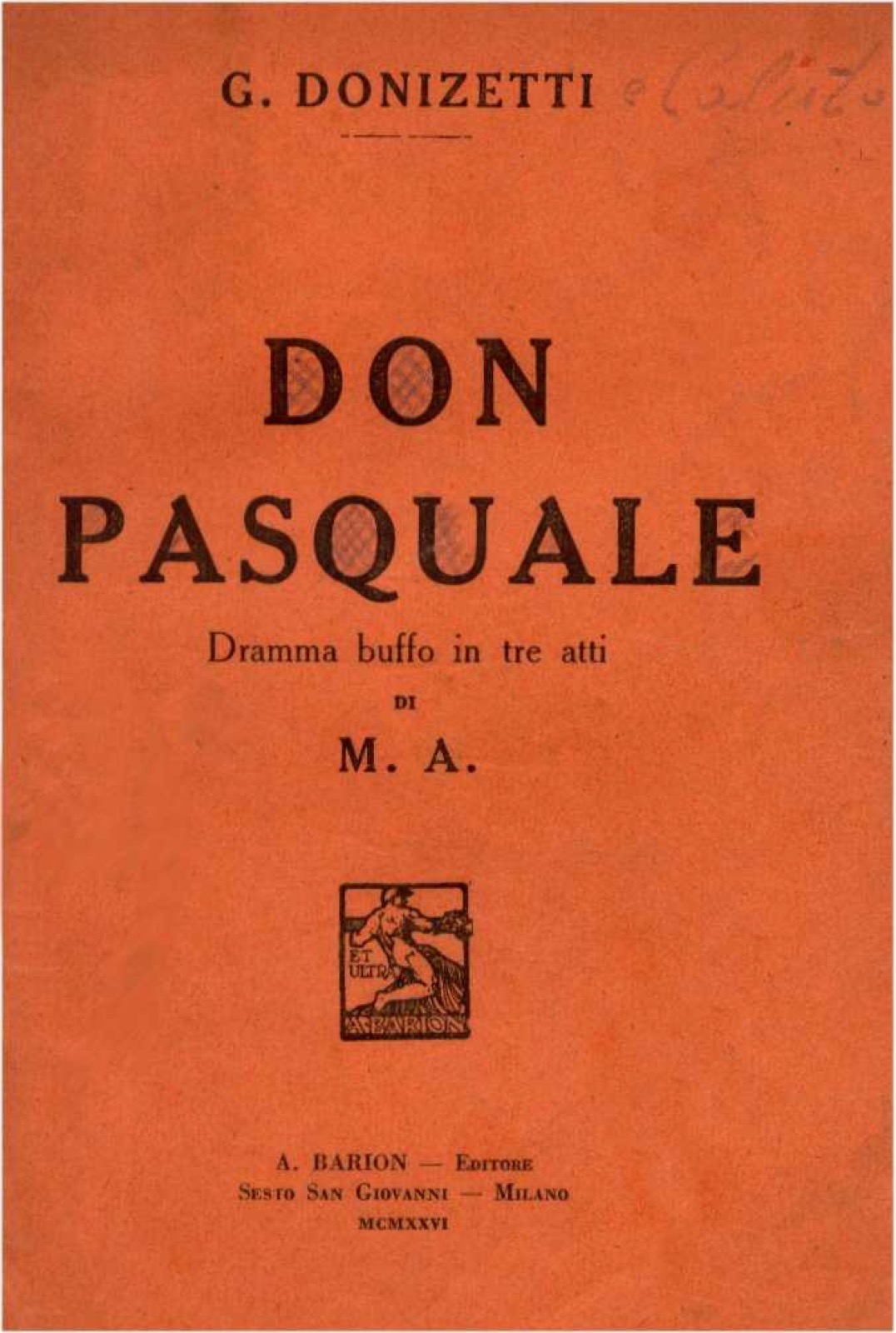
Donizetti so dominated the preparation of the libretto that Ruffini refused to allow his name to be put on the score1. The published libretto carried only the initials M.A., and the confusion over the identity of the librettist lasted more than half a century1,2. The initials were long read as Michele Accursi, who ceded the rights to Ricordi on condition that his name never be used1,2. Herbert Weinstock established that the libretto was largely Ruffini’s work1. Ruffini himself complained that his freedom of action had been paralyzed by the maestro1.
At the final dress rehearsal Donizetti added Com’è gentil, a piece he had already written for the tenor, designed for the third act1. Don Pasquale was the 64th of his eventual 66 operas6. It became his last really big success2.
The 1843 libretto is headed dramma buffo in tre atti7. Modern references call the work an opera buffa1,6.
Roles and voice types
Don Pasquale is an elderly bachelor, sung by a bass1. He is a rich man who decides to marry at the last minute in order to deprive his nephew of his inheritance3. He has no children, so all his money and property would go to Ernesto on his death2. Donizetti’s own character note reads: old celibate, old-fashioned, thrifty, credulous, obstinate2.
| Role | Voice type | Character |
|---|---|---|
| Don Pasquale | Bass | An elderly bachelor1 |
| Dr. Malatesta | Baritone | Pasquale’s physician1 |
| Ernesto | Tenor | Pasquale’s nephew, in love with Norina1,3 |
| Norina | Soprano | A youthful widow, Ernesto’s beloved1 |
| Carlino | Bass | Malatesta’s cousin, a notary1 |
Who is Malatesta in Don Pasquale?
Malatesta is Pasquale’s physician, a baritone, and the mastermind of the plan to fool Don Pasquale1,3. He is a friend of both Ernesto and Pasquale who helps the young couple devise the plan8. He is a self-made, facetious and enterprising man, though with a doctor’s title2. In the commedia dell’arte tradition he is the scheming Scapino1.
The other roles follow the same stock types. Pasquale is the blustery Pantalone, Ernesto the lovesick Pierrot and Norina a wily Columbina1. Norina is a young widow who has suffered her share of hardship2. In the plot she takes the pseudonym Sofronia and pretends to be Don Pasquale’s wife3.
Synopsis
Act 1
The libretto opens in a salon in Don Pasquale’s house, with an entrance door at the back7. The elderly bachelor impatiently awaits his friend Dr. Malatesta9. Pasquale is furious because Ernesto refuses to marry the woman he has picked4. He disinherits Ernesto and orders him to move out9.
Malatesta, a family friend, puts forward as a bride his beautiful, young, convent-bred sister4. Sofronia, in his telling, is a timid, naive girl raised in a convent3. Malatesta announces that he will bring the bride to Don Pasquale that very evening2. In scene 4 Norina enters in her own house with a book in her hand, reading aloud7.
Act 2
Ernesto believes he has no choice but to travel and lose himself in exotic locales9. Pasquale, in full gala dress and followed by a servant, decides to marry Sofronia immediately7,9. Malatesta summons his cousin, who, disguised as a notary, draws up the contract3. When Pasquale dictates the conditions, the notary repeats the last syllable of his words2.
Once the papers are signed, Norina turns from an obedient and religious girl into an upper-class primadonna2. Malatesta has planned that the seemingly sweet woman will turn into a veritable harpy as soon as the vows are uttered3.
Act 3
The bills are piling up in Pasquale’s house3. The Act 3 garden scene is set in a grove in the garden next to Don Pasquale’s house7. Malatesta finally reveals that Sofronia and Norina are one and the same person3. Pasquale is so relieved to be rid of Sofronia that he happily gives the young couple his blessing4. He grants permission for Ernesto to marry Norina9. Norina’s last words in the opera are a moral against marrying in old age2.
Arias and numbers
The act and character of each number below come from the sources that list it. The Act 3 finale is titled La moral di tutto questo in one edition and La morale in tutto questo in the others1,8. StageAgent lists it as a scene and rondo for Norina; Wikipedia calls it a quartet, and the table follows Wikipedia1,8.
| Number | Character | Act | Type |
|---|---|---|---|
| Bella siccome un angelo | Malatesta | Act 17,8 | Aria describing the bride2 |
| Un foco insolito | Pasquale | Act 12 | Aria on how young he feels at the idea of marrying2 |
| So anch’io la virtù magica | Norina | Act 18 | Cavatina, a long and demanding soprano aria8,2 |
| Pronta io son | Norina and Malatesta | Act 11,8 | Recitative and duet, first finale8 |
| Povero Ernesto | Ernesto | Act 22 | Aria of over-the-top self-pity2 |
| Cercherò lontana terra | Ernesto | Act 21,8 | Prelude, scene and aria8 |
| Com’è gentil | Ernesto | Act 31,8 | Serenade, accompanied by guitars2,8 |
| Tornami a dir che m’ami | Norina and Ernesto | Act 31,8 | Notturno, the outstandingly beautiful love duet2,8 |
| Cheti, cheti, immantinente | Malatesta and Pasquale | Act 38 | Recitative and duet8 |
| La moral di tutto questo | Norina has the last words2 | Act 31,8 | Finale: a playful quartet that reveals the moral1 |
Bella siccome un angelo is Malatesta’s most famous aria, where he describes all the wonderful attributes of the future bride2. Com’è gentil is Ernesto’s most famous aria2. Cheti, cheti immantinente is one of the highlights, and it is very rare to have a baritone and a bass sing together in a duet2. The Act 2 finale is a very fast quartet2.
In our wording, Bella siccome un angelo is lovely as an angel, Pronta son is I’m ready, and Aspetta, aspetta, cara sposina is hold on, hold on, my dear little wife1.
Here are sung first lines from the 1843 libretto, each with our own translation7:
| Original | Our translation |
|---|---|
| Dot. Bella siccome un angelo7 | Doctor: Beautiful as an angel (Act 1) |
| Farò imbrogli, farò scene, Mostrerò quel che so far7 | I’ll stir up trouble and make scenes; I’ll show what I can do (Norina, Act 1) |
| Cercherò lontana terra Dove gemer sconosciuto7 | I’ll find a remote country where I can grieve unknown (Ernesto, Act 2) |
| Cheti cheti immantinente Nel giardino discendiamo7 | Quietly, quietly, at once, down into the garden we go (Act 3) |
| Tornami a dir che m’ami7 | Say it again: you love me (Act 3) |
Performance history
The 1843 premiere was performed by four of the most celebrated singers of the day and was an immediate success1. The 1843 Paris production was wildly successful and the opera has never gone out of favor9. Pasquale is one of the three most popular Italian comic operas, the others being Rossini’s The Barber of Seville and Donizetti’s L’elisir d’amore1.
The first performance in Italy was at La Scala in Milan on 17 April 18431. The first Italian cast was Ottavia Malvani as Norina, Napoleone Rossi as Pasquale, Leone Corelli as Ernesto and Achille De Bassini as Malatesta1. The Vienna premiere of 1843 at the Kärtnertortheater included a comic baritone duet that Donizetti borrowed from his unperformed opera L’Ange de Nisida1.
The opera was first performed in Buenos Aires on 18 May 18511. The first Australian performance was presented in Sydney on 12 October 1854 at the Royal Victoria Theatre1. The Royal Opera House gave the work on 29 June 1854 at the Royal Italian Opera, and The Royal Opera’s company premiere was on 9 February 19735. The opera was translated into French by Gustave Vaëz and Alphonse Royer1.
Music and style
Don Pasquale is the first comic opera without secco recitatives2. The secco recitative is accompanied by only a harpsichord and sometimes a cello, which gives the singer great freedom2. Earlier, opera seria had omitted it, but in comic opera this was the first time2. The Act 2 recitative is the famous accompanied recitative that substitutes for the secco recitative2.
The work is the apotheosis of opera buffa3. It is generally regarded as the high point of the 19th-century opera buffa tradition as well as marking its ending1.
Language and diction notes
The libretto is in Italian1, so the rules in Italian diction for singers apply to every number above. The 1843 libretto is on the Internet Archive as a scan of the dramma buffo in tre atti7. Opera Theatre Saint Louis staged its 1998 production in an English translation by Phyllis Mead4.
Further reading: Opéra national de Paris and Royal Ballet and Opera Collections.
Where to go next
The nearest comedies are L’elisir d’amore and Il barbiere di Siviglia, the other two of the three most popular Italian comic operas1. For another Donizetti heroine, see Lucia di Lammermoor.
