Lyric diction
German diction for singers: glottal stop, ich-Laut and ach-Laut, final devoicing and r
German lyric diction in one page: the glottal stop, the two ch sounds, final devoicing of b, d and g, vowel length, schwa and the German r.
By Diction Desk editors · Published · Updated · Checked against 9 sources
German has two ch sounds: [ç] after i, e, y, ä, ü, ö or a consonant and [x] after a, o, u11. When sung, final b, d and g become p, t and k, and words that begin with a vowel take a glottal stroke11. The sung r is the alveolar tongue-tip r that Siebs preferred; the uvular r of speech does not carry8,12.
- Two ch sounds
- Ich-Laut [ç] and ach-Laut [x]11
- Ach-Laut after
- a, o, u11
- Final b, d, g (sung)
- p, t, k at the end of a word element11
- Glottal stop (sung)
- Before words and word elements that begin with a vowel11
- Stage r
- Alveolar tongue-tip r; the uvular r dominates in speech12
- Standard text
- German for Singers, in use for more than 40 years9
Contents
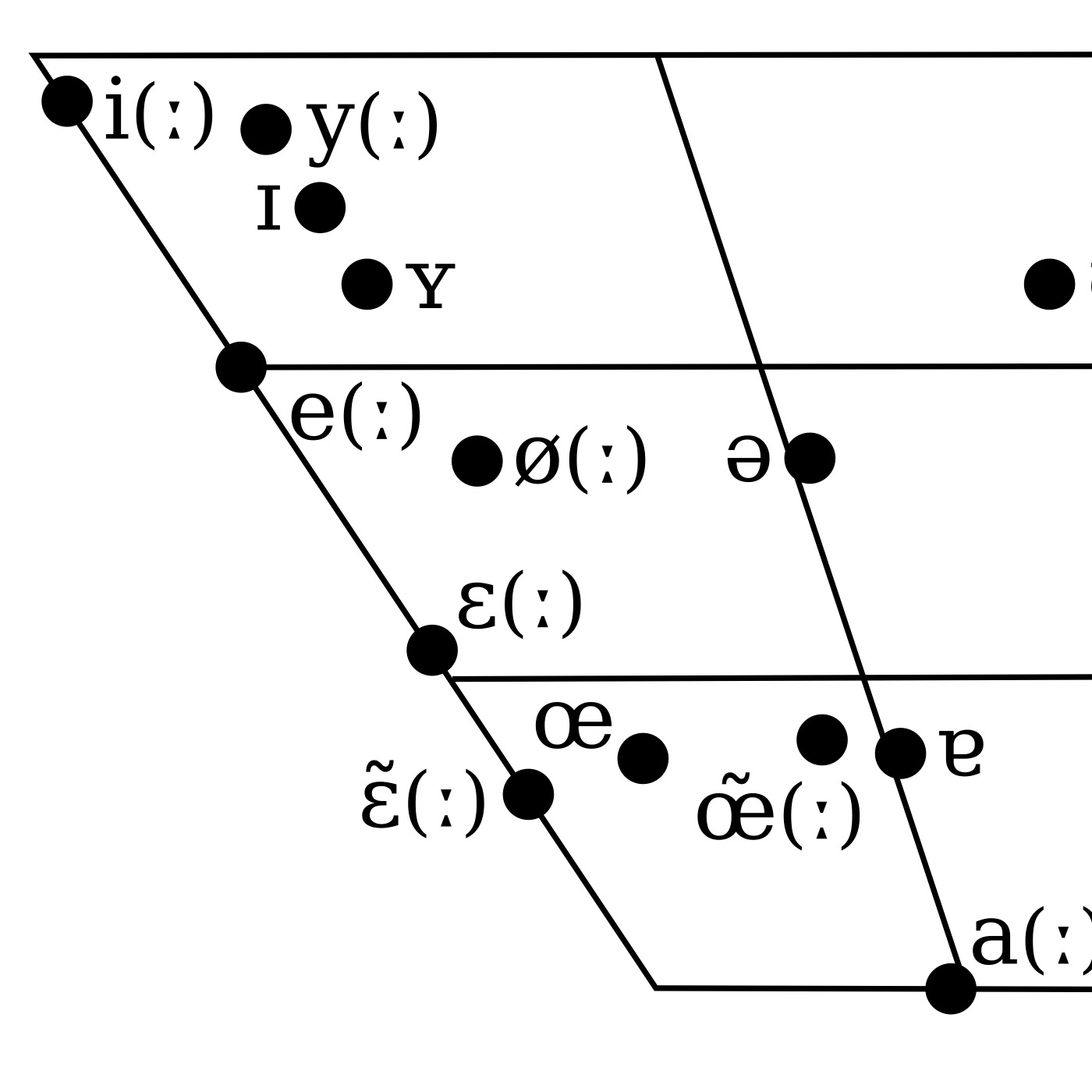
German diction for singers follows the stage standard, Bühnenaussprache. In 1898 theatre directors and Germanists met in Berlin to settle a uniform German stage pronunciation, and Siebs’s Deutsche Bühnenaussprache grew out of that meeting12. Everyday speech differs on the r and the glottal stop, so each rule below is labeled sung or spoken. The wider diction section covers the other languages.
Vowels
As a general rule, long vowels are closed and long11. Length follows spelling within the word element: a is long before h or one consonant, and short before two or more consonants11. German vowels are pure: the sound does not change during the course of the vowel, as the Stanford pronunciation guide for singers teaches8.
| IPA | Example words |
|---|---|
| [a] | alles, Kalender6 |
| [aː] | aber, sah, Staat6 |
| [ɛ] | Ende, hätte6 |
| [ɛː] | spät, wählen6 |
| [eː] | eben, gehen, See6 |
| [ɪ] | ist6 |
| [iː] | Liebe, Berlin, ihm6 |
| [oː] | oder, hohe, Boot6 |
| [ɔ] | kommen6 |
| [øː] | Österreich, Möhre, adieu, Goethe6 |
| [œ] | Köln6 |
| [ʊ] | und6 |
| [uː] | Hut, Kuh6 |
| [ʏ] | fünf, Sylt6 |
| [yː] | über, Mühe6 |
Diphthongs and the reduced vowel:
German has several diphthongs8. Standard German pronunciation rests on a de facto standard documented in reference works4. The pronunciation Germans usually consider closest to the standard is that of Hanover4. Siebs set as his norm the northern German pronunciation of the High German spellings12.
Spelling and sound: e, i and ä
Short e is very like the English short e in best, as in Rest and denn8. Long e is similar to the Italian closed e of che8. Unstressed e often turns into a schwa, as in gegeben and Auge8. Short i is pronounced like the English i in mitt, as in dich, mit and ist8. Long i is almost always spelled ih or ie, as in ihn, wie and liegen8. Long ä makes the same sound as long e, and short ä the same sound as short e8.
The umlaut ö
Nothing quite like ö exists in English8. Form the German long e, then round the lips as for o8.
Schwa
The schwa occurs only in unstressed syllables4. The German schwa is used only when e is unstressed11.
The two ch sounds
German has two ch sounds, and neither exists in English, French or Italian11. The ich-Laut is the voiceless palatal fricative [ç], as in ich4. The ach-Laut is the voiceless velar fricative [x], as in ach4. They are allophones of one sound in the language4, but the ach-Laut itself splits into two allophones, [x] and [χ], depending on the preceding vowel4.
| Spelling | IPA | Example |
|---|---|---|
| ch after i, e, y, ä, ü, ö or a consonant | [ç] | Mädchen, durch11 |
| ch after a, o, u | [x] | Ach, hoch11 |
| diminutive -chen | [ç] | always an ich-Laut4 |
| -ig at the end of a word | like German ch | ruhig, lustig8 |
Back vowels a, o and u precede [x]; i, e, y, ä, ü, ö and consonants precede [ç]11. Teachers call the ich-Laut a cat hiss: if the tongue arch touches the hard palate, a [k] results11. They call the ach-Laut preparing to spit: if the arch is too far forward, it becomes an ich-Laut11. The ich-Laut is not the same as [ʃ]11.
After the front vowels e and i, ch is similar to the h sound in huge, drawn out in time8. After the back vowels o, a and u, the air flow sits further back in the mouth8.
Final devoicing
Sung. Sung German devoices b, d and g at the end of a word element: final b is [p], final d is [t] and final g is [k]11. Tag is [ta:k] and Hand is [hant]11. The rule follows the word element, not the whole word: in Abbild the first b ends a prefix and becomes [p], and the second b begins the root and stays [b]11. When a final vowel drops, as in hab’ for habe, the b keeps its voiced value11. Final b is pronounced like p, as in ab8.
Everyday speech. The classical analysis, described in a mismatch negativity study, has the voiced values turn voiceless in a syllable coda10. The change takes place obligatorily in a set of core environments that include the word-final position10. It makes homophones of such pairs as Rad and Rat3. In the nominative form, without the genitive suffix, both are pronounced identically as [ra:t]10.
Standard German keeps g as [g] inside a word and [k] at the end. Pronouncing the g as [ç] or [x], so that Tag ends in an ach-Laut, is dialect in central and northern Germany12. Regional context: the German varieties of the north, and many pronunciations of standard German, involve voice in the fortis-lenis distinction3. In southern varieties the lenis obstruents are voiceless4. Norwegian and Swedish do not have final devoicing3.
The glottal stop
Sung. Words and word elements that begin with a vowel are articulated by closing the vocal folds (the glottis) and gently blowing them apart on the onset of the vowel11. The glottal onset is also called the glottal stroke11. German and English use breaks, lifts and aspirate sounds, unlike the legato Romance languages11. Where a word element ending in a consonant meets one that starts with a vowel, as in herein, use a glottal stroke and keep the consonant with the first syllable11.
Everyday speech. A glottal stop is a consonantal sound produced by obstructing airflow in the glottis7. In German it occurs in careful speech before word stems that begin with a vowel4.
The r
Sung. Siebs preferred the alveolar tongue-tip r and opposed the uvular r that had become fashionable from French12. The uvular r often used in spoken German does not work for singing, and the American English r is never appropriate8. The handbook transcribes initial, medial, intervocalic and final r in a word element as the flipped [ɾ]11. After a vowel in a word element it gives [ɚ] or [ʁ], an r-colored vowel11. At the end of a syllable an r may be hardly pronounced at all, or it turns into a schwa, as in der8.
Everyday speech. The German r can be uvular, alveolar or even dental4. Its place of articulation varies from uvular to velar depending on the vowel context4. The uvular r can be reduced to an approximant in an intervocalic position4, and it is devoiced after voiceless plosives and fricatives4. The uvular r has gained ground and predominates today12. The moderate standard, the gemäßigte Hochlautung, allows the r to vocalize12.
Other consonants
The German consonant system has an average number of consonants compared with other languages4. One of the more noteworthy consonants is the unusual affricate pf4. Consonants in clusters are all pronounced8.
| Spelling | Sound | Example words |
|---|---|---|
| Initial s before a vowel | voiced, like English z | so, sie, sagen8 |
| Initial s before p or t | English sh | Sternlein, spielen8 |
| Initial v | like English f | vertraue, Verlust8 |
| w | like English v | wird, etwas8 |
| z | ts | zu, stürzte8 |
Pronouncing sp and st with sh inside and at the end of words, as in Last and hast, is dialect, not standard12.
Stage German versus everyday speech
Spoken pronunciation is not always the same as sung pronunciation11. Siebs’s rules were meant from the outset as pronunciation for the stage12. Siebs ruled out moving stage pronunciation mechanically into everyday speech12.
| Rule | Sung (Bühnenaussprache) | Everyday speech |
|---|---|---|
| r | Alveolar tongue-tip r; the uvular r of speech does not work8,12 | Uvular r predominates12 |
| r after a vowel | [ɚ] or [ʁ], or barely pronounced, or a schwa at syllable end11,8 | The moderate standard allows the r to vocalize12 |
| Glottal stop | Glottal stroke before vowel-initial words and word elements11 | Occurs in careful speech before vowel-initial stems4 |
| Final b, d, g | [p], [t], [k] at the end of a word element11 | Obligatory in core environments, word-final position included10 |
Common mistakes for English speakers
- English sh for the ich-Laut. The ich-Laut is not [ʃ]11.
- One ch for every word. There are two: [ç] and [x]11.
- A ch for final g. Standard German keeps final g as [k]; [ç] or [x] for g is dialect12.
- Voiced finals. Final b, d and g are [p], [t] and [k] in a word element11.
- Devoicing a b that begins a root. In Abbild only the first b devoices11.
- Skipping the glottal stroke before words and word elements that begin with a vowel11.
- The uvular or American r. Neither carries in singing8.
- Sh before p or t inside a word. Last and hast keep s12.
- A schwa that disappears. Unstressed e often turns into a schwa8.
- Lazy consonants. You cannot get away with lazy American English habits in German8.
William Odom and German for Singers
William Odom is professor of German language and music diction at the University of Southern Mississippi9. He authored the first edition of German for Singers, which appeared in 19819. German for Singers: A Textbook of Diction and Phonetics has been the standard for German lyric diction instruction for more than 40 years9. The third edition was updated to reflect current International Phonetic Alphabet (IPA) usage9.
The third edition adds Austrian baritone Benno Schollum, who studied at the University of Music and Performing Arts in Vienna, and Christina Balsam Curren, who has taught at the Eastman School of Music since 19899. The book puts difficult sounds first so that students have adequate time to practice them9. It includes consonant and vowel charts for English and German9.
Next steps
The symbols are laid out in IPA for singers, and Italian diction gives the contrast for German consonants. The Northern Colorado lyric diction handbook and the Strani jezici study of German pronunciation standards are the sources behind the sung rules. For scores, see Der Rosenkavalier and Fidelio.
Read next
IPA for singers: what the International Phonetic Alphabet is and how to use it
The International Phonetic Alphabet for singers: why one symbol equals one sound, the marks that matter, singers' charts and where to find IPA texts.
Lyric dictionItalian diction for singers: vowels, consonants, IPA and double-consonant rules
Italian lyric diction in one page: the 7 vowels, open and closed E and O, the c and g rules, gli, gn, sc, double consonants and the rolled r.
Opera guidesDer Rosenkavalier: synopsis, roles, arias and diction notes
Strauss's Der Rosenkavalier in one page: librettist, premiere, voice types, the silver rose plot act by act, key musical numbers and German diction notes.
Questions singers ask
What are the two ch sounds in German?
The ich-Laut is the voiceless palatal fricative [ç], as in ich, and the ach-Laut is the voiceless velar fricative [x], as in ach4. Ch is [ç] after i, e, y, ä, ü, ö or a consonant, and [x] after a, o, u11. The ich-Laut is not the same as [ʃ]11.
What is final devoicing in German?
Sung German turns final b into p, final d into t and final g into k within a word element11. Final devoicing makes homophones of pairs such as Rad and Rat3. The word element decides: in Abbild the first b ends a prefix and becomes p, and the second b stays b11.
How is the German r pronounced?
For singing it is the alveolar tongue-tip r, which Siebs preferred over the uvular r12. The uvular r of spoken German does not work for singing, and the American r is never appropriate8. In everyday speech the uvular r predominates12.
Does German vowel length matter?
Yes. As a general rule, long vowels are closed and long11. Length follows spelling within the word element: a is long before h or one consonant and short before two or more consonants11.
What is the glottal stop in German?
It is a consonantal sound made by stopping airflow in the glottis, written [ʔ]7. When singing German, words and word elements that begin with a vowel take a glottal stroke: the vocal folds close, then blow apart gently on the vowel11. In everyday speech it occurs in careful speech4.
Sources
- Final-obstruent devoicing · Wikipedia · en.wikipedia.org · checked 19 October 2026
- Standard German phonology · Wikipedia · en.wikipedia.org · checked 19 October 2026
- Help:IPA/German · Wikipedia · en.wikipedia.org · checked 19 October 2026
- Glottal stop · Wikipedia · en.wikipedia.org · checked 19 October 2026
- German Pronunciation Tips for singers · Stanford University · www-leland.stanford.edu · checked 20 October 2026
- German for Singers: A Textbook of Diction and Phonetics, Third Edition · Plural Publishing · pluralpublishing.com · checked 20 October 2026
- Evidence for the role of German final devoicing in pre-attentive speech processing: a mismatch negativity study · PubMed Central (NCBI) · pmc.ncbi.nlm.nih.gov · checked 20 October 2026
- A Lyric Diction Handbook: German diction · University of Northern Colorado, Digital UNC (open textbook) · digscholarship.unco.edu · checked 20 October 2026
- Zur Normierung der deutschen Aussprache · Strani jezici, University of Osijek (Talanga) · stranijezici.ffzg.unizg.hr · checked 20 October 2026
Photos (1)
- Wikimedia Commons contributors, CC BY-SA 3.0

Translations of libretto lines on this page are our own. How we check facts · Report an error.