Opera guides
Norma: synopsis, roles, arias and diction notes
Bellini's Norma in one page: librettist, premiere, voice types, the story of the druid priestess, Casta Diva and other arias, and Italian diction notes.
By Diction Desk editors · Published · Updated · Checked against 7 sources
Norma is a tragedia lirica in two acts by Vincenzo Bellini to a libretto by Felice Romani, after Alexandre Soumet's play Norma, ou L'infanticide1. It was first produced at La Scala in Milan on 26 December 18311. Its best-known number is the soprano prayer Casta diva in Act 1, one of the most famous arias of the nineteenth century1.
- Composer
- Vincenzo Bellini1
- Librettist
- Felice Romani1
- Premiere
- 26 December 1831, La Scala, Milan1
- Language
- Italian1
- Acts
- 21
- Genre
- Tragedia lirica; a leading example of bel canto1
Contents
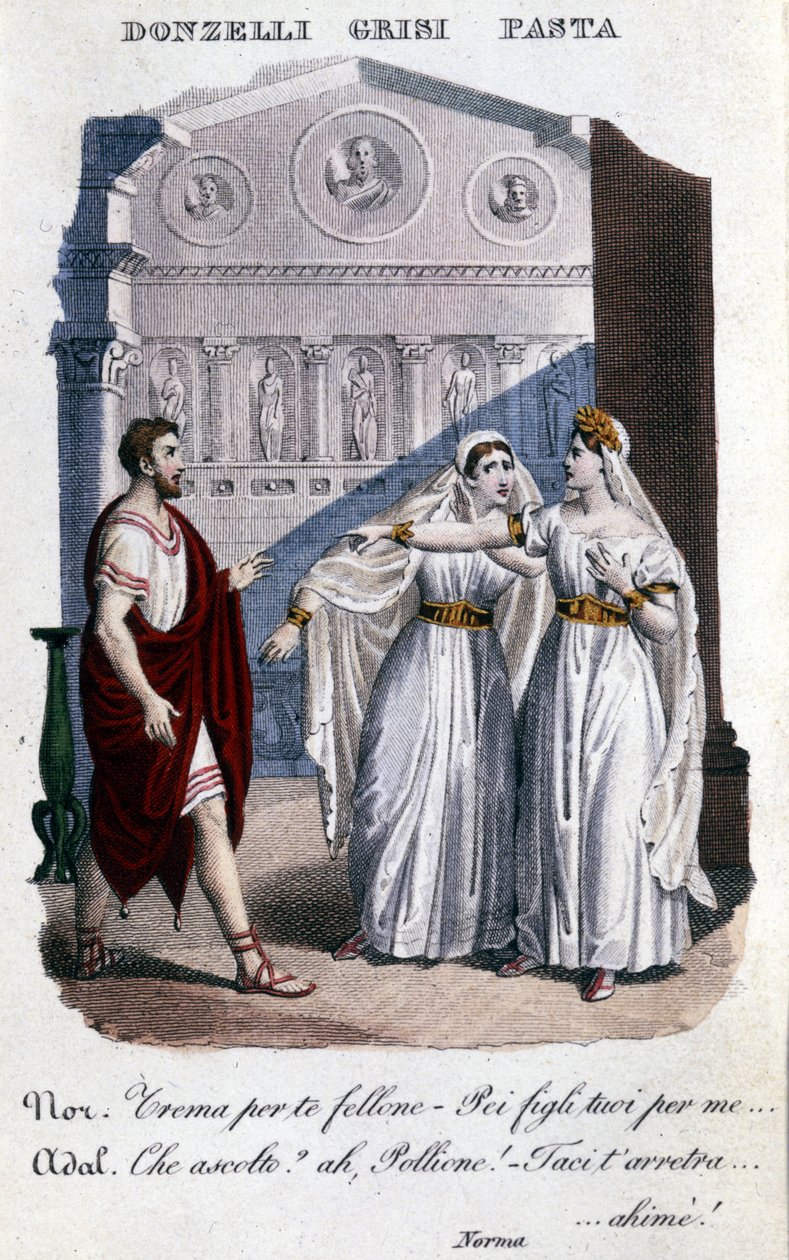
Norma is regarded as a leading example of the bel canto genre1. It is celebrated for its finely shaped melodies and exquisite arias, as the English National Opera synopsis puts it4. This page gives the facts to have in hand before you open the score; it is one of many guides in the operas section.
At a glance
Bellini’s two-act opera has a libretto by Felice Romani1. It follows the play Norma, ou L’infanticide (Norma, or The Infanticide) by Alexandre Soumet1. Romani (1788 to 1865) was an Italian poet, librettist and scholar, considered the finest Italian librettist between Metastasio and Boito, who wrote many librettos for Donizetti and Bellini5. Bellini, at the height of his powers, was very demanding of his librettist and required many rewrites1. Romani called Norma the most beautiful rose in the garland of his work with Bellini1.
The first production was at La Scala in Milan on 26 December 18311. The action takes place in Gaul during the Roman occupation, around 50 BC2.
Roles and voice types
| Role | Voice type | Premiere singer |
|---|---|---|
| Norma, daughter of Oroveso, high priestess of the druids | Soprano | Giuditta Pasta1 |
| Pollione, Roman proconsul in Gaul | Tenor | Domenico Donzelli1 |
| Adalgisa, priestess in the grove of the Irminsul statue | Soprano (often sung by mezzo-sopranos) | Giulia Grisi1 |
| Oroveso, Norma’s father, chief of the druids | Bass | Vincenzo Negrini1 |
| Clotilde, Norma’s friend | Soprano | Marietta Sacchi1 |
| Flavio, Pollione’s companion | Tenor | Lorenzo Lombardi1 |
The title role calls for great vocal control of range, flexibility and dynamics, and is one of the most taxing and wide-ranging parts in the soprano repertoire1. Lilli Lehmann said singing all three Brünnhildes in one evening would be less stressful than one Norma1. She also said that in Bellini a singer must always care for beauty of tone and correct emission1.
Synopsis
Norma is a high Druid priestess of a temple in Gaul during the Roman occupation3. Although she has secretly broken her vows to love Pollione, she has borne him two children1. Pollione has fallen in love with Adalgisa, a young priestess of the temple of Irminsul4,7. The Teatro Real summary and the OperaGlass summary from Stanford follow the same plot2,7.
Act 1
The druids, led by Oroveso, pray to their god Irminsul for victory against the invading Romans1,4. Pollione tells Flavio that he no longer loves Norma, having fallen in love with Adalgisa1. He fears Norma’s anger and describes a dream in which she harms the children7. Norma cuts the sacred mistletoe, invokes the moon and prays for peace2. She calms the Gauls with that prayer, Casta Diva, and tells them the time for war has not yet come6,7. The sacred gong summons her to the altar, and she says it portends Pollione’s death2. Adalgisa tells Norma she has resolved to leave Pollione and return to her temple4. Norma secretly acknowledges she would defend Pollione with her life should he return to her4.
Act 2
Norma, in her anguish and despair, contemplates killing her children4. She hovers over them as they sleep with a knife, intending to kill them and then herself, but even to be avenged on Pollione she cannot do it, overwhelmed by love for them2,4. Adalgisa protests that she has no further thoughts of marrying Pollione2. Clotilde tells Norma that Pollione still plans to take Adalgisa away with him2. Oroveso brings dispiriting news: the next proconsul will be even harsher than Pollione4.
Norma strikes the gong and tells the tribe the time is now ripe for rebellion2. Clotilde reports that a Roman has desecrated the temple and been captured in the sacred cloister of the virgins4. Pollione is dragged in, caught trying to carry off Adalgisa by force2. Oroveso and the druids urge Norma to strike him down, but she cannot4. Norma announces that the victim is a priestess who has broken her vows, and names herself2,4. Seeing her sacrifice, Pollione’s love for her is reignited4. She confesses the existence of her sons and begs Oroveso to protect them2, and he forgives her7. Norma publicly confesses her fault and is sentenced to death by fire1. Pollione joins her at the pyre, declaring that a holier and everlasting love will begin there1.
The famous arias
| Piece | Role | Act | First line |
|---|---|---|---|
| Opening chorus | Oroveso and druids | 1 | Ite sul colle, o druidi (Climb the hill, druids)1 |
| Dream aria | Pollione | 1 | Meco all’altar di Venere1 |
| Casta diva | Norma | 1 | Casta Diva, che inargenti (Chaste Goddess)3,6 |
| Va crudele | Pollione | 1 | Va crudele (Go, O cruel one)1 |
| Qual cor tradisti | Norma and Pollione | 2 | Qual cor tradisti, qual cor perdesti1 |
| Teneri, teneri figli | Norma | 2 | Teneri, teneri figli (Tender, tender sons)1 |
| Deh! non volerli vittime | Norma and Oroveso | 2 | Deh! non volerli vittime (Ah, do not demand them as victims)1 |
Casta diva is one of the most famous arias of the nineteenth century1. Giuditta Pasta first felt it was ill adapted to her vocal abilities, then adapted after a week of rehearsal1. Norma’s Teneri, teneri figli is sung over her sleeping sons1. Pollione’s duet with Adalgisa asks her to come to Rome1. Schopenhauer called the work a tragedy of extreme perfection, and singled out the duet Qual cor tradisti, qual cor perdesti1.
Lines to read aloud
| Original | Our translation |
|---|---|
| Casta Diva, che inargenti6 | Pure Goddess, you who silver |
| Queste sacre antiche piante6 | These sacred ancient trees |
| Ite sul colle, o druidi1 | Climb the hill, druids |
| Teneri, teneri figli1 | Tender, tender children |
Background, premiere and versions
On opening night the opera was received with what Weinstock described as chill indifference1. Bellini wrote to Florimo that night: Fiasco! Fiasco! Solemn fiasco!1 Norma was given 34 performances in its first season at La Scala, and by the end of the 19th century La Scala alone had given 2081.
The British premiere was in London on 20 June 18331. The US premiere was at the St. Charles Theatre in New Orleans on 1 April 18361. The Met gave its first Norma on 27 February 1890, with Lilli Lehmann singing the title role in German1.
Rosa Ponselle played the title role in New York and London in the first half of the 20th century1. Post-war exponents include Maria Callas, Leyla Gencer, Joan Sutherland and Montserrat Caballé1. Callas made two studio recordings of the opera for EMI/HMV1. Pavarotti called Joan Sutherland the greatest female voice of all time1.
Verdi wrote in 1898 that Bellini is poor in harmony and instrumentation but rich in feeling and in an individual melancholy of his own1. Bellini believed the true magic of opera depended on a kind of incantation in which dramatic poetry and song are perfectly fused1. Marion Zimmer Bradley’s 1993 novel The Forest House was based on the plot of Norma1.
Language and diction notes
The libretto is in Italian, so the rules in Italian diction for singers apply throughout. Before you sing an aria, mark each stressed e and o and each double consonant. The first lines in the table above are good first exercises: transcribe each into IPA, then check it with a coach.
Bellini’s ideal is poetry and song fused, so speak each line as text before you sing it1. Care for beauty of tone and correct emission applies to every vowel you sing1.
Where to go next
Two more bel canto and Italian operas to study next are Lucia di Lammermoor and La traviata.
