Lyric diction
Spanish diction for singers: five vowels, b d g, tap and trill, seseo and yeismo
Spanish lyric diction in one page: the five pure vowels, soft b d g, the tap and the trill, c and z, ll and y, and Castilian versus Latin American choices.
By Diction Desk editors · Published · Updated · Checked against 9 sources
Spanish has five vowel phonemes, i, u, e, o and a, each occurring in stressed and unstressed syllables, with no open-mid versus close-mid contrast1. The consonants b, d and g are voiced stops only after a pause or a nasal and approximants elsewhere1. The tap and the trill are separate sounds1. Regional choices include seseo and yeismo2.
- Vowel phonemes
- 5: i, u, e, o, a1
- Open-mid vs close-mid
- No contrast, unlike Italian and French1
- b, d, g
- Stops only after a pause or nasal; approximants elsewhere1
- r
- Tap and trill contrast between vowels1
- Stress
- Penultimate syllable about 80% of the time1
- Regional features
- 5 features distinguish varieties, including seseo and yeismo2
Contents
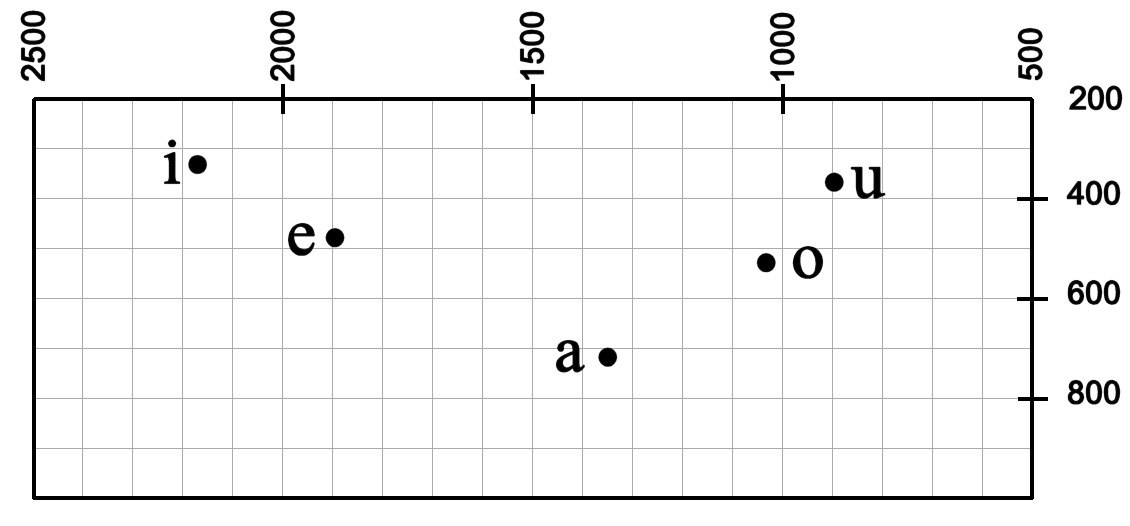
The vowels are few and steady. The consonants shift with their neighbors. Unless a source says otherwise, the facts here describe Castilian Spanish, the standard dialect used in Spain on radio and television1. The rules below are for singers moving across the diction section; the Italian vowel rules in Italian diction are the closest comparison.
The five vowels
Spanish has five vowel phonemes: i, u, e, o and a1. Each of the five occurs in both stressed and unstressed syllables1. There is no contrast between close-mid and open-mid vowels, unlike in Catalan, Galician, French, Italian and Portuguese1. In the historical development of Spanish, former open-mid vowels were replaced with the diphthongs [ie] and [ue] in stressed syllables1. The close vowels i and u are rare in unstressed word-final syllables1.
Vowels are phonetically nasalized between nasal consonants or before a syllable-final nasal1. Singing guides still mark a difference in transcription. In the IPA Source transcriptions, following Arden Hopkin, the long e is used in open syllables and the short e in closed syllables3. An open syllable ends in a vowel and a closed syllable ends in a consonant3. The vowels a, i and u are pronounced similarly in Standard American Spanish and Standard European Spanish3. Nico Castel’s manual uses only the open e and o for Castilian3.
Diphthongs and hiatus
Spanish has falling diphthongs that end in a glide and rising diphthongs that start with one1. There is still lexical contrast between diphthongs and hiatus1. In fast speech, sequences of vowels in hiatus become diphthongs1.
Soft b, d and g
The phonemes b, d and g are pronounced as voiced stops only after a pause or after a nasal consonant1. In all other contexts they are realized as approximants1. Between vowels, then, b, d and g are soft, not the hard stops of English.
| IPA | Example words |
|---|---|
| [β] | bebé, fútbol, viva6 |
| [ð] | dedo, arde, sed, ritmo6 |
| [ɣ] | haga, galgo, signo, águila6 |
The t and d of Spanish are laminal denti-alveolar sounds1. At the end of a syllable, the contrast among the three nasals is generally neutralized, as nasals assimilate to the place of articulation of the following consonant1.
The tap and the trill
The alveolar trill and the alveolar tap are in phonemic contrast word-internally between vowels1. The tap occurs after any syllable-initial consonant, while the trill occurs after any syllable-final consonant1. Only the trill can occur at the start of a word1. Only the tap can occur after a word-initial obstruent consonant1. The three rhotic sounds are all articulated at the same point, the alveolar ridge2.
| Spelling | IPA | Example |
|---|---|---|
| r between vowels | [ɾ] | brío, caro, por6; contrasts with the trill1 |
| rr, and r at the start of a word | [r] | río, carro, honra6; only the trill can start a word1 |
| r after a syllable-initial consonant | [ɾ] | tap1 |
| r after a syllable-final consonant | [r] | trill1 |
The alveolar trill is one of the most difficult sounds to produce in Spanish1, and it is often very difficult for those learning Spanish as a second language1. The attempted trill of poor trillers is often perceived as a series of taps1. In syllable-final position before consonants inside a word, the tap is more frequent than the trill1. A word-final rhotic is a tap when the next word begins with a vowel1. When two rhotics occur consecutively across a word or prefix boundary, they result in one trill1. The trill is only found in words where the rhotic is preceded by a morpheme boundary1, and in native Spanish words it does not appear after a glide1.
C, z, s and the Castilian choice
In Castilian, c before e or i is pronounced [θ], as in gracias3. Seseo is the use of [s] in place of [θ], found in parts of southern Spain and all of Latin America1. In Latin American Spanish z is always voiceless [s]3. Transcribing words spelled with z or c before i or e with [s] is most commonly found outside mainland Spain6.
In many varieties, s may be pronounced as [h] or omitted entirely, especially at the end of a syllable1. The IPA Source guide separates Castilian (SES, Standard European Spanish) from Latin American (SAS, Standard American Spanish)3. In its Ladino transcriptions, the letters c and g before e and i are always [s] and [dʒ] respectively, and v is always [v], never [β]3. The letter j is [dʒ], ll is [j], and s is always voiced [z] except when initial in a word group3.
| Spelling | IPA | Example |
|---|---|---|
| c before e, i; z (Castilian) | [θ] | cera, zoo, caza, juzgar6; gracias3 |
| c before e, i; z (seseo) | [s] | outside mainland Spain6 |
| z (Latin American) | [s] | always voiceless3 |
| v (Ladino transcription) | [v] | always [v]3 |
| g before e, i; j | [x] | gen, jarra, ojo, México6 |
Yeismo
Yeismo is the merger of the palatal lateral /ʎ/ into /ʝ/1. In the Wikipedia key, [ʎ] is heard in lluvia, halla and conlleva, and [ʝ] in haya6. In Standard American Spanish an initial ll is pronounced [dʒ] as in gentle3. In Latin American Spanish, ll and y are pronounced the same way7. Both ll and y end up pronounced as the palatal fricative4. Halla and haya are pronounced exactly the same, [ˈaʝa]4. Yeismo makes spelling harder, like seseo7.
A minority of transcribers use [lj] for the Castilian ll [ʎ]3. In peninsular Spanish the two sounds have merged for the vast majority of speakers, and learners should produce the merger4. A phonetic study of regional Spanish identifies five phonetic features that distinguish regional varieties, including seseo and yeismo2. In varieties where the sounds are not used, a substitution takes place: yeismo replaces /ʎ/ with /ʝ/, and seseo replaces /θ/ with /s/2.
Word stress
Primary stress falls on the penultimate syllable 80% of the time1. The other 20% of the time it falls on the last syllable or the third-last syllable1. Nonverbs are generally stressed on the penultimate syllable if they end in a vowel1. Lexical stress patterns differ between words carrying verbal and nominal inflection1. Learned words from Greek and Latin are exceptions with antepenultimate stress1. Numerous minimal pairs contrast solely in stress, such as sábana and sabana1. In writing, stress is marked in certain circumstances with an acute accent1. Stressed syllables may be up to 50% longer in duration than unstressed syllables1.
Regional choices for singers
Castilian Spanish is the standard dialect of Spain1. Regional variation in the Americas and the Caribbean is outside the scope of the IPA Source transcriptions3; Spanish dialects have many pronunciation variables in Latin America3. Vernacular pronunciation, an entirely different issue, is generally avoided in art song repertoire3.
Manuals and references for singers
A Singer’s Manual of Spanish Lyric Diction by Nico Castel addresses the Castilian idiom and also explores the Latin American variants needed to sing music from the New World5. The manual was formerly published by Excaliber Publishing before Leyerle Publications took it over5. The manual teaches Spanish diction through charts of sounds, prose descriptions, diagrams of the vocal mechanism and a wealth of exercises, per its August 1995 review in The American Music Teacher9. Classical Castilian diction is presented first9. Dialectic variations are discussed for Andean countries9.
The University of North Texas diction resources for singers include Nico Castel’s manual8 and The Spanish Song Companion by Jacqueline Cockburn and Richard Stokes8. They also include books with phonetic readings, IPA and translations, by language8. Leyerle song anthologies usually have texts, IPA and translations8.
Sung versus spoken
Spoken Spanish varies more than a score can. S may be [h] or dropped in many varieties1, and vowels are phonetically nasalized near nasal consonants1. Ladino, the language of the Sephardic Jews exiled from Spain in the late fifteenth century, keeps the soft interior consonants of Spanish3. For that repertoire, see Ladino diction.
Common mistakes for English speakers
- Gliding vowels. Each of the five vowels is one steady sound1.
- Opening or closing e and o. There is no such pair in Spanish1.
- Hard b, d, g between vowels. They are approximants outside the positions above1.
- One r for everything. The tap and the trill are different sounds1.
- A failed trill. The attempted trill of poor trillers is heard as a series of taps1.
- Mixing [θ] and [s]. Castilian uses [θ] for c before e and i, and seseo uses [s]1.
- Following speech habits. S may be [h] or omitted in many varieties1.
- Stressing the wrong syllable. Sábana and sabana differ only in stress1.
Next steps
The symbols are laid out in IPA for singers. Italian diction covers the vowel rules Spanish shares.
Read next
IPA for singers: what the International Phonetic Alphabet is and how to use it
The International Phonetic Alphabet for singers: why one symbol equals one sound, the marks that matter, singers' charts and where to find IPA texts.
Lyric dictionItalian diction for singers: vowels, consonants, IPA and double-consonant rules
Italian lyric diction in one page: the 7 vowels, open and closed E and O, the c and g rules, gli, gn, sc, double consonants and the rolled r.
Lyric dictionLadino diction for singers: Judaeo-Spanish pronunciation and Sephardic song
Ladino (Judaeo-Spanish) for singers: how it relates to Spanish, its vowels and consonants, dialect differences, spelling and the borrowed-melody tradition.
Questions singers ask
How many vowels does Spanish have?
Spanish has five vowel phonemes: i, u, e, o and a1. Each occurs in both stressed and unstressed syllables1. Unlike Italian and French there is no contrast between close-mid and open-mid vowels1.
What is seseo?
Seseo is the use of [s] in place of [θ]1. It is found in parts of southern Spain and all of Latin America1. In Castilian, c before e or i is [θ], as in gracias3.
What is yeismo?
Yeismo is the merger of the palatal lateral /ʎ/ into /ʝ/1. Both ll and y end up pronounced as the palatal fricative4. Halla and haya are pronounced exactly the same, [ˈaʝa]4.
What is the difference between the tap and the trill in Spanish?
The alveolar trill and the alveolar tap are in phonemic contrast between vowels1. The tap occurs after any syllable-initial consonant, while the trill occurs after any syllable-final consonant1. Only the trill can occur at the start of a word1.
Where does the stress fall in Spanish words?
Primary stress falls on the penultimate syllable 80% of the time1. The other 20% of the time it falls on the last syllable or the third-last syllable1. Several minimal pairs differ only in stress, such as sábana and sabana1.
Which manual teaches Spanish lyric diction to singers?
A Singer's Manual of Spanish Lyric Diction by Nico Castel addresses the Castilian idiom and also explores the Latin American variants needed to sing music from the New World5.
Sources
- Spanish phonology · Wikipedia · en.wikipedia.org · checked 19 October 2026
- Caracterización fonética de las variedades del español (Coloma), Revista de Filología Románica · Universidad Complutense de Madrid, Revista de Filología Románica · revistas.ucm.es · checked 19 October 2026
- Spanish Transcriptions & Translations (IPA Source) · IPA Source · ipasource.com · checked 19 October 2026
- LL y Y: el yeísmo en España · Elon.io grammar reference · elon.io · checked 19 October 2026
- A Singer's Manual of Spanish Lyric Diction (Leyerle Publications) · Leyerle Publications · leyerlepublications.com · checked 20 October 2026
- Help:IPA/Spanish · Wikipedia · en.wikipedia.org · checked 19 October 2026
- Yeísmo in Spanish: Why LL and Y Sound the Same (Latin America) · Elon.io grammar reference · elon.io · checked 19 October 2026
- Diction Resources for Singers (University of North Texas College of Music) · University of North Texas College of Music · music.unt.edu · checked 20 October 2026
- Books: A Singer's Manual of Spanish Lyric Diction by Nico Castel (review, The American Music Teacher) · The American Music Teacher (via ProQuest) · search.proquest.com · checked 20 October 2026
Photos (1)
- Wikimedia Commons, Public domain

Translations of libretto lines on this page are our own. How we check facts · Report an error.